Language
You can read the magazine in one of the following languages

5-min read

 Bookmark now

 Copy Link
Few other inventions developed during our lifetimes have provoked as much existential dread as AI. A recent survey by the Pew Research Center claims half of all American adults are more concerned than excited by the nascent technology.
In the eyes of naysayers – and even some of its founding architects – this marauding digital boogeyman is on the verge of stealing our jobs, abusing our personal data and eroding precious social connections. For the first time in history, humans could no longer be the most advanced beings on the planet, according to detractors, and that is a bone-chilling prospect.
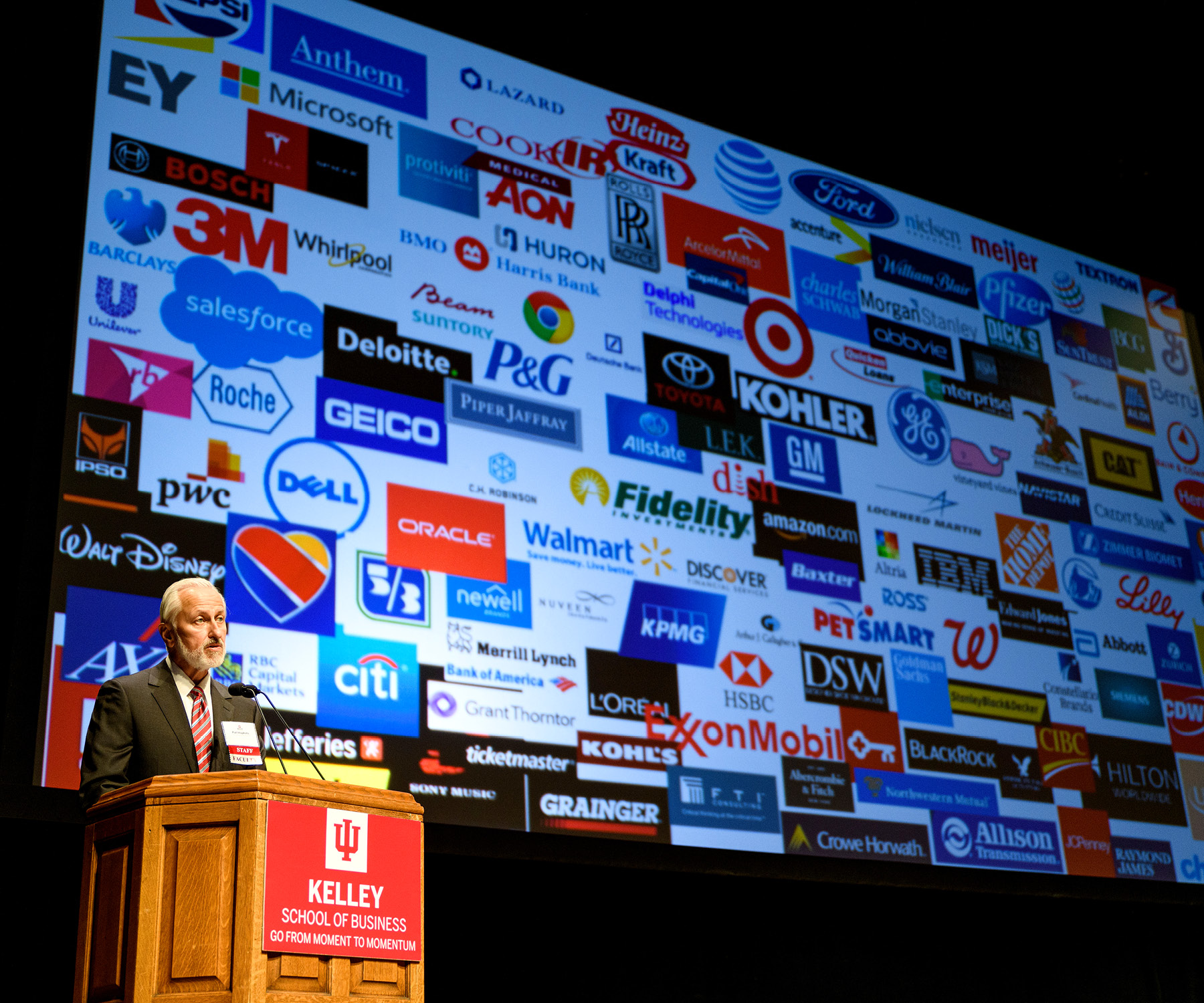
“Our job is to ensure graduates are effective, efficient, responsible and ethical users of AI.”
Patrick Hopkins, Dean of Indiana University’s storied Kelley School of Business, is a living antidote to AI phobia, a shot in the arm to those sick of hearing the negative mood music.
“I view this technology as the new Excel,” he says. “In the mid 80s, when Lotus 1-2-3 and spreadsheet technologies were introduced, there were predictions that they were going to replace finance and accounting jobs, but instead what we saw was an explosion in the sector.
“What’s going to come out of this AI is the creation of entirely new jobs, and we have to be imaginative about what those are because we’ll have to be able to manage workflows better.”
To dovetail Hopkins’ vision of a sunny AI horizon, the 31-year veteran of the Kelley family has earmarked a number of significant investments over the coming years, using algorithmic systems to build core capabilities and augment teaching and curriculum development within the faculty.
Kelley has already tapped AI specialists to build agents and applications across all corners of the school, from the administrative back offices to facilities for the student population of more than 15,000.
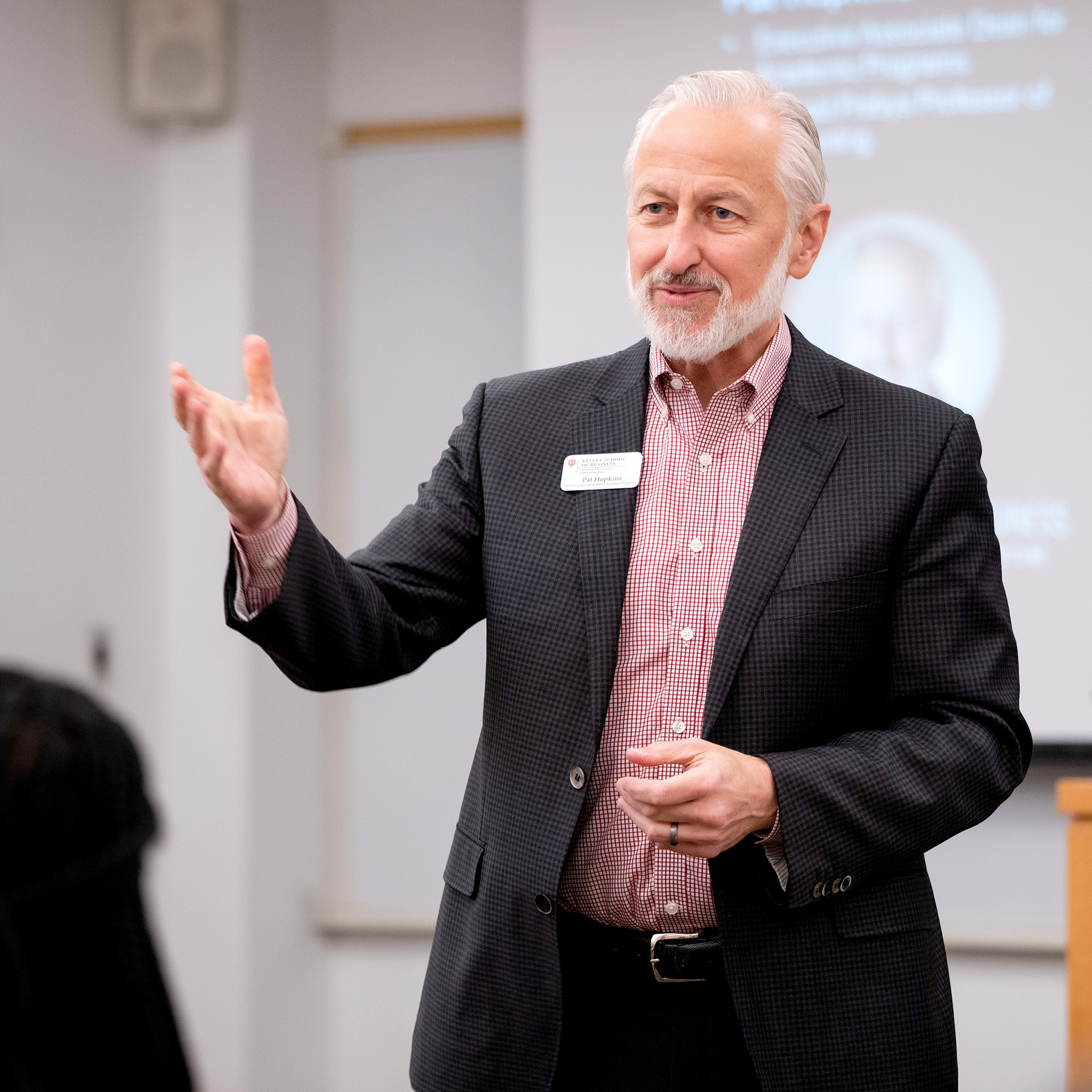
“What’s going to come out of this AI is the creation of entirely new jobs.”
Hopkins spotlights one particular model designed to provide feedback to students’ assignments – commentary that’s of exceptionally high quality.
“What I wanted to happen as quickly as possible is to shift the perspective from ‘Oh, god, students are using AI to cheat,’ to our students being expected to integrate this technology into their work,” he explains.
“Our job is to ensure graduates are effective, efficient, responsible and ethical users of AI.”
A delve into the annals of the Kelley School of Business reveals an establishment for which ingenuity and the embracement of game-changing concepts are stitched into its DNA. Since opening 106 years ago, the culture of the school in Bloomington and Indianapolis has pivoted around leading the market rather than dancing to its tune.
In the early 1960s, when the only people using computers were a handful of elite scientists, the school introduced a then-revolutionary Computer and Business class as a requirement for all students; in 1999, the institution became the first top-ranked business school to launch an online MBA.
It’s little wonder then that the phrase “first-mover mindset” is a perennial refrain around its historic corridors, according to Hopkins.
Hopkins’ own approach expands on that defining concept, which he calls the school’s “clean sheet of paper mentality”– a multidisciplinary outlook that avoids the stifling siloing present at some universities.
He may be an AI acolyte but not so much that he’s blinkered to its potential limitations. As well as injecting capital into internal AI infrastructure, he’s doubling down on investment into experiential learning and client-facing projects, equipping students with analog, apprentice-style skills that may otherwise fall by the wayside as AI automates certain entry-level corporate tasks.
One of those immersive experiences, ominously dubbed ‘Spine Sweat’, requires Kelley School of Business students to pitch business ideas to venture capitalists in Silicon Valley.
“Ultimately, business is a social enterprise,” Hopkins points out. “Real business, you can’t do with robots – the relationship part, the strategizing part. We’re training students to lead, strategize and make judgment calls – not just execute tasks.”
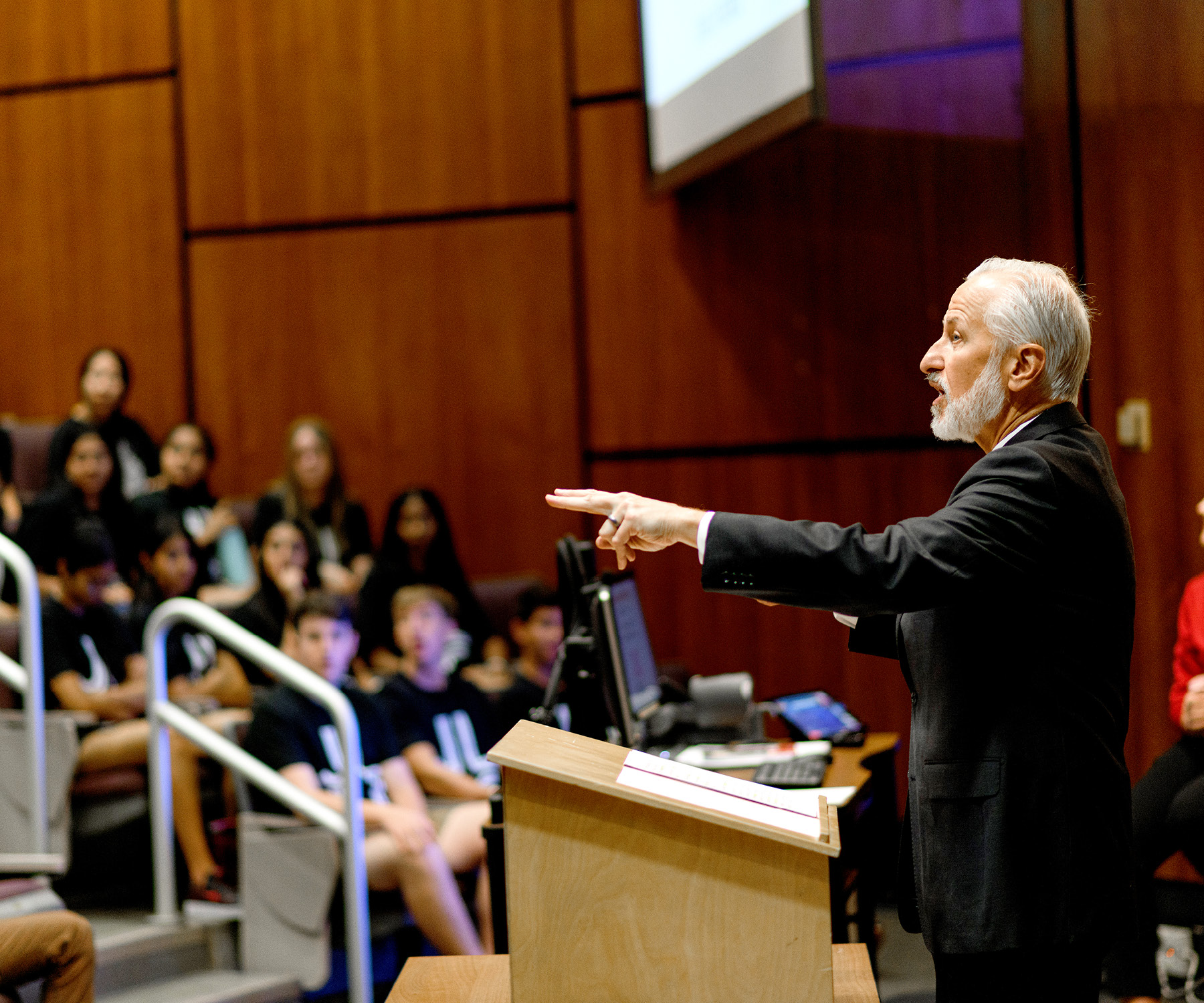
“We’re training students to lead, strategize and make judgment calls – not just execute tasks.”
On top of experiential learning, Hopkins points to the various career preparedness courses and workshops the school has put in motion during the past 15 years – classes that executives in the real world say give the university’s alumni a competitive edge, but without the entitlement evident in the progeny of other educational establishments.
“At the time, it was controversial to do that, but that was a first-mover mentality. And now other schools are catching up,” he says.
“I mean, in their first semester, our students get LinkedIn profiles that are perfected, and they have to have a mock interview in our career center. That’s when they first step on campus. So by the time they leave, they’re ready.”
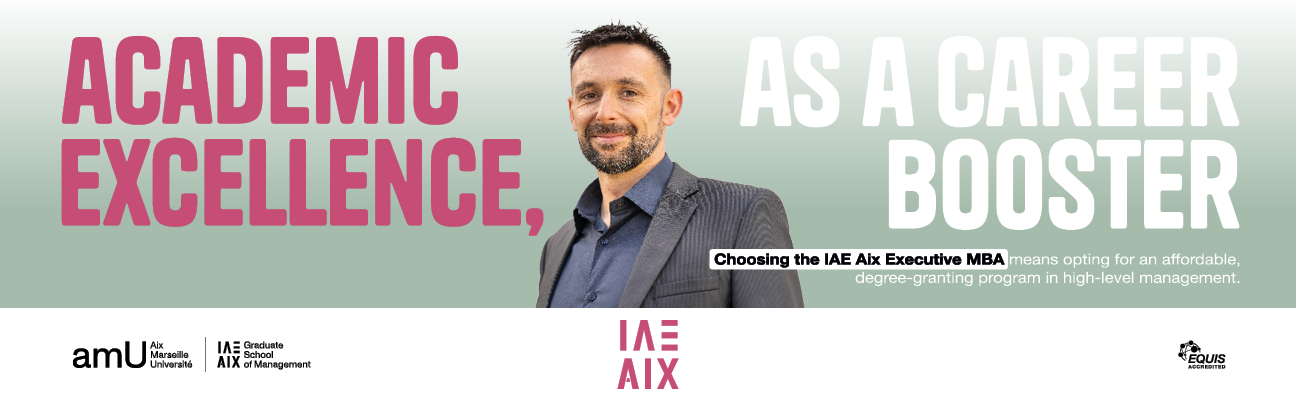
To broaden their worldviews, students are encouraged to explore the Kelley School of Business ecosystem, a series of partnerships and exchange programs with academia around the globe, including South Korea’s Sungkyunkwan University, University of Manchester in the United Kingdom and IAE Aix-Marseille Graduate School of Management. As such, more than 60 percent of scholars (around 2,000) are currently studying overseas.
If students are the heartbeat of the Kelley School of Business, then its alumni, an army of more than 137,000 – one of the largest alumni networks of any American business school – is the lifeblood that keeps the institution’s reputation alive as the world stands on the precipice of a seismic technological shift.
When they’re not evangelizing about the school to corporate colleagues, former attendees often return to the Bloomington site to enhance students’ learning, just like alumni who predated them, creating an invaluable feedback loop.
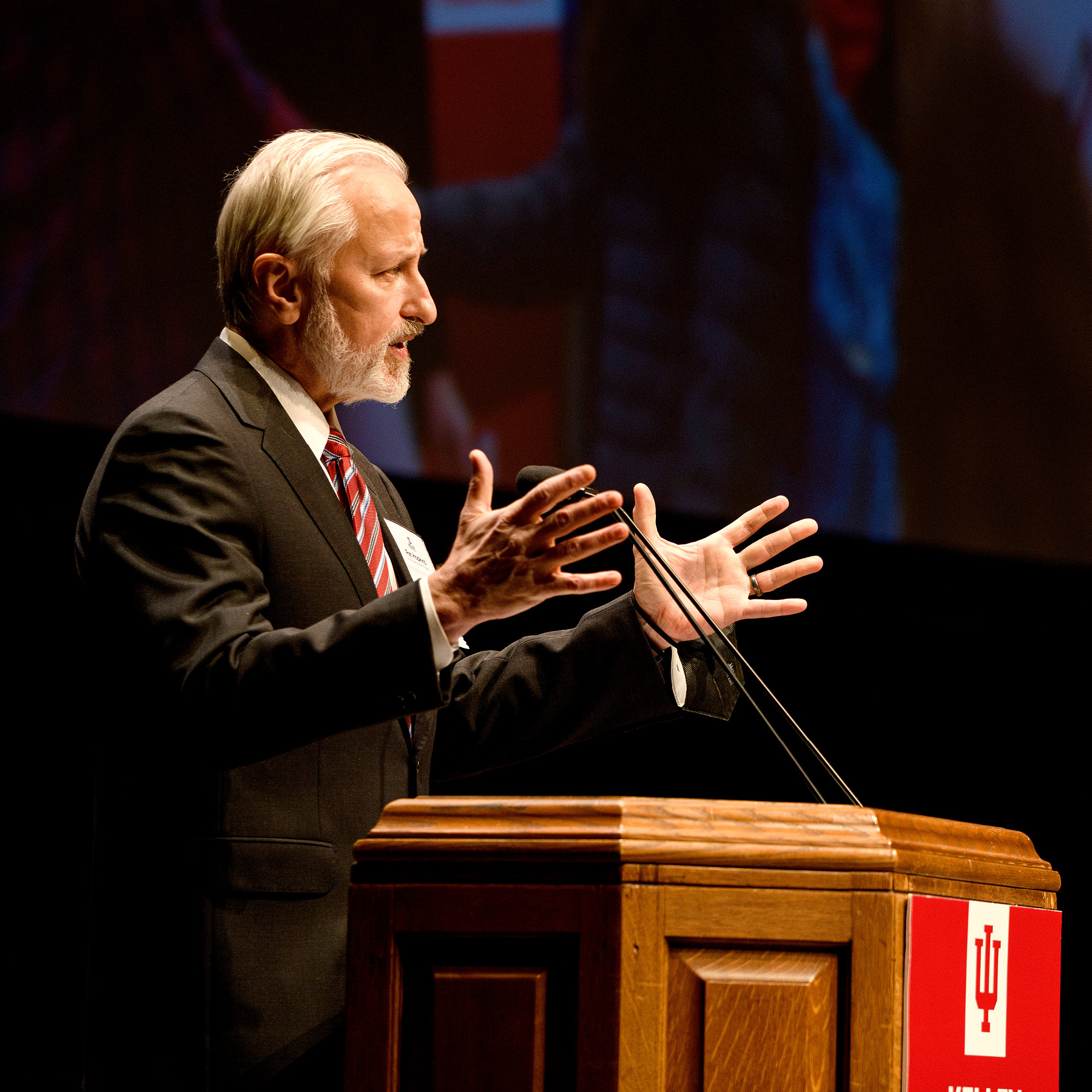
“We can’t view the changes in technology as something that’s going to happen. It’s already happening.”
Recruiting and keeping the best of the country’s researchers and faculty members also remains a top priority for Hopkins. These include individuals of the caliber of George Ball, who recently testified to a Congressional Committee on the generic drug supply chain, or Vivian Fang, currently consulting with the Treasury Department and federal banking regulators on cyber and cryptocurrencies.
“In the month or so leading up to me taking over in 2025, I’d been meeting with some key individuals who I’ve viewed as visionary thinkers,” Hopkins recalls.
“And within this team of individuals, the common thread was that we can’t view the changes in technology as something that’s going to happen. It’s already happening. We are seeing it transform industries.
“If we go down to our career center, which is probably the best in the country, more than half of the postings have technology and skills in AI and generative AI and applying it in business contexts. That’s a leading indicator that this thing is actually a thing.”
 RELATED ARTICLES


 Home
Home
 Podcasts
 Covers
 Be Featured
 Community