Language
You can read the magazine in one of the following languages

7-min read

 Bookmark now

 Copy Link
If there’s one industry that’s typically resistant to overnight reinvention, it’s healthcare. But every so often, a shift comes along that changes not just how medicine is practiced, but how it’s understood. Genomics is one of those shifts, and it’s moving healthcare away from treating illness toward personalizing, preventing and predicting it.
“Around the globe, healthcare systems are increasingly shifting from reactive treatment to precision and prevention-focused care, from sick care to healthcare,” Nilesh Shah, Head of Region, APAC at Illumina, tells The CEO Magazine.
“And genomics and multi-omics are key enablers of that transition.
“Genomics, multi-omics and AI are some of the game-changing technologies of the century. These technologies provide insights that help healthcare professionals to better understand disease risk, diagnose conditions earlier and tailor treatment to the individual – while also strengthening population health strategies.
“At Illumina, we are working to simplify and connect sequencing, software and AI so biological data can be translated into meaningful clinical and research insights,” Shah says.
The promise of genomics has been clear for years. The challenge has always come down to scale – how to move from cutting-edge capability to widespread, everyday use.
“As we have done for more than 25 years, Illumina continues to push genomics to new frontiers,” Shah points out.
“We are committed to developing technologies that move every element of sequencing to new industry benchmarks – driving down the total cost of workflow, expanding access and accelerating discovery to improve human health.
“Our approach is to meet markets where they are. That means offering scalable platforms that work for large national programs as well as regional hospitals and reference labs.”

“Genomics, multi-omics and AI are some of the game-changing technologies of the century.”
Essentially, it’s about designing systems that can support both large-scale genomic national initiatives and smaller, localized healthcare settings.
“Strong partnerships are essential,” Shah says. “By working with governments, healthcare systems and research institutions, we help build sustainable genomics infrastructure that can grow over time, ensuring the benefits of genomics reach more patients – not just a few centers of excellence.”
Even the most advanced technology means little if it doesn’t translate into better patient care. Bridging the gap between innovation and implementation is where much of the real work now sits.
“Genomic testing is increasingly becoming standard care in oncology, genetic disease, infectious disease and reproductive health worldwide,” Shah says. “Illumina’s advances in sequencing technology have been a big contributor to making these tests affordable and accessible.”
The shift has been gradual and shaped by clinical evidence and system-level changes.
“The challenge today is no longer whether genomics works. The challenge is how to implement it consistently and sustainably across real healthcare systems,” he notes.
“Ongoing investment in evidence generation has helped update professional guidelines and expand payer reimbursement. While progress continues, more patients than ever are now benefiting from precision health insights from genomic testing.”

“Ongoing investment in evidence generation has helped update professional guidelines and expand payer reimbursement.”
Access remains uneven, but Shah insists expanding it is a priority.
“There remains significant potential to improve healthcare by expanding access to clinical genomics,” he says.
Long-term, genomics also has the potential to reduce healthcare costs by enabling earlier diagnosis, avoiding ineffective treatments and improving population health strategies.
“Illumina is working with healthcare providers to bring genomic testing closer to the point of care,” he adds.
“Our technology helps to bring large-scale genomics insights at central labs, where we tailor workflows to meet each lab’s needs. These labs are essential for clinical genomics and remain key partners in advancing high-throughput sequencing.”
The next phase of genomics, according to Shah, is not just about sequencing more data and more about simply understanding it. That’s where AI is becoming indispensable.
“We’re seeing rapid convergence between genomics, broader biological data and AI – and this is especially important as datasets grow in scale and diversity,” he says.
This convergence is being reinforced at a policy level.
“As part of Budget 2026, Singapore has introduced sector-specific ‘National AI Missions’, establishing a strong policy framework for AI-driven healthcare innovation, including data-based medicine, clinical decision support and genomics-powered precision health,” he adds.

“As we have done for more than 25 years, Illumina continues to push genomics to new frontiers.”
For Illumina, the focus is on integration – bringing multiple layers of biological data together into a single, coherent system.
“At Illumina, we are focused on bringing insights together in AI-powered, complete and integrated workflow solutions to deliver integrated insights across the genome, epigenome, transcriptome, proteome and other omics,” he says. “These solutions help researchers and clinicians interpret increasingly complex biological data faster and with greater confidence.”
This integration is critical, as it allows researchers and clinicians to move beyond isolated data points and toward a more complete understanding of disease.
“We are entering an era where biology and data science will increasingly reshape how healthcare is practiced,” he says.
New initiatives are accelerating that work.
“BioInsight, our newly launched business within Illumina, is dedicated to generating large-scale multi-omics data in collaboration with partners, developing advanced AI, informatics software tools and accelerating data-driven scientific discoveries.”
Precision medicine is often framed as a technological breakthrough. But in reality, it’s a systems challenge. It depends on alignment across governments, healthcare providers and research institutions.
“Advancing precision medicine is not achievable by any single organization,” Shah says. “It requires the collaboration of strong ecosystems.
“Adoption also requires reimbursement pathways, clinician education, informatics capability and long-term investment in healthcare infrastructure.”
Across the Asia–Pacific, this collaboration is taking shape through national initiatives and long-term partnerships.
“These efforts include supporting population genomics projects, facilitating clinical implementation programs and advancing workforce development initiatives,” Shah explains.
Singapore, recognized as a regional and global innovation hub, offers a prime example of how those elements can come together.
“The flagship research institutes A*STAR GIS has established a strong ecosystem that seamlessly drives scientific discovery from the laboratory to real-world clinical impact,” he says.
“The population-scale genomics initiative PRECISE, and most recently the SG100K Phase 2 project, successfully sequenced 100,000 whole genomes with outstanding quality and reliable data delivery.”
Shah believes that the countries that invest early in genomics infrastructure, workforce capability and AI-enabled healthcare systems will be better positioned to lead the future of precision heath and biotechnology innovation.
With opportunity comes complexity. Genomics sits at the intersection of science, ethics and regulation and requires careful navigation across very different national frameworks.
“The Asia–Pacific region is a highly diverse regulatory landscape and navigating that complexity requires early engagement and long-term commitment,” Shah says.
Governments take on a foundational role in setting parameters.
“They play a critical role in establishing clear, modern regulatory frameworks for genomic data, including robust national standards for data privacy, security and informed consent,” he explains.
“Done well, these frameworks build public trust while still enabling responsible research and innovation.”
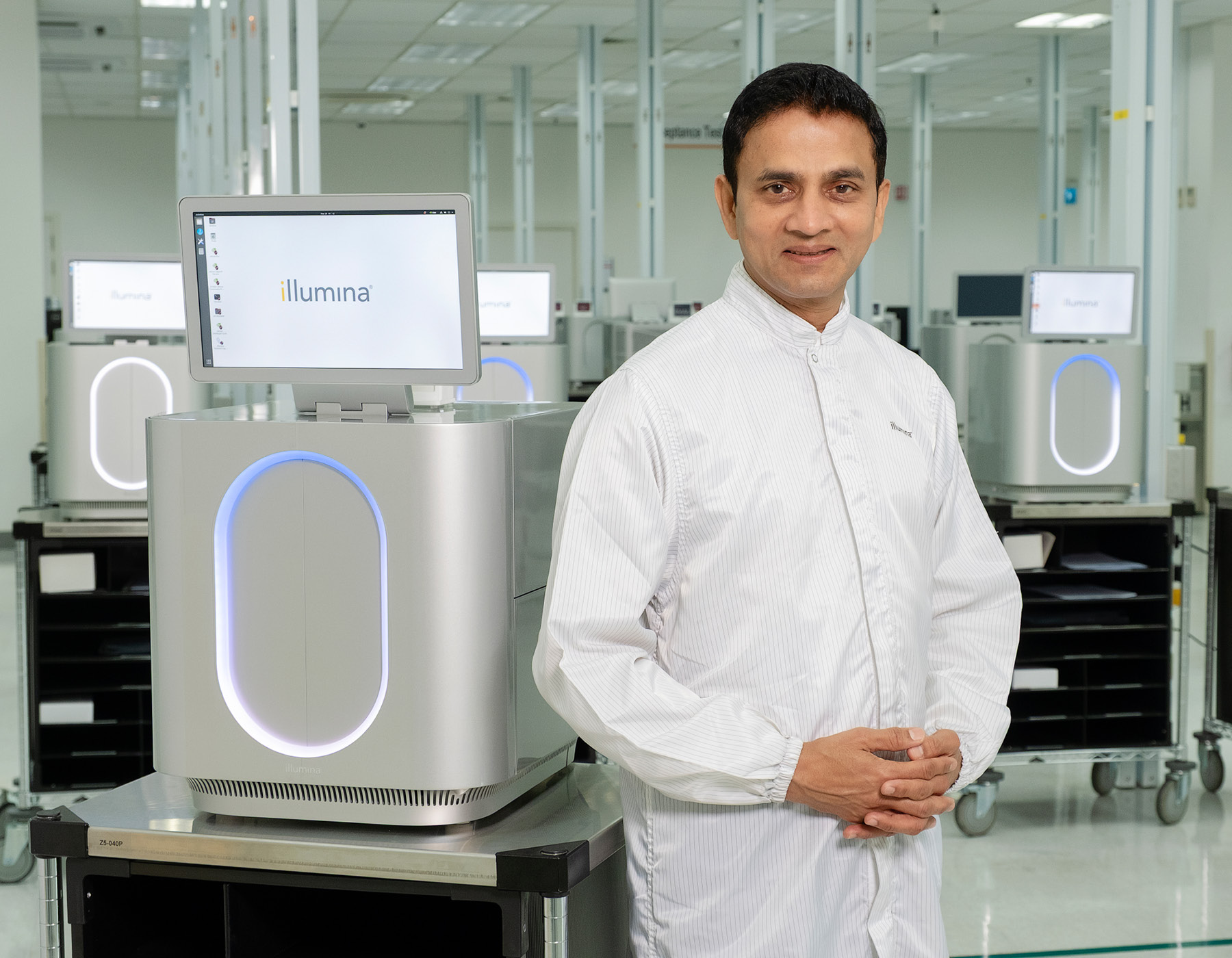
“The 21st century is the era of genomics and biology.”
For the industry, the responsibility is to meet those standards and help to shape them.
“We must act as active partners in the ecosystem, advocating for responsible policies and ensuring our technologies are secure and compliant by design,” Shah says.
Ultimately, implementation rests with healthcare systems.
“They must invest in secure, resilient IT infrastructure and just as importantly, in educating and empowering clinicians so genomic insights can be applied ethically, safely, effectively and at scale in real-world care,” he stresses.
For all the complexity, Shah is clear on what success ultimately looks like.
“We are at a critical inflection point where the promise of precision medicine is becoming a reality,” he says.
“In areas like oncology and rare disease diagnostics, genomics is increasingly becoming a routine part of the standard of care across many advanced health systems.”
Illumina’s role is to help push that transition further and faster.
“We remain deeply committed and invested in the research, scientific and clinical community by providing the platforms, expertise and collaborative partnerships needed to shape the next decade of healthcare innovation,” he acknowledges.

“True impact is achieved when genomics becomes routine.”
The real measure of impact is simple.
“The 21st century is the era of genomics and biology,” he confirms. “They are helping healthcare systems move toward earlier diagnosis, more personalized treatment and ultimately better prevention.”
At Illumina, success comes down to ensuring scientific advances deliver tangible improvements in patient outcomes at a global scale.
“True impact is achieved when genomics becomes routine,” Shah says.
“When genomic and multi-omics tools are as accessible as a CT scan or MRI – embedded in the daily practice of hospitals and health systems – then we know transformation has taken hold.”
 RELATED ARTICLES


 Home
Home
 Podcasts
 Covers
 Be Featured
 Community