Language
You can read the magazine in one of the following languages
11-min read

 Bookmark now

 Copy Link
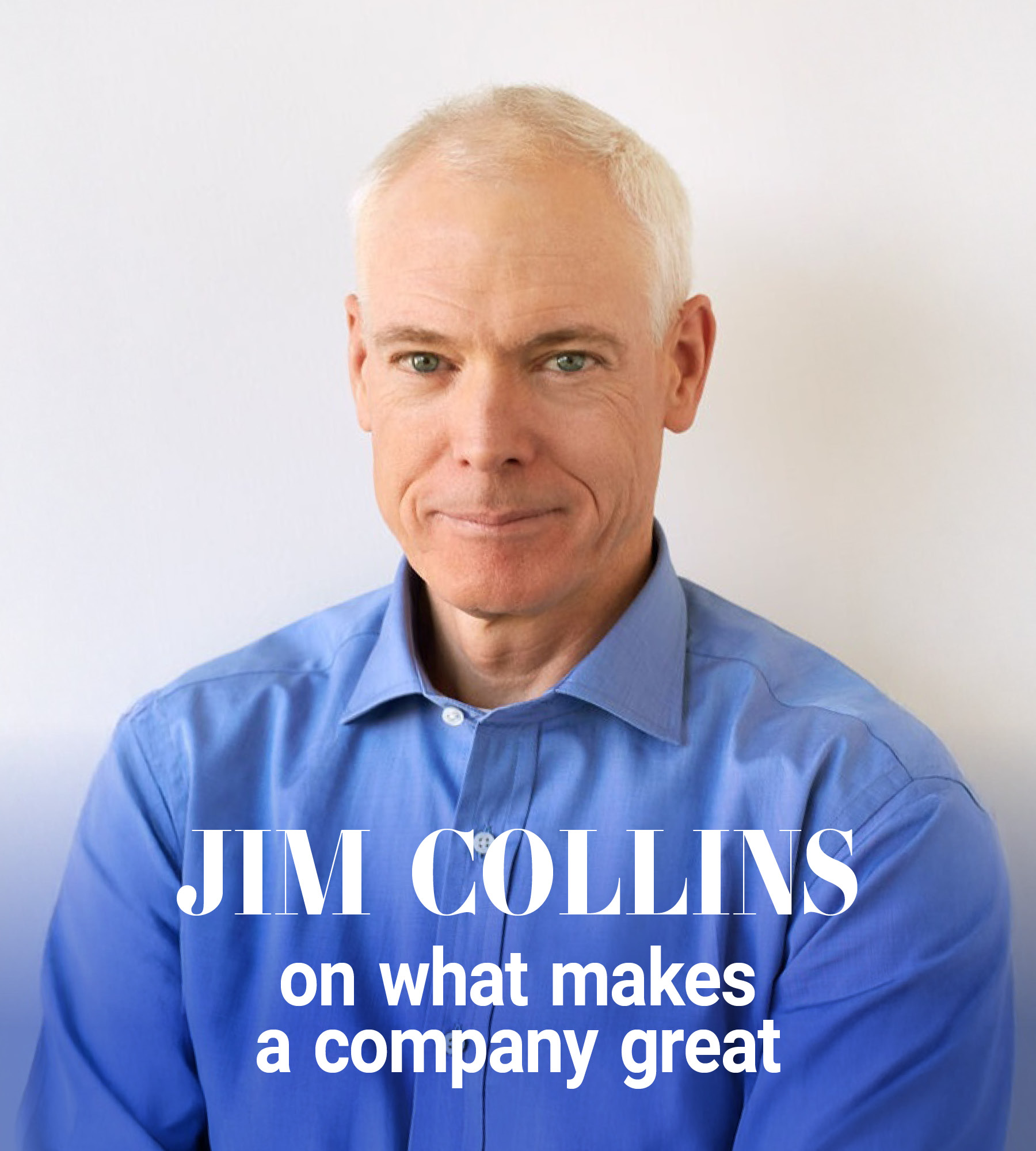
When Jim Collins opened World Business Forum New York 2023, it marked a full circle moment. He had also inaugurated the event 20 years earlier, when it first began.
Since then, Collins has become one of the defining business thinkers of his generation. Best known for books including Good to Great and Built to Last and for decades of research into what separates exceptional companies from the rest, he returned to one of his best-known ideas: ‘Good is the enemy of great’.
From that starting point, Collins laid out a framework of 12 questions for leaders who want to move beyond solid performance and build companies that endure. Together, they form a demanding blueprint for turning good into great.
On our journey to transforming from good to great, it is essential to understand the hierarchy of leadership capabilities. The foundational levels of leadership begin with individual skills (level one), team skills (level two), effective management (level three) and effective leadership (level four).
However, Collins discovered a higher echelon – level five leadership, which lies in a paradoxical blend of personal humility and indomitable will. Unlike the charismatic, larger-than-life figures we often associate with leadership, many level five leaders exhibit a remarkable absence of ego.
Their ambition is directed not toward personal glory but toward the success of their company and its mission. This humility, however, is paired with a fierce determination to do whatever is necessary to achieve their goals.
True level five leadership is not just about individual leaders but cultivating an ethos that permeates the entire organization, creating pockets of greatness that collectively drive sustained success.
As Collins points out, an illustrative example of level five leadership is Katharine Graham of The Washington Post. Unexpectedly thrust into leadership after her husband’s tragic death, Graham’s journey was marked by a relentless dedication to her company’s mission and a willingness to learn and lead despite immense challenges.
She welcomed guidance from experts like Warren Buffet and made critical decisions, such as publishing the Pentagon Papers and supporting the Watergate investigation, demonstrating both humility and an unwavering commitment to her principles.
To achieve excellence, it is essential to prioritize placing the right people in the right roles before establishing a vision. In this regard, Collins’ research highlights the importance of ‘first who, then what’.
Successful companies focus on getting the right people on the bus and the wrong ones off, ensuring key positions are filled with the right talent before deciding on direction. Collins invites us to reflect on our teams: What percentage of key seats are filled with the right people?

It is essential to prioritize placing the right people in the right roles before establishing a vision.
If this isn’t high enough, we have to consider the impact of delayed action in replacing underperformers. Leaders often wait too long, leading to frustration and suboptimal performance.
Two approaches exist: Developing people into key roles or quickly replacing underperformers. Both can be effective, if the goal of having 80–90 percent of key positions filled with the right people is achieved.
Recognize the value of ‘who luck’ – finding the right people by chance – and always be open to these opportunities. Reframe every ‘what’ question into a ‘who’ question to ensure you’re focusing on getting the right people for the best results. By prioritizing the right people and fostering their potential, we set the stage for true excellence.
In response to this third question lies one of the key traits of highly visionary companies: their rejection of what we call the ‘Tyranny of the OR’ – the restrictive mindset that struggles to accept paradox and cannot reconcile two seemingly contradictory ideas simultaneously.
The ‘Tyranny of the OR’ compels people to believe that they must choose either A OR B, but not both. Instead, great companies free themselves from this constraint by adopting the ‘Genius of the AND’ – the capacity to embrace both extremes of multiple dimensions at once.
Rather than choosing between A OR B, they find ways to achieve both A AND B. As Collins explains, “Humility or will? Well, it’s both. Take care of our people or focus on the mission? It’s both. People who share our values or people who deliver results? It’s both. Purpose or profit? It’s both. Long-term or short-term? Innovation or execution? It’s always both.”
Every good-to-great company confronts their brutal facts and embraces what Collins calls ‘The Stockdale Paradox’. They hold onto a steadfast belief in their ability to ultimately succeed, no matter the challenges they face, all the while demonstrating the discipline to confront the harshest realities of their present circumstances, whatever those may entail.
But what is the Stockdale Paradox? As the highest-ranking officer in the Hanoi Hilton prisoner of war camp, Admiral Jim Stockdale endured seven grueling years of captivity.
According to Collins, what struck most about his experience was not just the physical torture, but the mental anguish of not knowing if or when it would end. How did Stockdale maintain hope amidst such uncertainty?
“His unwavering faith, coupled with a sober acknowledgment of the brutal realities he faced, kept him resilient. He never wavered in his belief that he would prevail, but he also confronted the harsh truths of his situation,” Collins reveals.
As Stockdale aptly put it, “You must never ever confuse the need for unwavering faith with the need for the discipline to confront the most brutal facts of your current reality.”
This duality of faith and facing facts, what we now call the Stockdale Paradox, is a cornerstone of resilience and effective leadership.
Question number five in our journey to excellence centers on the ability to make disciplined decisions within the three circles of the hedgehog concept. Collins explains that the hedgehog concept, inspired by Isaiah Berlin’s essay, stems from a deep understanding of the intersection of three circles: What you are deeply passionate about, what you can be the best in the world at and what best drives your economic or resource engine.

Success comes from gradually building momentum through continuous, focused effort.
As we delve into the essence of the hedgehog mindset, we confront a fundamental dichotomy: Simplicity amidst complexity. Visionary companies make disciplined decisions that align with these three circles.
They either specialize in a specific content area (content hedgehogs) or excel at a repeatable process (process hedgehogs). As Collins argues, by consistently making decisions that fit these criteria, companies can simplify complexity, seize new opportunities and maintain a clear focus, propelling their success forward.
The best companies are aware that no matter how dramatic the end result, remarkable transformations from good to great don’t occur suddenly or with a single event. Achieving excellence isn’t about one big action, a revolutionary program, a groundbreaking innovation or a stroke of luck.
Instead, it is akin to steadily pushing a massive flywheel. Success comes from gradually building momentum through continuous, focused effort.
For Collins, the flywheel principle is one of the most impactful concepts in business strategy, emphasizing the power of consistent and disciplined action over time. An illustrated example is Amazon.
In 2001, during the uncertainty of the dot-com crash, Amazon’s future was in doubt. By adopting the flywheel principle, they focused on offering lower prices and more products to attract more customers.
This, in turn, attracted more third-party sellers, expanded their store and increased revenue, allowing for further price reductions. This cycle made Amazon into the giant it is today.
Question seven prompts us to consider if we’ve embraced the discipline of the 20-mile march in every aspect of our flywheel. This concept emphasizes consistent execution across all components and Collins explains that it can be likened to a flywheel with six components, each assigned execution scores.
If any component’s execution weakens, the entire flywheel stalls. This disciplined approach, inspired by the Antarctic expeditions of Roald Amundsen and Robert Falcon Scott – whether applied to growth, profitability creativity or technology – ensures consecutive performance.
The 20-mile march addresses both short-term and long-term goals simultaneously, fostering sustainable progress. As we execute on our flywheel, the 20-mile march serves as a guiding principle, driving consistent performance and enabling renewal and extension of our efforts.
Question eight urges us to strategize on how to renew and extend our flywheel. Collins illustrates this with a metaphor of firing bullets and cannonballs.
Instead of using up all our resources in one big shot, we start by firing bullets – small, targeted experiments. These bullets help us calibrate our aim.

Once we find what works, we then fire cannonballs – big, decisive actions that propel us forward.
Once we find what works, we then fire cannonballs – big, decisive actions that propel us forward. Collins emphasizes the importance of this iterative approach in navigating uncertainty and achieving long-term success.
He exemplifies this with a story about Apple. Starting with the iPod as a small experiment, the company gradually built upon it, launching iTunes and eventually the iPhone and iPad, renewing and extending its flywheel with each successful iteration.
‘The only mistakes you can learn from are the ones you survive’ – this statement serves as the starting point for Collins to develop this number nine question, prompting us to channel our ‘productive paranoia’ to avoid the five stages of decline. This also emphasizes a fundamental truth: The first step in building a lasting company is ensuring its survival.
Collins points out that less than 15 percent of the companies from the original 1955 Fortune 500 list are still around today, and even some of the greatest companies have eventually fallen. He highlights the hubris born of success as the first stage of decline, cautioning against complacency and overconfidence, even in noble purposes.
In essence, the message is clear: To endure, companies must remain humble, stay alert and always prepare for the worst while striving for the best. They must obsessively ask, “What if?”
By preparing ahead of time, building reserves, preserving a margin of safety, bounding risk and honing their disciplines in good times and bad, they handle disruptions from a position of strength and flexibility.
A company knows that it achieves excellence when it answers “yes” to this question without hesitation. Collins confronts a prevalent misconception that there are distinct categories of leaders: The visionary entrepreneurs who initiate ventures and the managerial executives who assume control as companies expand.
As he points out, leaders such as Herb Kelleher of Southwest Airlines, Sam Walton of Walmart and Jeff Bezos of Amazon not only possessed visionary qualities but also demonstrated a remarkable ability to construct enduring organizational structures. They transcended the role of mere visionaries by cultivating robust systems, cultures and structures within their companies.
This evolution, from emphasizing the founder’s vision to prioritizing the creation of a resilient organization, is pivotal for sustained success. The process of being an effective clock-builder involves establishing a solid organizational foundation, imbuing the company with core values and fostering adaptability to ensure longevity and resilience.
By embracing this shift, companies can transcend dependence on individual leaders and cultivate enduring excellence.
This question delves into how exceptional organizations manage a delicate balance between tradition and innovation. Excellence is achieved by upholding a set of timeless core values and purposes that endure over time, while simultaneously pursuing progress through embracing change, improvement, innovation and renewal.
Great organizations distinguish between their unchanging core values and purposes and their adaptable operating strategies and cultural practices, which evolve to meet the demands of a changing world. Collins refers to this dynamic as the yin-yang of organizational dynamics, emphasizing the importance of distinguishing between values that remain constant and strategies that evolve with the times.

Greatness is never accidental.
He introduces the concept of big, hairy, audacious goals – BHAGs – as a powerful means to inspire progress. These goals go beyond ordinary objectives, challenging organizations to strive for excellence and create significant impact.
By setting BHAGs, companies aim to inspire their teams, foster creativity and drive transformative change.
Luck, according to Collins, is characterized by three criteria: It wasn’t caused by you; it has a potentially significant consequence; and it came as a surprise. We all encounter luck, both good and bad, in various aspects of our lives.
Despite this, Collins notes that his research revealed an interesting finding: The great companies he studied weren’t necessarily luckier than their counterparts. They didn’t experience more good luck, less bad luck, bigger spikes of luck or better timing of luck.
Instead, what set them apart was their ability to achieve a higher return on luck, effectively capitalizing on the luck they received.
Taken together, Collins’ 12 questions suggest that greatness is never accidental. It is built through discipline, clarity, resilience and a willingness to confront reality while continuing to push forward.
 RELATED ARTICLES


 Home
Home
 Podcasts
 Covers
 Be Featured
 Community