Language
You can read the magazine in one of the following languages

5-min read

 Bookmark now

 Copy Link
If there’s a sentence guaranteed to make homeowners around the world quake, it’s telling them that their roof needs to be replaced.
That’s why the seamless way TAMKO Building Products’ StormFighter FLEX and Titan XT shingles simplify the pain of storm restoration products and roof replacements is music to most people’s ears.
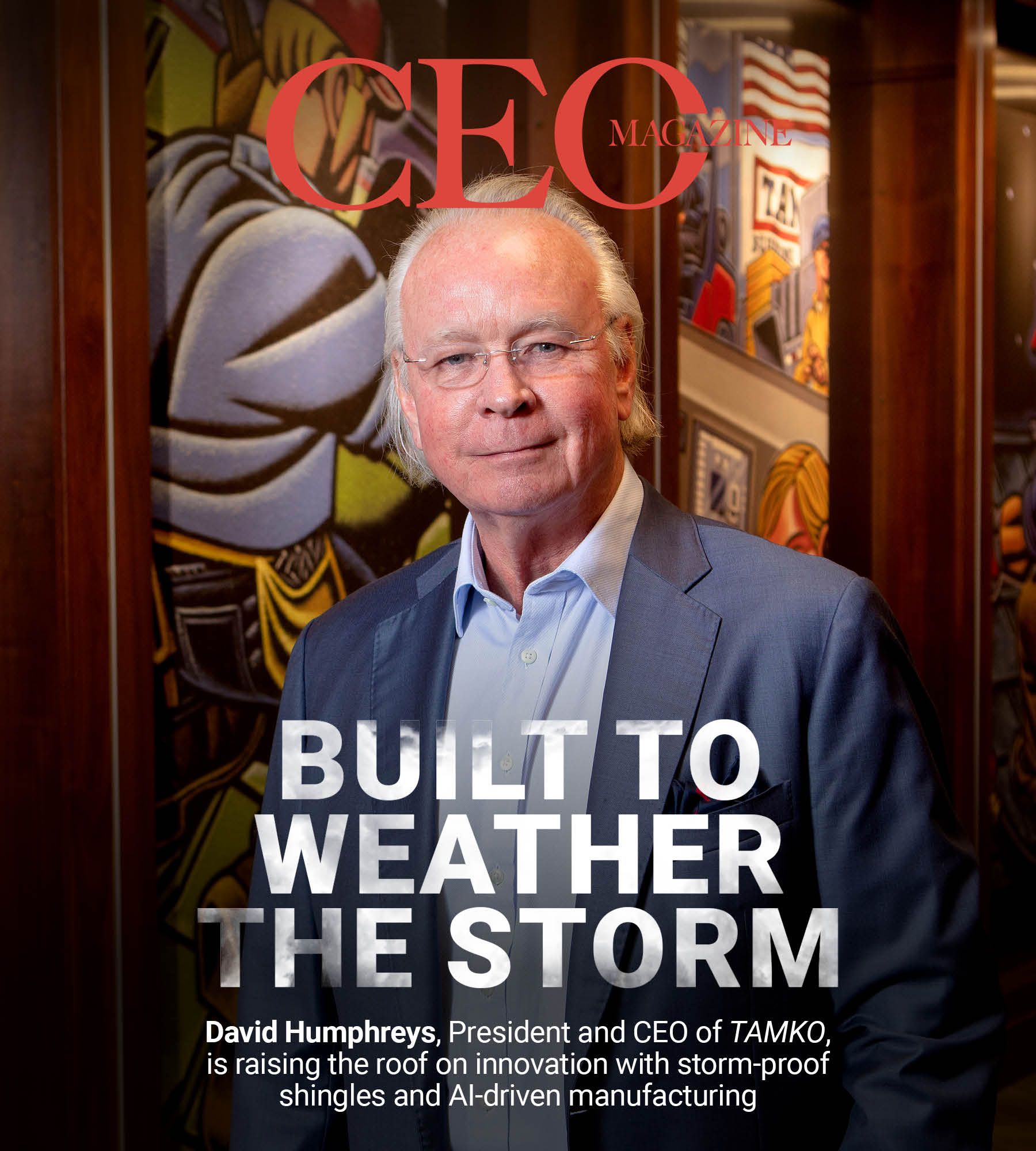
“It simplifies things by not needing to be replaced; that’s the bottom line,” TAMKO President and CEO David Humphreys tells The CEO Magazine.


Both products have earned national recognition for the Kansas-headquartered company, including accolades such as the ‘2025 Product of the Year’ in the Home Solutions Category by Kantar for the Titan XT and the ‘2024 Experts’ Choice Award’ at the International Roofing Expo for the StormFighter FLEX. Crucially, the products have also won over roofers and homeowners.
“Those two products address two particular performance characteristics that roofers look for and homeowners probably expect without thinking about it, which are performance in high wind and performance in severe weather – hail in particular,” Humphreys explains.
In high winds, both shingles have a reinforcement built into their design that enables the company to promise a 258-kilometer-per-hour wind warranty. On top of that, StormFlighter FLEX has a polymerized blend that offers a level of bounce.
“If there’s hail, it bounces off and doesn’t affect the shingle’s performance – it often doesn’t even leave a visible mark,” he says.
Both products are a hallmark of the innovation that has allowed TAMKO to position itself apart in the market against larger competitors or from the manufacturers that may have a warranty but can’t compete on performance.
Humphreys says both are so good that videos are organically appearing on social media networks, posted by roofing contractors who are impressed by their durability.
“When these contractors go out to a house after a hailstorm, the siding is full of holes, the gutters are dented, but the StormFlighter FLEX doesn’t show a mark,” he reveals. “That’s the kind of performance that you can hang your hat on.”
It’s been a busy four years for TAMKO since the Titan XT range launched in 2021, followed by StormFighter FLEX in 2024, and an important chapter in its growth story.
Founded in 1944 by Humphreys’ grandfather and named after Texas, Arkansas, Missouri, Kansas and Oklahoma, the states it originally sold into, both his parents had a turn running TAMKO before he succeeded his late father in 1994, who had been at the helm for 38 years. The consistency has paid dividends.
“My father and I combined, that’s 70-plus years with a continuous approach to how we manage, how we treat people, how we deal with customers and how we deal with suppliers,” Humphreys points out.

Long-standing partners include the likes of construction contractor Crossland Construction, and he adds that the company’s supply chain is almost entirely based in North America.
Today, TAMKO has around 1,000 employees in 10 plants across the country and revenues north of US$1.3 billion. This success is driven by a focus on a trio of philosophies: the Deming model of quality management, a set of 14 practices to help companies increase their quality and productivity; the Six Sigma quality control methodology; and a process that Humphreys calls Autopilot, or “total process automation, with a heavy focus on AI in the manufacturing process in particular.”

In the 1950s, corporate basketball was big and influenced the hiring process.
“My grandfather had a partner who was really into basketball, so they hired basketball players to come and work for us so they could play in the corporate team,” Humphreys explains.
One of the matches they played was against the legendary Harlem Globetrotters.
“They actually beat them, which you were not supposed to do in the 1950s!” he says.
Automation has been a 20-plus-year journey for TAMKO, enabling it to reduce its staffing needs from 15 people per shift to just four. For the past three years, a former Six Sigma Black Belt has led its Autopilot strategy.
“We’re closing in on our goal, which is to turn the machine on, it does what you need, then you turn it off and you don’t need human intervention in between,” Humphreys says.

AI has been seized upon, he adds.
“It’s a way to stitch all that together to address the complex analysis of the interaction between raw materials and blending processes to optimize overall productivity of the line and to minimize the variation of what we produce,” he explains.
Previously, this was a process the company used Six Sigma for, although it was more of a backward-looking analysis.
“Now you can do it in real time with much more complexity and many more variables operating at the same time.”
As the company continues to innovate, with new products in the pipeline to build upon the wind and impact performance of StormFighter FLEX and Titan XT shingles, Humphreys says AI will drive that growth and product innovation.
He also sees AI as an enabler for talent development, which is key at TAMKO. After the launch of its Six Sigma program over 20 years ago, the company turned to hiring alumni of military academies such as West Point with leadership experience and strong quantitative skills.
“Those Six Sigma alumni are all in leadership positions at all of our manufacturing plants now and two-to-four levels deep in every plant and throughout the corporate office in various key positions, many having been around 15–20 years with the company,” he says.


As operations become more automated and technology becomes increasingly integral to the business, skill sets, leadership capabilities and vision become three essential criteria in any hire.
“Talent is more important now because they’ve got more responsibility. We’re not a physical labor business anymore,” he notes.
Humphreys knows that it’s TAMKO’s people who are at the core of its ongoing success.
“We’ve got a great bunch of people who are hungry, humble, smart, honest, have integrity and try every day to do something well,” he says.
 RELATED ARTICLES


 Home
Home
 Podcasts
 Covers
 Be Featured
 Community