Language
You can read the magazine in one of the following languages
5-min read

 Bookmark now

 Copy Link
For decades, the path of enterprise technology adoption was predictable: Leadership approves a new system, IT deploys it and employees learn to use it, regardless of preference. Under this system, organizations controlled the rollout. But AI has reversed the traditional technology adoption model.
Today, the sequence often looks very different: Employees experiment with AI tools on their own, teams begin quietly integrating them into daily workflows and leadership discovers it later. In many organizations, employees are using AI to draft emails, summarize documents, analyze data or prepare reports long before formal AI strategy discussions begin.
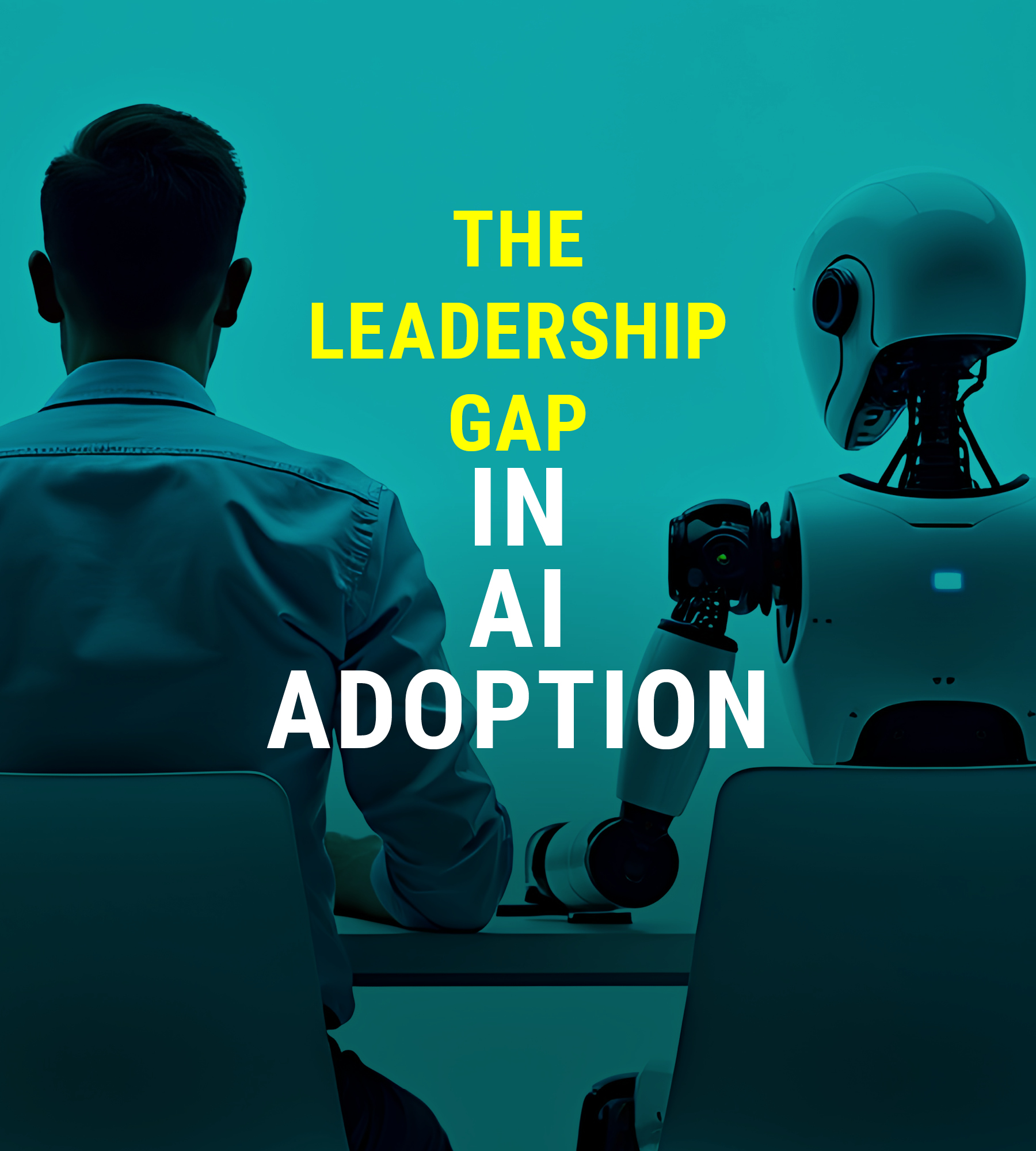
This inversion of the adoption model is what creates the leadership gap. The enterprise has shifted from compliance to experimentation, and technology is spreading faster than organizational governance.
Part of the reason for this shift is simple: most generative AI tools were designed for individuals before they were designed for organizations. Even now, roughly 70 percent of ChatGPT usage is personal rather than business.
Unlike most enterprise technologies, tools like ChatGPT did not begin inside corporations and slowly move outward. They launched directly to the public. Millions of people began experimenting with these tools in their personal lives, long before most companies had a formal conversation about how to use AI internally.

Most generative AI tools were designed for individuals before they were designed for organizations.
Employees discovered the tools on their own and experimented with them on their personal devices. They used them to plan trips, write personal emails, brainstorm ideas or answer questions. Many realized the same capabilities could help them complete work faster. So they brought the tools into the workplace.
This is fundamentally different from how enterprise software has traditionally spread. And it means that by the time leadership teams start evaluating AI, adoption may already be happening across the organization. When technology spreads this way, executives face three immediate challenges.
Many organizations have limited visibility into how employees are currently using AI tools:
In many companies, leadership simply doesn’t know.

Traditional technology policies were not written with generative AI in mind.
These tools don’t behave like conventional software systems. They function more like collaborative thinking partners, helping employees research, draft, analyze and problem-solve. That makes it harder to define clear rules around when and how they should be used.
Perhaps most importantly, if companies do not provide employees with safe AI environments, employees will naturally turn to whatever tools are easiest to access.
This is where the concept of “shadow AI” emerges: employees using AI tools they prefer, on their own devices, outside official company oversight, often without leadership awareness.
Shadow AI is usually not malicious. Most employees are simply trying to do their jobs more efficiently. But without structure, it creates risks.

We’re already seeing how this dynamic plays out. In a recent news report, sensitive government documents were uploaded into ChatGPT by President Donald Trump’s acting director of the Cybersecurity and Infrastructure Security Agency. The incident sparked headlines about AI security, but it also revealed something deeper: Even leaders responsible for cybersecurity are turning to these tools because they help get work done. When adoption moves this quickly, governance inevitably struggles to keep up.
The first phase of AI adoption was experimentation involving individuals discovering what the technology can do. In many organizations, this experimentation quickly spreads from individuals to teams. Marketing teams draft content, operations teams summarize reports, HR teams review documentation and analysts use AI to interpret complex information. They may be using different, overlapping tools and there’s little to no coordination.
The next phase is infrastructure and organizational capability. When a technology reaches this level of influence, it can no longer be managed informally. Companies need environments where AI can be used productively while still protecting company data and maintaining visibility into how it’s used. That means moving beyond scattered tools and isolated experimentation toward structured systems designed for organizational use.
Forward-thinking organizations are closing the leadership gap by building structured AI environments inside their companies. Instead of relying on policy alone, they are building integrated AI environments in which employees can use AI seamlessly while leadership maintains clear boundaries over company data and systems.
These environments typically include:
The goal is to guide adoption rather than attempt to control it. The organizations moving fastest understand that AI leadership is not about restricting the technology. It is about creating the conditions where people can use it productively, responsibly and with confidence.

Structured AI environments bring AI use inside the organization while keeping company data under control.
Some organizations are addressing this challenge by building structured AI environments inside the company. Technologies such as pipIQ provide a governed space where employees can use powerful AI capabilities while company data remains inside a controlled system and leadership maintains visibility into how the technology is being used.
Delivered as a private, secure operating layer that protects company data, these environments allow AI to work with a company’s internal knowledge while keeping sensitive information protected. The result is infrastructure that captures the productivity gains AI offers while protecting one of the organization’s most valuable assets, its data.
The leadership gap exists because AI is moving faster than organizations can govern it. Employees are already discovering how AI can help them work more efficiently. The productivity gains are simply too compelling for experimentation to remain limited.
The real question for executives is no longer whether AI will be used inside their organizations. The question is whether leaders will shape how AI is adopted or allow it to spread without structure.
Structured AI environments bring AI use inside the organization while keeping company data under control. Organizations that build these environments deliberately and safely integrate AI into everyday work. Those who do not may eventually discover the same reality: AI is already part of the workplace, but without leadership to guide its use.

Will Adams
Contributor Collective Member
Will Adams is President of Tarkenton and pipIQ, where he leads strategy and innovation at the intersection of entrepreneurship, technology and small business growth. He works closely with founders and business owners to modernize operations, strengthen financial performance and build resilient, scalable companies. Find out more at https://tarkenton.com/about-tarkenton/our-team/will-adams/
 RELATED ARTICLES


 Home
Home
 Podcasts
 Covers
 Be Featured
 Community