Language
You can read the magazine in one of the following languages
5-min read

 Bookmark now

 Copy Link
In the United Kingdom, 40.1 million working days were lost due to work-related ill health and non-fatal workplace injuries in the 2024–2025 financial year. Stress, depression or anxiety accounted for 22.1 million of those days.
That is not a wellbeing sidebar. That is capacity, delivery risk, missed deadlines, delayed invoices, fragile teams and a leadership issue that eventually shows up in the numbers.
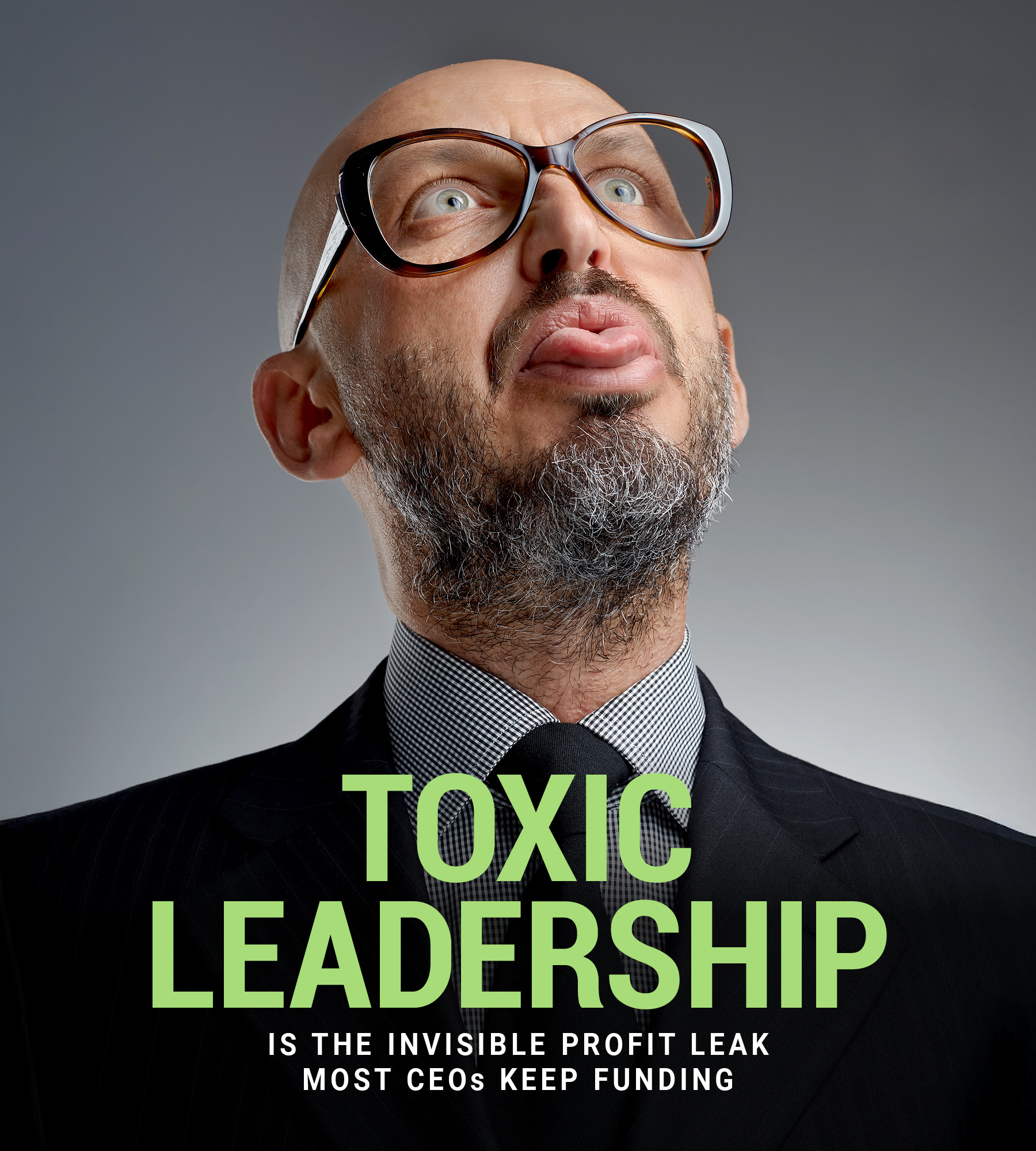
Here’s the uncomfortable truth: many organizations are not losing talent to the market. They are bleeding talent, focus and health because a small number of managers make work feel unsafe, unpredictable or quietly humiliating. That’s toxic leadership. And it often gets mistaken for having high standards or drive.

When leadership goes wrong, people stop collaborating. They stop learning. They stop telling you the truth.
High expectations are clear, fair and consistent. They come with support and feedback.
Toxic leadership is different. It is the pattern that makes people second-guess themselves before they speak. It is the manager who creates urgency through fear. It is the quiet punishment of dissent. It is favoritism, public put-downs, shifting goalposts, and the kind of pressure that keeps people awake at 3am, rehearsing conversations that never should have existed.
When leadership goes wrong, people stop collaborating. They stop learning. They stop telling you the truth. And your business starts paying for the silence.
The impact of toxic leadership is measurable and expensive.
At the individual level, the damage compounds quickly. Research published in the International Journal of Environmental Research and Public Health found that 94 percent of employees have worked under a toxic leader, with the majority reporting reduced motivation, impaired performance or long-term wellbeing effects as a result.

It erodes discretionary effort, slows decision-making and increases costs through absence, churn and underperformance.
This does not stay contained within individuals. The Society for Human Resource Management reports that 40 percent of employees identify poor leadership as a primary source of workplace stress, ahead of workload and job security. Stress of that kind directly undermines output. Separate workforce studies show 80 percent of employees say stress reduces their productivity, and 71 percent report missing work because of it.
For CEOs, this is the key point: toxic leadership is not a people problem. It is a capacity problem. It erodes discretionary effort, slows decision-making and increases costs through absence, churn and underperformance. And, unlike market conditions, it is entirely within leadership control.
Most toxic leaders do not look toxic on paper.
They often hit short-term targets. They push hard. They create visible urgency. In environments under pressure, those behaviors are frequently rewarded.
The problem is that output is confused with effectiveness.
A large-scale study published in Harvard Business Review found that toxic managers are more likely to be rated as high performers by senior leadership, even as they drive higher attrition, burnout and team disengagement beneath them. In other words, the damage is hidden by surface-level results.

Poor behaviors are tolerated because they are framed as intensity, resilience or ambition.
Gallup’s global management research reinforces this. It estimates that 70 percent of variance in team engagement is explained by the manager alone. Yet most organizations still promote managers based on individual performance rather than people impact.
The result is predictable. Strong technical performers are elevated without the capability to lead safely. Poor behaviors are tolerated because they are framed as intensity, resilience or ambition. Over time, those behaviors become normalized.
This is how toxicity scales. Not through dramatic blow-ups, but through quiet endorsement. Silence from peers. Inaction from leadership. And promotion systems that reward pressure without accountability.
By the time results begin to fall, the culture damage is already embedded.
Toxic leadership rarely collapses results overnight. It erodes them quietly.
The World Health Organization now classifies burnout as an occupational phenomenon, and research published in Occupational Medicine links chronic workplace stress directly to increased risk of cardiovascular disease, depression and long-term absence. That risk compounds when leadership behavior is unpredictable or punitive.
From a business perspective, the costs are measurable. Gallup estimates that low engagement costs the global economy US$8.8 trillion annually, equivalent to nine percent of global GDP. Teams led by poor managers consistently score lower on productivity, safety, quality and retention metrics.

Toxic leadership rarely collapses results overnight. It erodes them quietly.
Attrition is where the damage becomes impossible to ignore. Replacing an experienced employee typically costs between 20 percent and 100 percent of their annual salary once recruitment, onboarding and lost productivity are factored in. In senior or specialist roles, that figure rises sharply.
This is why any credible leadership expert will tell you that culture risk is financial risk. When people do not feel safe to speak, challenge or admit mistakes, problems travel upwards late and distorted. Decisions slow. Innovation stalls. Execution becomes fragile.
On paper, nothing looks broken. In practice, capacity is leaking every day.
The most dangerous phase is not collapse. It is false stability.
This is also what I see consistently through leadership commentary and speaker work via Champions Speakers Agency: the costs surface late, but the behaviors are visible early.
2. Cultures driven by fear suppress information flow. That silence is where operational mistakes and strategic blind spots grow.
3. High standards do not require intimidation. The strongest teams operate with clarity, psychological safety and consistent accountability.
4. Positive leadership leads to profits. Organizations that treat leadership behavior as a measurable system outperform those that rely on individual charisma or results alone.
5. The cost of inaction is cumulative. Every quarter it goes unchallenged, the organization quietly pays for it in lost capacity and trust.

Tabish Ali
Contributor Collective Member
Tabish Ali is a United Kingdom-based digital PR specialist and editorial strategist, producing expert-led commentary, interviews and publication-ready features designed for earned media coverage and sustained search visibility. His work has been featured in outlets including MSN, Benzinga, ‘The Scotsman’, ‘Daily Mirror’, ‘Daily Express’, CIO, CSO Online, ‘Edinburgh Evening News’ and ‘Express & Star’. He is also a Top-Rated Plus freelancer on Upwork, recognized for combining journalistic standards with performance-driven digital PR strategy. Find out more: https://www.linkedin.com/in/tabish-ali-abbasi/
 RELATED ARTICLES


 Home
Home
 Podcasts
 Covers
 Be Featured
 Community