Language
You can read the magazine in one of the following languages
11-min read

 Bookmark now

 Copy Link
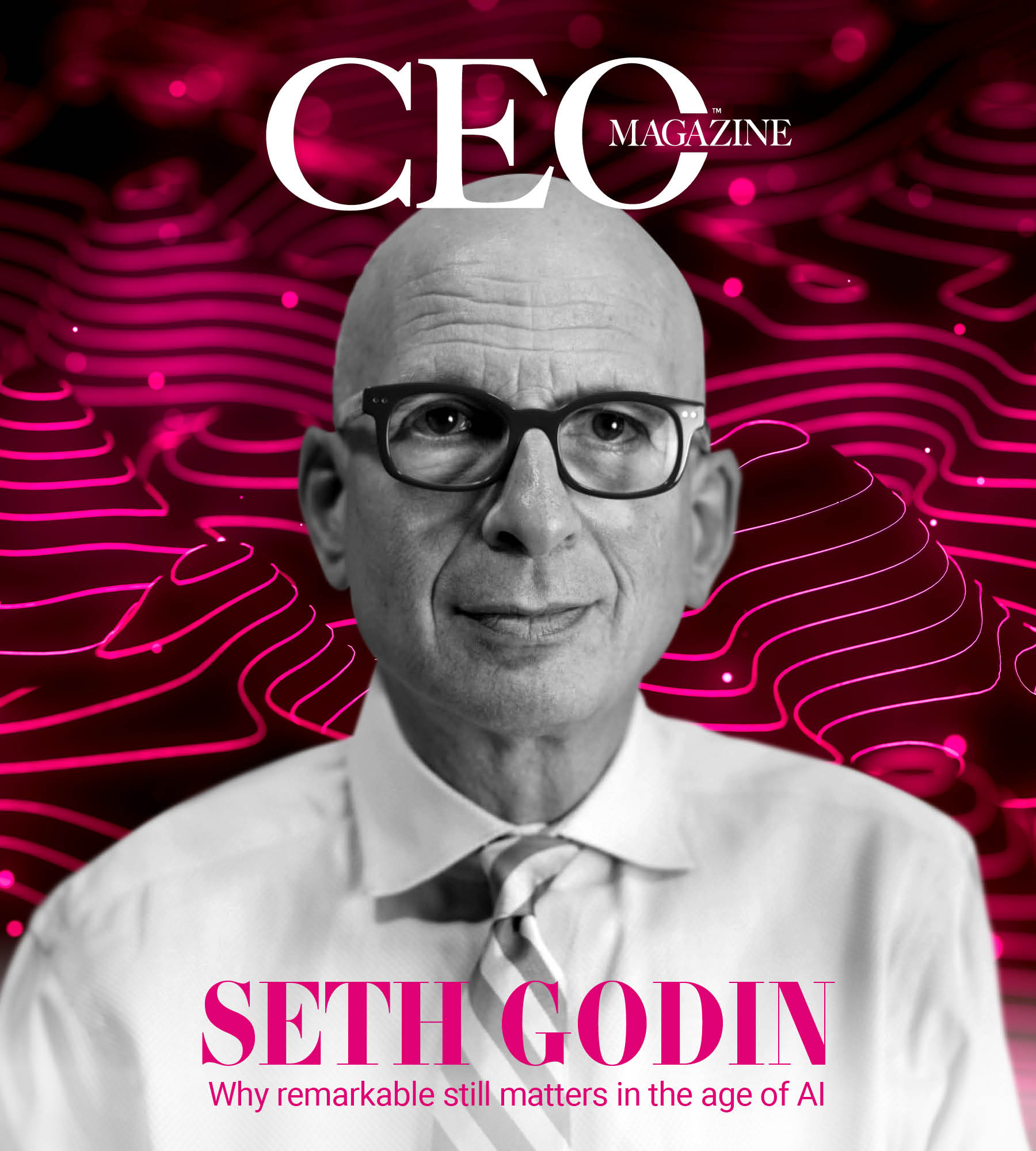
Ask Seth Godin how famous he is and he’ll almost certainly disappoint you.
“I’m happily unknown to most people,” he tells The CEO Magazine, without a trace of false modesty.
It’s an unexpected answer from someone who has written 21 bestselling books, founded two companies, invented ethical email marketing, delivered two of the most-watched TED talks of all time and built one of the longest-running blogs on the internet.
But it does reveal everything about what makes Godin tick. For him, the point isn’t to be well-known. It’s to be useful.
“My goal as a teacher is to help others spread ideas that matter,” he says. “The source isn’t important.”
His outwardly generous and almost stubborn focus on the person being served, rather than the person doing the serving, is a common thread in everything he’s built over the last four decades.
It also shapes how he approaches his next chapter. Godin’s 22nd book, The Knot: Problems Can Be Solved, arriving in September 2026, centers on a deceptively simple idea: getting ‘unstuck’.

“Once we realize how much agency we have, we can put ourselves on the hook and actually make a difference.”
At its core is a distinction many people have lost sight of. There are situations – the facts of life we cannot change – and there are problems, which, by definition, can be solved. The trouble, Godin argues, is that most of us have stopped being able to tell the difference.
“We have more tools, more reach, more leverage than any humans in history,” he points out. “So the constraint isn’t resources. It’s the choices we’re afraid to make.”
So then, why do so many people still feel stuck?
“This stuckness comes from entanglement – the sunk costs we can’t let go of, the phantom audiences we’re performing for and the borrowed definitions of success that don’t actually belong to us,” he explains.
“When we name those entanglements clearly, something remarkable happens: We stop defending them and start working.”
For Godin, that shift is where progress begins.
“Problems can be solved,” he says. “That’s not a platitude – it’s a practice. And the world needs more people who are willing to practice it.”
Godin is candid about the vantage point he speaks from.
“Compared to just about anyone on Earth, I have had no challenges at all,” he says. “I grew up with a loving family and food on the table.”
And yet, the internal struggle he describes is universal.
“The biggest challenge for me, and for many people reading this, is the voice,” Godin explains. “The one in your head that’s undermining, distracting or pushing us toward trivia. The resistance, the slog that holds us back.”
This inner dialogue, he says, is often the root of selfishness, bitterness and anxiety. But its purpose, according to Godin, isn’t to cause pain.
“It’s there to protect us from the magic – the extraordinary,” he says. “I made it through because I honestly believe I have something to contribute. And being generous is additive, it’s welcome and it never gets old.”
“Strategy is a philosophy of becoming.”
Today, that perspective shapes how he shows up in the world.
“I’m trying to help people see the difference between a situation [which we can’t change] and a problem [which, by its nature, we can solve],” he says.
“Once we realize how much agency we have, we can put ourselves on the hook and actually make a difference.”
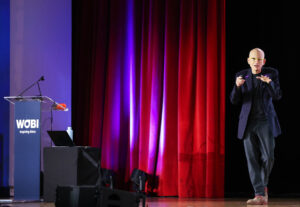
That lens doesn’t stop at the individual level. It also carries through to his views on strategy. Godin’s upcoming talk at the World Business Forum Sydney, presented by the World of Business Ideas (WOBI), focuses on the architecture of modern strategic choice.
And he arrives at the subject with a perspective designed to challenge the status quo.
“Organizations are built on avoidance of risk and the compounding of success. When systems change, it feels like a threat,” he explains. “The new thing always feels riskier – and is always more of a hassle – than the old thing.
“Strategic planning is a term that gives it all away. It implies that if you get the plan right, all you need is your staff to follow the instructions and you’ll succeed. But, of course, that’s tactics.”
True strategy, he argues, is something altogether different.
“Strategy is a philosophy of becoming,” Godin says.
“It’s the work of deciding who you want to become and who you will help your customers become. Your practical and actual purpose. It’s the one thing you’re optimizing for and the one group of people you’re focused on.”
In his mind, organizations, both large and small, are hesitant to tell the truth about their purpose, though.
“They dress it up in cloud-like aphorisms and talk about serving many objectives in almost mythical ways,” Godin says. “Actually, the purpose of just about every corporation is to make the senior executives comfortable.
“If they’re looking for control and reliable steps, a new strategy is a challenging moment. It’s easier to simply waffle.”
Godin reaches for an analogy. “An architect doesn’t just react to space that exists,” he says.
“They decide what the space is for, who will use it and what they’ll feel when they’re in it. Then they build toward that.”
Most leaders, he suggests, are handed a building that already exists and spend their careers trying not to let it crumble.
“That’s management,” Godin states. “It’s honorable work, but it’s not strategy.”

“Resilient strategy doesn’t eliminate risk.”
In his view, strategy goes much deeper.
“Strategy asks: Who do we want to become? Who are we trying to help and what do we want them to be able to do or feel that they couldn’t before?
“Once those questions are answered honestly, the decisions get easier. Not easier in the sense of comfort – easier in the sense of clear.”
He also insists that the architect analogy is a good reminder that constraints are actually a gift.
“You can’t build anything without them,” Godin says. “Gravity, load-bearing walls, the needs of people who will actually live there – these aren’t obstacles to good design. They’re the vocabulary of it.”
But defining strategy, he argues, is only the beginning of the problem. While strategy depends on clarity of purpose, most organizations are built in ways that discourage the patience needed to sustain it.
Godin believes the pressure of modern-day business creates a trap – one that has claimed a number of great companies.
“Every organization that has ever failed was, at some point, optimizing for short-term certainty,” he says. “Because short-term certainty feels like safety.”
He points to Kodak, which invented digital photography and then suppressed it.
“Then there were the buggy whip manufacturers who doubled down on leather tooling,” he shares. “They weren’t unwise – they were entangled.
“They wanted to move forward and stay still at the same time. And so, they got neither.”

“When you try to make something for everyone, you end up making something that matters to no-one.”
The deeper issue at play, he says, is that risk carries emotional weight, not just financial risk.
“When you commit to a long-term transformation, you’re making a bet that might not pay off during your tenure,” Godin points out. “You’re making yourself vulnerable to critics who will say, with the benefit of hindsight, that you were wrong.”
The short-term choice, by contrast, is the defensible one.
“It’s the choice that lets you say, ‘I was just following best practice.’ Resilient strategy doesn’t eliminate risk,” he stresses. “It accounts for luck, both good and bad, and builds something durable enough to survive the bad and benefit from the good.
“That requires a kind of patience that quarterly earnings cycles actively punish.”
One of the ideas Godin has championed most forcefully over the years is the concept of the smallest viable audience. For CEOs schooled in the logic of market share and mass reach, it’s a confronting perspective.
“Mass markets are a myth we tell ourselves to avoid commitment,” Godin says. “When you try to make something for everyone, you end up making something that matters to no-one.
“You average it out and sand off every edge. You remove the thing that would make someone love it because you’re afraid of the thing that would make someone else not like it.”
From Godin’s perspective, scale is an outcome, not a strategy.
“The CEOs I see get this wrong are the ones who start with, ‘How do we reach a million people?’ “Instead of, ‘What would 10 people love so much they’d tell 11?’” he says.
At the end of the day, it’s about finding the right audience.
“Find the people who would genuinely miss you if you were gone,” he says. “Serve them with everything you have, earn their trust – they’ll tell others. They’ll build something for you. They’ll be the flywheel.”
In a similar vein, this logic applies to culture. Godin measures strategic traction beyond dashboards or press coverage.
“Culture is simply ‘People like us do things like this’,” he says. “So the sign you’re looking for when trying to determine whether your strategy is truly gaining traction is when the people you’ve been serving start to define themselves by what you’ve built together.
“It’s not the press coverage. It’s not the metrics on the dashboard.
“It’s the moment when someone says, ‘Of course, we do it this way’ – and they mean it.”
“Remarkable is still available. It’s just not comfortable.”
It also shows up in subtle cues, he describes, like when a new hire learns how things are done not from the policy manual but from the people around them. Or when customers become offended on your behalf if someone criticizes your work.
“That’s traction,” Godin insists. “That’s culture building.”
And in the same breath, he says the warning side is the opposite.
“When you have to keep explaining why the strategy matters. When every meeting starts with re-litigating the premise,” he says. “Those are signs the idea hasn’t landed yet – or that it’s not actually the right idea.”
In a time when AI is rewriting the rules, Godin, whose work often returns to the idea of building something ‘remarkable,’ sees the strategic stakes and the risks with characteristic clarity.
“Remarkable means worth remarking on,” he says. “It has never meant flashy or expensive or viral. It simply means someone saw this and felt compelled to tell someone else.”
Regarding AI, he says it’s very good at producing the average of what has already been done.
“It can optimize a landing page, write a serviceable email and compress a process. What it cannot do – at least not yet – is take the risk of being specific. Of saying, this is for you, not for everyone,” he adds.

“Make a ruckus about something that actually matters, for people who genuinely care – and be willing to be wrong in public in service of that.”
The businesses he expects to matter in the next decade will be those that choose to be for someone in particular, about something particular and with a point of view that isn’t average.
“It’s not a technology question; it’s a courage question,” he says. “Remarkable is still available. It’s just not comfortable. It requires specificity, commitment and the willingness to be wrong in public – those things aren’t going anywhere.”
If courage is the prerequisite, then action is the proof. And Godin’s advice to leaders is characteristically direct.
“Make a ruckus about something that actually matters, for people who genuinely care – and be willing to be wrong in public in service of that,” he says.
Much of what holds leaders back, in his view, is the search for certainty before action.
“They want proof that the thing will work before they put themselves on the line for it,” he says.
But that proof, he insists, never arrives in advance. “It can’t come,” he says. “The proof only arrives after you’ve begun.”
Instead, the leaders he most admires take an approach grounded in intent.
“They understood that the work itself was worth doing, independent of whether it worked,” Godin says. “They took responsibility for the outcome without taking credit for needing it to succeed. They made a generous bet.”
The path forward, then, is not about scale or perfection but momentum.
“If you want to make something better, start,” he urges. “Start before you’re ready. Start with the smallest possible version of the change you seek to make.”
From there, it becomes about finding alignment and continuing despite doubt.
“Find the people who want to go where you’re going,” he says. “And keep going, even when the resistance tells you to stop.”
Because resistance, he adds, is not a warning sign – it’s a signal.
“The resistance is always there,” Godin says. “That’s how you know you’re on to something.”
 RELATED ARTICLES


 Home
Home
 Podcasts
 Covers
 Be Featured
 Community