Language
You can read the magazine in one of the following languages
5-min read

 Bookmark now

 Copy Link
Every CEO is under pressure to make AI pay. Boards expect productivity gains. Investors want margin expansion. Leadership teams are being asked to automate work, reduce costs and show measurable returns from technology investments that are no longer optional.
That pressure is rational. Profitability matters, and no serious company can ignore the efficiency potential of AI. But there is a danger in allowing the conversation to narrow too quickly to cost. A company can become leaner and still become less relevant. It can automate work, reduce headcount, improve revenue per employee and still lose if it is executing the wrong strategy.
Efficiency applied to the wrong strategy does not create advantage. It simply helps the company arrive at the wrong destination faster.
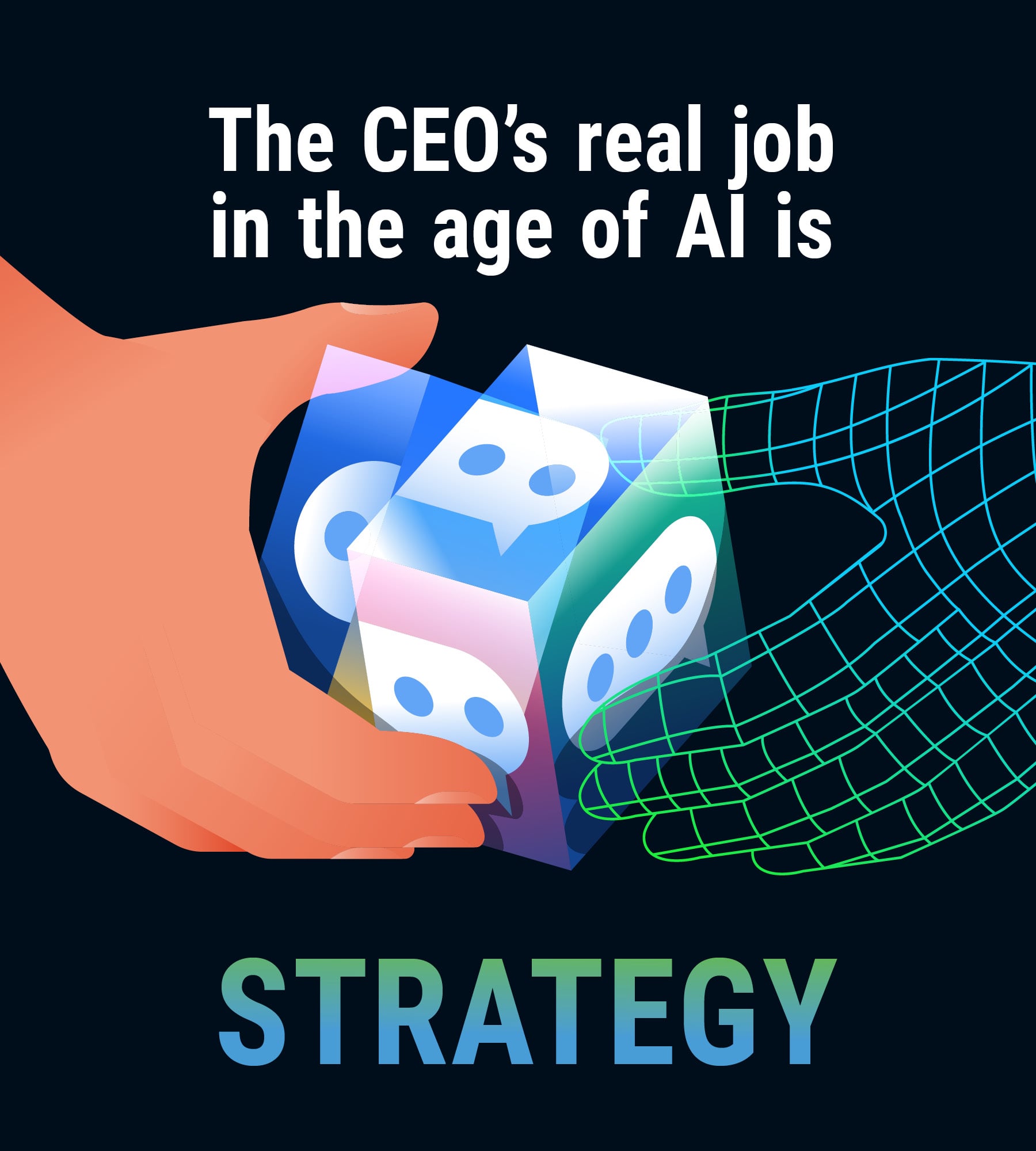
That is why the CEO’s most important decision in the age of AI is not which tools to deploy or which costs to remove. It is the strategic choice: where the company will play, how it will win and what it will deliberately choose not to do. Everything else – including AI investment and cost discipline – creates value only when it serves that choice.
Ask most leadership teams to describe their strategy and you will often hear a list of goals, initiatives and aspirations: revenue targets, product launches, market expansion, operating priorities, cultural themes or an AI road map. These may be important, but they are not strategy.

Efficiency applied to the wrong strategy does not create advantage. It simply helps the company arrive at the wrong destination faster.
Strategy is a choice among real alternatives. It defines the customers the company is built to win, the value it will create for them, the capabilities that make that value difficult for competitors to copy and the trade-offs required to deliver it. A plan tells the organization what to do. A strategy tells it what game to win and what gives the organization the unique capability to win it.
That distinction matters, because AI will make planning easier. It will generate options, summarize markets, model scenarios, draft road maps and accelerate the mechanics of execution. What it will not do is make the hard human choice that gives the company focus.
The current efficiency mandate can be useful when it forces companies to remove complexity, eliminate low-value work and redirect resources toward what matters most. But without a clear strategy, cost cutting becomes blunt. The organization may weaken the very capabilities that differentiate it, preserve activities that no longer matter, and emerge smaller but not stronger.
The question for the CEO is not simply, “Where can we cut?” It is, “Which capabilities must we protect or strengthen because they are central to how we win?” The same reduction can be wise or destructive depending on the strategy it serves.
A company built to win through superior service cannot treat customer-facing expertise as expendable. Conversely, a company built to win through product leadership cannot starve the capabilities that make its product meaningfully different. Efficiency is valuable only when it sharpens the position the company has chosen to occupy.
Many organizations separate strategy, differentiation, and positioning into different rooms. Strategy is discussed with the board. Differentiation is debated by product and sales. Positioning is handed to marketing as a messaging exercise.
That separation is one of the reasons companies sound more differentiated than they actually are.
Strategy, differentiation, and positioning are not three separate disciplines. They are one system. Strategy is the choice of where to play and how to win. Differentiation is the advantage, rooted in capabilities or choices competitors cannot easily replicate, that makes the strategy real. Positioning is how that advantage becomes clear in the customer’s mind relative to alternatives.
When these elements are built together, they reinforce one another. The strategy gives the market claim something true to stand on. The differentiation makes the claim defensible. The positioning makes the strategy visible, understandable, and valuable to customers. When they are built apart, the market senses the disconnect. The company may communicate well, but it will not persuade. It may move fast, but it will not become more distinct.

A company built to win through superior service cannot treat customer-facing expertise as expendable.
This is not a marketing problem. It is a CEO problem. A position that is not anchored in a real strategic choice is copywriting. A strategy that never reaches the market as a clear position never earns its return.
AI should become part of the strategy process. Used well, it can expand the CEO’s field of vision. It can synthesize market data, identify patterns, pressure-test assumptions, summarize customer signals, model competitive scenarios, and compress weeks of analysis into hours.
But strategy is not the average of available information. It is not the consensus answer produced from the public record. The value of strategy comes from the fit between a market opportunity, a company’s unique capabilities, and the trade-offs leadership is willing to make under uncertainty.
That is why the CEO cannot outsource the strategic choice to AI. If the answer is equally available to every competitor using similar tools and similar data, it is unlikely to be a source of advantage. AI can help leaders see more clearly. It cannot decide what the company is willing to become.
The hardest part of strategy is not analysis. It is commitment. It means choosing a market when others look attractive, prioritizing one kind of customer over another, investing behind a few capabilities while starving others and holding the line when early results are uneven.
The companies that execute a real strategy create clarity throughout the organization. Teams know which customers matter most, which opportunities to pursue, which requests to decline and which investments deserve protection. They can make faster decisions because the strategic logic is understood. In that environment, AI becomes more powerful because it amplifies a clear direction instead of accelerating confusion.

Use AI aggressively, but do not confuse AI-enabled productivity with strategic advantage.
This is the CEO’s mandate now: use AI aggressively, but do not confuse AI-enabled productivity with strategic advantage. Manage costs, but not as a substitute for choice. Demand efficiency, but only in service of a position worth strengthening.
The age of AI will make analysis faster, execution cheaper, and options easier to generate. That makes the CEO’s irreducible responsibility more important, not less.
The job is to decide where the company will play, how it will win, and what it will give up to make that choice real. The machines do not change that. They make it clearer who the job belongs to.

Gerardo Dada
Contributor Collective Member
Gerardo Dada is a seasoned marketing strategist and technology leader with more than 25 years of experience at the center of the web, mobile, social and cloud revolutions. He has held senior leadership and executive roles at some of the world’s most influential technology companies, including Microsoft, Rackspace, SolarWinds, Bazaarvoice and Catchpoint. Find out more at https://theadaptivemarketer.com/about/



 Home
Home
 Podcasts
 Covers
 Be Featured
 Community