Language
You can read the magazine in one of the following languages

3-min read

 Bookmark now

 Copy Link
AI in the workplace is often framed as a threat. Leaders talk about productivity. Employees worry about job loss. Somewhere in the middle, anxiety lingers.
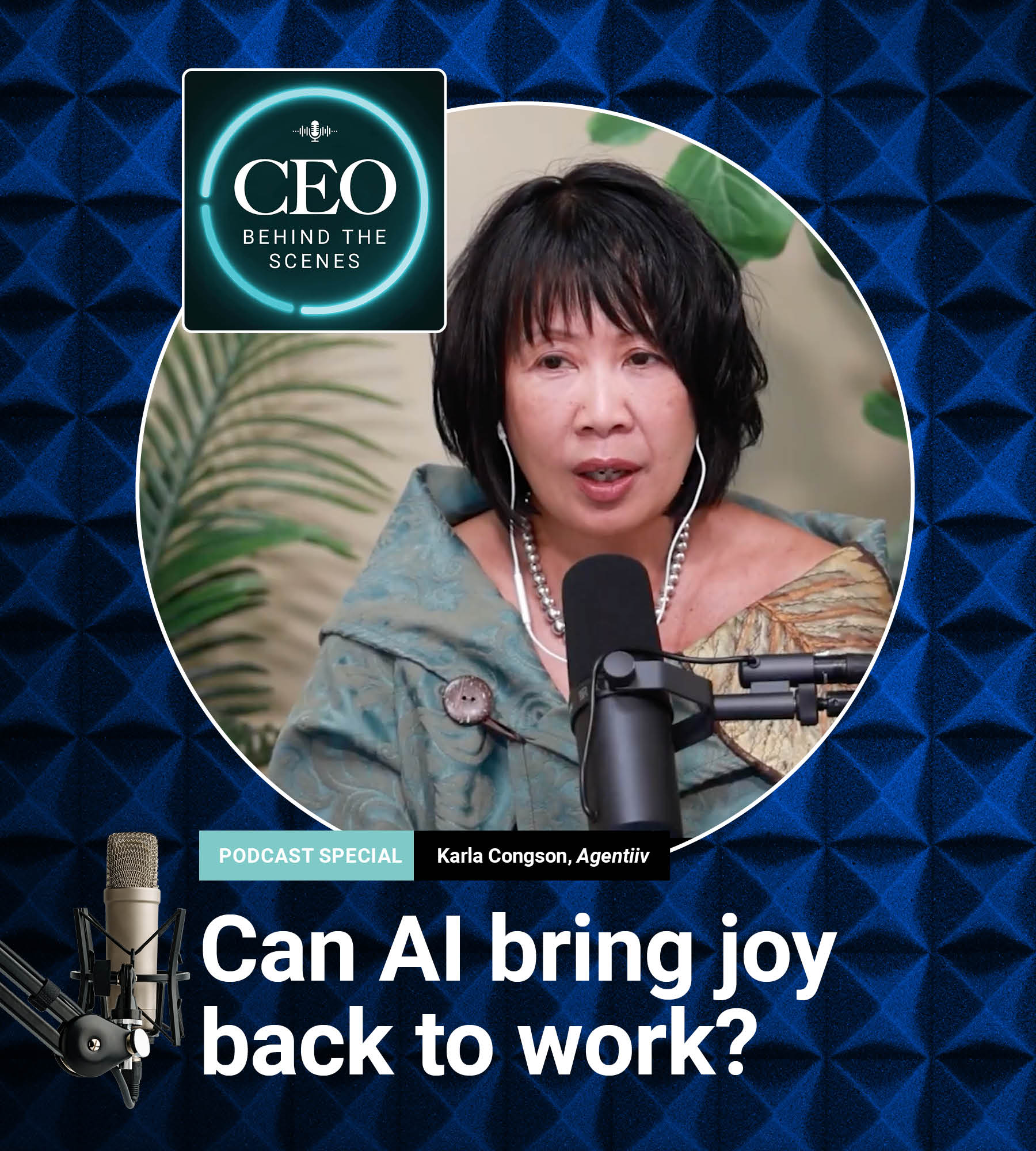
Karla Congson sees something else entirely.
“When we think about AI and what it can do, taking away some of that ‘grudge’ work. And if your teams aren’t spending 30 percent of their time in what I call cognitively numbing work or grudge work, suddenly you can focus on the things that actually give you joy, that help you rediscover the reasons why you started this vocation or this profession or this expertise in the first place,” she says on CEO: Behind the Scenes.
For Congson, AI is not about squeezing more output from already stretched teams. It is about reclaiming the 30 percent of work most people don’t enjoy. Remove the cognitively numbing tasks and it unlocks energy, creativity and discretionary effort.
That shift is not just cultural. It is competitive.

“Your ability to learn continuously is actually more important than what you know today.”
“So imagine if 100 percent of your people enjoyed 90 percent of what they do, because we’re able to focus on the things that create value, that create impact, that really leverage their special talent or expertise. Imagine what your company would be capable of,” Congson enthuses.
“In the future, that’s not going to be a nice to have. That’s actually going to be a competitive advantage.”
Congson’s conviction comes from experience. After 25 years in corporate marketing, including serving as CMO of two organizations and leading major automotive accounts in Canada, she stepped away in 2016 to build a distributed agency powered by 200 freelancers.
Then, in early 2023, ChatGPT arrived. “I was wondering, ‘oh gosh, is this the beginning of the end?’” she recalls.
Instead of retreating, she leaned in. A self-described non-technical founder, Congson immersed herself in prompt engineering, machine learning communities and Discord forums. But while others focused on code, she focused on people.
“What set us apart and the advice that I would give to people who want to create agents is: Start with the human,” she says. “And what I mean by that is take a very human-centered design to the way you create agents.”
Congson worked with her top experts to map their workflows at a granular level, identifying friction points and decision logic. From there, she built AI digital twins trained on their frameworks. Today, more than 100 AI agents support her teams, handling meeting notes, synthesis and structured outputs, freeing human talent for higher-value thinking.
Technology, however, is only part of the equation.
“The reality is this is as much a talent opportunity and a talent challenge as it is a technology challenge,” she says.
Over time, it’s become clear to Congson that organizations do not change. People do. Without adoption at the front line, even the most advanced systems fail.
“AI amplifies the human by giving them superpowers,” she says. “But then the human is part of amplifying the end product by providing our talent, our expertise.
“If you look at AI as simply a way to increase your productivity or reduce your staff, you will be left behind.”

“Your ability to learn continuously is actually more important than what you know today.”
The pace alone demands attention.
“ChatGPT and generative AI reached 50 percent adoption in six months, and it’s only getting faster,” she says.
“Your ability to learn continuously is actually more important than what you know today.”
In the age of AI, curiosity may be the ultimate competitive advantage.

Listen to the latest episode of our CEO: Behind the Scenes podcast with Karla Congson on Amazon, Apple or Spotify.
 RELATED ARTICLES
 4-min read
6-min read



 Home
Home
 Podcasts
 Covers
 Be Featured
 Community