Language
You can read the magazine in one of the following languages
7-min read

 Bookmark now

 Copy Link
For many leaders, cash flow management revolves around building forecasts, identifying peaks and troughs and then scrambling to plug gaps through bank facilities, owner capital injections or dipping into reserves. While these actions may relieve immediate pressure, they rarely address the underlying causes.
Scaling Up takes a fundamentally different approach. Rather than managing symptoms, it focuses on permanently improving the underlying drivers of cash performance. This discipline is known as Financial Excellence, a framework that helps leaders understand the internal relationships within their financial data, enabling clearer and more effective decision-making, ultimately strengthening the organization’s ability to self-generate its own cash.
At its core, Financial Excellence shifts the leadership conversation from asking:
“Where did the cash go?” to a far more strategic question: “What is driving our cash, profit and long-term value and how can we improve it?”
At the heart of Financial Excellence lies a powerful insight: within every set of financial reports are just seven core drivers that shape profit, determine cash flow and ultimately, influence business valuation. This concept is known as the Power of One.
Four of these drivers – price, volume, cost of goods and overheads – directly influence profitability and are measured in percentage terms. The remaining three – receivables, work-in-progress inventory and payables – determine how quickly cash moves through the organization and are measured in days.
By modeling these seven drivers together, leaders can clearly see how small movements in operational performance translate directly into changes in profit, liquidity and long-term value.
The illustration below shows the Power of One applied to a mid-sized business, JM Holdings, generating approximately US$22 million in annual revenue.
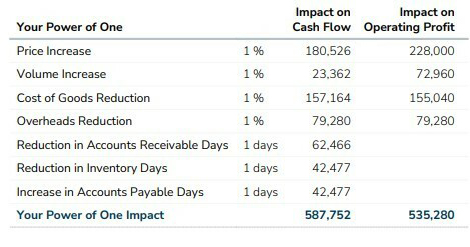
When leadership teams first see the Power of One modeled visually, several insights become immediately clear.
The first is the disproportionate influence of pricing and cost efficiency. In most businesses, often in around nine out of 10 cases, a one percent improvement in price or reduction in the cost of goods produces a significantly greater financial impact than an equivalent increase in sales volume.
For example, in the case of JM Holdings, a one percent increase in price or a one percent reduction in cost of goods delivers a dramatically greater financial outcome than a one percent increase in volume. In this example, the cash impact alone is approximately six to seven times greater, while the profit impact is two to three times higher. This often surprises leaders, as organizations typically devote far more energy to driving volume growth while overlooking more powerful levers already within their control.
Equally important, the model highlights the reverse effect. Leaders begin to see that even small price reductions can have a seriously negative impact on profit, cash flow and long-term value. A one percent discount decreases cash by US$180,000 and profit by US$228,000 – on a five times multiple, US$1.14 million in valuation decline.
Many recognize for the first time how frequently pricing concessions are made in pursuit of growth, without fully understanding the financial consequences.
The second insight relates to liquidity discipline. While leaders focus heavily on revenue and margins, far less attention is typically given to the operational drivers of working capital, including billing accuracy, collection speed, inventory efficiency, supplier terms and the payment conditions embedded within contracts and deals. Individually, these factors may appear minor but collectively they can materially shape a company’s cash position.

Rather than managing symptoms, it focuses on permanently improving the underlying drivers of cash performance.
When leaders begin to view these drivers together, the strategic impact becomes clear. In the case of JM Holdings, strategizing a two percent price increase, a two percent reduction in cost of goods and a three-day reduction in receivables would generate approximately US$860,000 in additional cash and improve profitability by a further US$766,000.
These outcomes illustrate how small but disciplined improvements across a handful of drivers can produce substantial financial gains without requiring significant changes to overall sales volume.
As leaders absorb these insights, behavior begins to shift. Rather than focusing primarily on driving sales volume, they begin to examine pricing discipline, cost efficiency and the operational drivers that most directly influence cash flow.
This shift extends to liquidity management. Leaders start to scrutinize payment terms within contracts and commercial arrangements, seeking opportunities to strengthen conditions and accelerate collections. They adopt a critical mindset shift, recognizing that an invoice issued is not simply revenue recorded; it represents cash invested in delivering a product or service that must be recovered quickly.
What is most surprising to many organizations is how quickly this clarity translates into momentum. Team members rapidly recognize practical opportunities within their own areas of responsibility, often identifying actions they can take immediately, even before the leadership team has formally agreed on the next steps to be implemented.
With consistent discipline, the results are typically visible within a single quarter. Over time, the cumulative impact can be significant, strengthening profitability, improving cash generation and enhancing overall financial resilience.
One of the most important insights revealed through Financial Excellence is the true cash cost of growth.
When leaders model the working capital dynamics within their business, a critical reality becomes clear. Growth quite possibly may not generate cash in the short term; it begins to consume it.
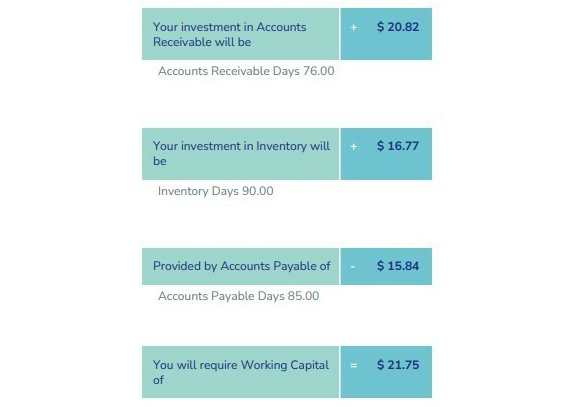
For example, in the case of JM Holdings, the analysis shows that for every US$100 of revenue growth, the business requires approximately US$21.75 of additional cash to support the working capital expansion. This reflects a fundamental reality – as revenue increases, organizations must invest in receivables, inventory and operational capacity before the associated cash is collected.
This insight becomes particularly powerful when applied to real growth targets. If JM Holdings were to pursue a 10 percent growth objective, equivalent to approximately US$2.2 million in additional revenue, it would require roughly US$478,000 of additional working capital cash to support that expansion, based on approximately US$21.75 of cash required for every US$100 of revenue growth.

Ultimately, this discipline strengthens an organization’s ability to generate its own cash, reducing reliance on external funding sources.
This dynamic explains why many companies can appear strong on their profit and loss statements while simultaneously experiencing increasing pressure on liquidity as they expand. It is one of the most common challenges faced by scaling organizations, often described as ‘growing broke’.
Financial Excellence changes this conversation by introducing a question many leaders have never previously considered: “Based on the cash required to support growth, how fast can we actually afford to grow?”
From there, the discussion quickly deepens. Leadership teams begin to explore more strategic questions, “What levers do we have to pull to fund our growth?” and “How do we sustainably finance that growth over time?”
These conversations shift growth from being purely an ambition to becoming a disciplined financial strategy.
Across organizations implementing Financial Excellence within the Scaling Up framework, a consistent pattern emerges.
The first reaction is clarity. When leaders see the Power of One modeled visually, they are often struck by the disproportionate impact of pricing and cost efficiency. For many, it is the first time they fully appreciate how small movements in these drivers can dramatically influence profit, cash flow and long-term value.
The second reaction is ownership. Almost immediately, individuals begin identifying practical improvements within their own areas. The framework makes financial performance tangible and actionable, rather than abstract or confined to the finance function.
Over time, this clarity fosters a culture of disciplined decision-making. Leaders begin to evaluate everyday choices through the lens of their impact on cash, profitability and valuation.
Ultimately, this discipline strengthens an organization’s ability to generate its own cash, reducing reliance on external funding sources such as bank facilities, investor capital or owner injections.
Within the Scaling Up methodology, this financial clarity becomes a powerful driver for safe sustainable growth.
For more information on Scaling Up, click here.
 RELATED ARTICLES


 Home
Home
 Podcasts
 Covers
 Be Featured
 Community