Language
You can read the magazine in one of the following languages
5-min read

 Bookmark now

 Copy Link
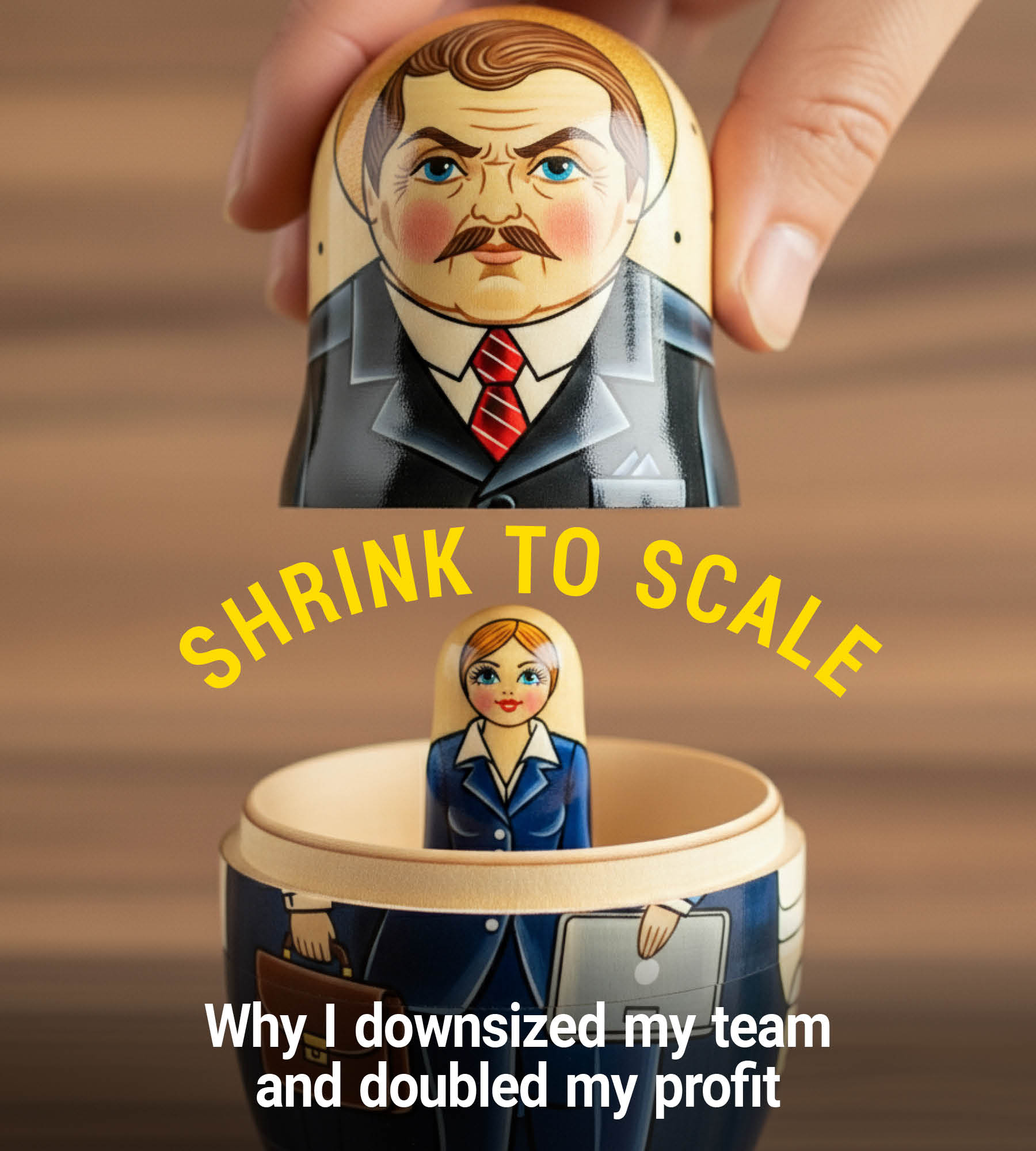
The business world is obsessed with hypergrowth, so the idea of deliberately making your company smaller can feel rebellious.
For years, I chased the traditional playbook: build a team, expand capacity and grow fast. But as a single parent raising two energetic boys while running a nationally recognized, multi-award-winning PR consultancy, I realized ‘bigger’ was not only unsustainable – it was quietly eroding both my margins and my wellbeing.
So I made what seemed like a radical choice. I dismantled my in-house team, rebranded to better reflect what we truly delivered – marketing communications – and built a lean, contractor-led model supported by one trusted full-time employee who became my right hand. The results were extraordinary: less stress, sharper focus, happier clients and profits that doubled year on year.
‘Shrinking’ unlocked scalable, sustainable growth and taught me lessons I believe many founders need to hear.
Modern business culture glorifies expansion. The bigger the team, the bigger the office, the bigger the turnover, the more ‘legitimate’ your success appears. But scale without strategy is a trap.
For me, the warning signs were clear. Costs spiraled while productivity plateaued. Internal management consumed more energy than client delivery (when my team was at its largest, I often joked I was running an adult creche, as I spent more time on HR than PR).

Growth had delivered the very opposite of what I set out to achieve: freedom, fulfillment and sustainable profit.
Despite national industry accolades, I found myself stretched thin, disconnected from the work I loved and constantly firefighting personality clashes in my team. Growth had delivered the very opposite of what I set out to achieve: freedom, fulfillment and sustainable profit.
I am far from alone in reaching this conclusion. A 2023 McKinsey survey found that 58 percent of executives now use external contractors in core business functions, citing flexibility and cost efficiency as the main drivers. Deloitte’s ‘2025 Global Human Capital Trends’ report has also highlighted the rise of fractional talent models, where companies access senior expertise on demand rather than locking it into fixed roles. What once seemed like an unorthodox approach is fast becoming mainstream.
The decision to shrink was not about retreat but about redefining what growth meant for me. I started by rebranding the agency. ‘PR’ no longer captured the breadth of what we offered and it often created confusion about outcomes. By repositioning as a marketing communications business, I brought clarity both internally and externally, which sharpened our pitch and strengthened client relationships.
Next, I dismantled the traditional in-house model and rebuilt the company around a contractor-led approach. Rather than carrying the weight of multiple salaries, office costs and rigid roles, I created a flexible ecosystem of trusted specialists. They were engaged on demand for their expertise, each one accountable for outcomes, not hours.
Crucially, I didn’t want to leave myself completely exposed as the only employee, so I retained one full-time team member who became my right-hand woman. She provides continuity, stability and operational support, giving the business both agility and a strong backbone. We are committed to the same goals, which means alignment rules the roost, not annoying squabbles.
Of course, a lean model requires robust systems to function. I standardized onboarding, established communication protocols and invested in project management platforms to ensure contractors integrated seamlessly. Far from abandoning metrics, I reframed them around outcomes rather than time spent, which created sharper alignment across the board.
Within the first year, my profit margin doubled. With lower overheads, revenue flowed more directly to the bottom line. The business could scale capacity up or down depending on client demand, removing the stress of idle staff or overstretched teams.

I rediscovered joy in my work, focusing more on strategy and client relationships and less on people management and administration.
But the financials were only part of the story. I rediscovered joy in my work, focusing more on strategy and client relationships and less on people management and administration. My boys saw a mother who was less stressed, more present and genuinely happier. And clients noticed too – they receive sharper, more agile service delivered by highly motivated specialists. It’s a win, win, win.
Moving away from the mantra of ‘grow at all costs’ forced me to confront the myths that often drive founders.
Success is not measured by headcount but by the value a business delivers. Flexibility is often more powerful than rigidity, particularly in industries that demand responsiveness. And perhaps most importantly, chasing size for its own sake may look impressive externally, but it means little if the business model is fragile or the founder is burnt out.
Running a leaner operation has not meant abdicating leadership, it has simply required a new kind of leadership from me. Contractors thrive on trust and clarity, so I learned to communicate goals and outcomes more explicitly, then step back and allow experts to deliver.
Trial engagements became a natural way of testing new collaborators, ensuring cultural and performance alignment without the risks of permanent hires. Rebranding the business forced me to be crystal clear about what we do and, just as importantly, what we don’t.

Sometimes the boldest, most strategic move a founder can make is to let go, get lean and build a business that truly works.
That clarity has been a powerful filter for both clients and collaborators. There is a reason we are now called Grass Is Greener Marketing Communications – because the grass really is greener here on the other side of the traditional business model.
For me, shrinking was never about playing small. Sure, I had some mental hurdles to get over as I bucked the trend and needed to be brave to step fully into the business model I knew was best for me. But really, it was about scaling smarter.
By reducing headcount (while retaining one indispensable team member), stripping back operations and embracing a contractor-led model, I gained agility, profitability and a renewed sense of purpose.
The lesson is simple but often overlooked: growth is not always linear and bigger does not always mean better. Sometimes the boldest, most strategic move a founder can make is to let go, get lean and build a business that truly works – for clients, for the bottom line and for the human being at the center of it all.
The success of a business runs off the energy of its founder, and this for me, is the most important business lesson of all.

Lisa Burling
Contributor Collective Member
Lisa Burling is an award-winning marketer, journalist, author and podcaster who has built a career around one simple truth: stories change everything. She is the Founder & CEO of Grass Is Greener Marketing (formerly LBPR), one of Australia’s most awarded consultancies. Alongside her corporate success, Lisa is the host of ‘Unscripted with Lisa Burling’, a podcast that explores what it really takes to rebuild and thrive in today’s world. Visit https://www.lisaburling.com/
 RELATED ARTICLES
 6-min read
5-min read



 Home
Home
 Podcasts
 Covers
 Be Featured
 Community