Language
You can read the magazine in one of the following languages
10-min read

 Bookmark now

 Copy Link
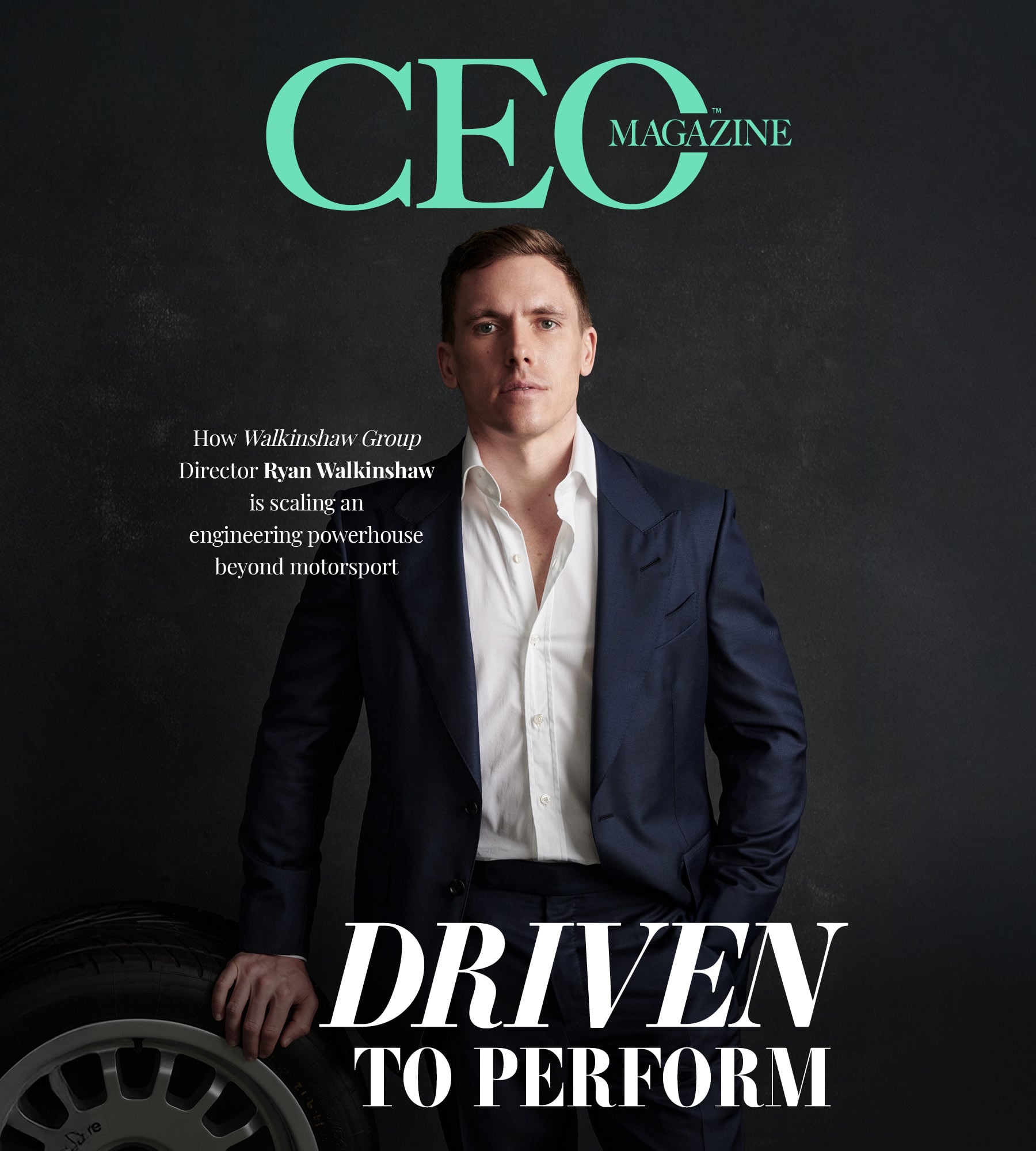
Few businesses carry the weight of legacy quite like Walkinshaw Group. The name is synonymous with motorsport success, engineering precision and decades of automotive innovation. But for Ryan Walkinshaw, inheriting that legacy in his early 20s meant balancing what came before with the need to shape what comes next.
“Taking over the business at 23 was both a privilege and a significant responsibility,” he tells The CEO Magazine. “At that stage, my priority was simple – absorb as much as possible, protect the foundations that had been built and ensure the organization continued to move forward.”
Stepping into the role of Director at just 23, Walkinshaw had to learn at speed. Every decision carried consequences, not only for the future of the company but also for the people who had built their careers within it.
“The learning curve was steep commercially, operationally and personally,” Walkinshaw admits. “While growth in leadership never truly plateaus, experience brings perspective and perspective shapes clarity.”
That clarity eventually shaped a leadership philosophy that values capability over hierarchy and performance over ego.
“I don’t believe the CEO needs to be the smartest person in the room,” he says. “My responsibility is to build a team of exceptional individuals and give them the environment to excel.”


Walkinshaw also quickly recognized the power of having the right people around him.
“Surrounding yourself with capable, independent thinkers – not passive agreement – elevates performance and strengthens decision-making,” he explains. “And assembling a team like that requires humility and confidence in equal measure.”
Walkinshaw applies that approach not just to hiring but to tackling the hurdles that arise.
“Challenges are inevitable in any ambitious business, but leadership should not become a bottleneck,” he says. “When issues arrive, I encourage my team to present considered options alongside the problem. That mindset builds accountability and ensures decisions are proactive rather than reactive.”
Empowerment is also essential to his philosophy.
“High-performing environments, whether in sport or business, depend on trust, clarity of roles and ownership,” he insists. “My role is to set direction and standards, but execution belongs to the leaders closest to the work. When people are empowered with responsibility and held to high expectations, performance follows.”
This approach, he believes, allows the organization to evolve without losing sight of its roots.
“Building on a strong legacy has never been about reinventing the organization,” Walkinshaw says. “It has been about respecting the foundations while evolving the business to meet new realities, ensuring the culture remains ambitious, disciplined and forward-looking.”
To the outside world, Walkinshaw Group is motorsport. Racing success, engineering innovation and iconic performance vehicles have defined the public perception of the business.
But according to Walkinshaw, that perception only reveals part of the picture.
“Motorsport has never been the entirety of who we are, but it has been the most visible demonstration of our capability,” he says.
Indeed, the engineering DNA behind those achievements runs far deeper.
“Engineering and advanced manufacturing have always been at the core of the business, even dating back to the Tom Walkinshaw Racing era, when my father was leading the original family enterprise,” he explains.
Motorsport, in many ways, functions as a live demonstration of the organization’s technical strengths.
“It showcases our ability to perform under pressure, innovate rapidly and deliver at the highest level,” Walkinshaw says.
“What happens on the track is ultimately a public expression of the same engineering rigor and advanced manufacturing expertise that underpins our broader commercial operations.”


As Walkinshaw Group expanded into advanced manufacturing programs for global original equipment manufacturers (OEMs), the transition was less dramatic internally than it appeared externally.
“Culturally, the transition was not dramatic because the expectations have always been consistent: high performance, precision, accountability and a relentless drive to win,” Walkinshaw notes. “Whether building a racecar or delivering a complex OEM program, the standard is the same.”
The operational dynamics, however, required a shift in thinking.
“Motorsport operates on compressed timelines, with performance judged event by event,” he explains. “Advanced manufacturing programs require long-term discipline, often working years ahead of production, managing compliance, complexity and scale.”
Building that capability didn’t happen overnight – it required structural maturity and a healthy dose of patience.
“Adapting to those time horizons required structural sophistication and a different cadence of execution,” Walkinshaw says. “But the underlying mindset of excellence remained constant.”
What began as a motorsport-driven engineering operation has evolved into a diversified group of businesses that extend far beyond the racetrack. Today, Walkinshaw Group operates across five core divisions, each playing a distinct role in the company’s expanding industrial footprint.
At the center sits Walkinshaw Automotive Group, the advanced engineering and manufacturing arm of the business. While deeply embedded in the automotive sector, its capabilities increasingly extend into adjacent industries, applying the same precision manufacturing and engineering expertise to complex programs outside traditional vehicle production.
Then there is Walkinshaw Performance, the division responsible for the company’s high-performance vehicle programs. Known for delivering upgrades and performance enhancements that push vehicles beyond factory specification, the business continues to draw directly from the Group’s deep motorsport and engineering heritage.
The portfolio extends further through Walkinshaw Sports, a major distributor of golf and sporting equipment representing some of the biggest global brands in the industry.
And anchoring the organization to its competitive roots remains Walkinshaw Andretti United, the Group’s Supercars Championship team, competing at the highest level of Australian motorsport.
This mindset now underpins the Group’s growing presence in industries beyond automotive.
“We are global leaders in a highly specialized segment of the automotive industry, with capabilities few organizations worldwide can replicate,” he says. “The expertise in complex engineering, precision manufacturing, rapid problem-solving and disciplined execution is highly transferable.”
Rather than expanding for expansion’s sake, the Group has pursued a carefully considered approach.
“Our diversification strategy is deliberate,” he explains. “We move into adjacent sectors such as defense, mining, marine and aviation where our technical strengths are directly relevant, rather than pursuing expansion disconnected from our core competencies.
Alongside the precision is speed – the Group’s ability to move quickly remains a competitive advantage.
“Larger incumbents often struggle with speed and cost efficiency,” he points out. “We have built a model capable of delivering complex solutions to exacting standards while remaining nimble and commercially competitive.
“Basically, our ability to adapt quickly, mobilize talent effectively and execute within demanding timeframes positions us as an attractive partner in sectors where reliability and precision are non-negotiable.”
One of the clearest signals of Walkinshaw Group’s ambition arrived with the opening of its new advanced manufacturing facility in Melbourne.
At more than 100,000 square meters, it’s one of the largest automotive engineering and manufacturing sites in Australia – and represents far more than additional floor space.
“Our new facility represents a defining milestone,” Walkinshaw says. “Strategically, it allows us to consolidate previously standalone operations into a single integrated ecosystem.”
Bringing multiple functions together under one roof brings results that were previously difficult to achieve.
“It unlocks operational efficiencies, faster collaboration and greater scalability,” he reveals. “Bringing engineering, manufacturing and support functions under one roof enables us to innovate more effectively and deliver enhanced value to our customers.
“It also strengthens our competitive position globally. Improved efficiency and streamlined processes allow us to remain cost-competitive against international players while maintaining uncompromising quality standards.”


Internally, Walkingshaw notes, the impact has been just as important.
“Previously siloed teams now operate as one cohesive organization. The innovation benefits are tangible, but so too are the human ones like shared purpose, stronger communication and a unified identity,” he says.
More than a facility, he believes, it’s a better representation of who the Walkinshaw Group is.
“Externally, the facility signals scale, ambition and long-term commitment. It’s not simply infrastructure,” he says. “It’s a statement of intent. We want people to see on the outside how we feel we are on the inside.”
Despite the sophistication of Walkinshaw Group’s engineering capability, Walkinshaw insists the organization’s real strength lies elsewhere.
“Our business is fundamentally built on people,” he says.
The decline of Australia’s local automotive manufacturing sector created an unexpected opportunity for the business.
“Following the closure of local automotive manufacturing in Australia, we were uniquely positioned to retain exceptional engineering and manufacturing talent,” Walkinshaw explains. “That proved transformative.”
Today, Walkinshaw Group continues to invest heavily in developing the next generation of talent.
“Our focus is on structured internal development and succession planning,” he says. “We view talent development as a long-term strategic investment. We are committed to building a genuine pipeline of engineers, technicians and leaders from within, ensuring institutional knowledge compounds over time.
“Sustainable growth requires depth across critical roles and a deliberate approach to identifying and mentoring future leaders early in their careers.”


At the heart of this investment is a commitment to culture.
“High performance begins with hiring exceptional people and providing clarity, autonomy and accountability,” he says.
Yet culture, he acknowledges, can be fragile.
“It’s often said that business is simple but people are complex – and that resonates,” he reflects. “The quality of one individual in a key role can materially influence culture and outcomes, positively or negatively.”
That reality makes decisive leadership essential.
“One of the hardest lessons in leadership is acting decisively when something is not working,” he says. “Delaying necessary change can erode momentum and culture. When strong leadership exists at multiple levels, standards propagate organically and resilience becomes embedded.”
Few moments have tested Walkinshaw Group’s resilience more than the closure of Holden’s manufacturing operations in Australia.
“That was the most defining challenge,” he says. “At that time, our core business was directly dependent on locally manufactured vehicles. When production ceased, the foundation of our existing model effectively disappeared.”
Faced with that reality, the company took the challenge head-on.
“We made a decisive pivot into multi-OEM engineering and advanced manufacturing programs,” Walkinshaw explains. “It required conviction, significant investment and a willingness to accept risk. There were periods of genuine financial pressure, and the path was far from linear.
“That experience reinforced the importance of clarity and belief in strategy. When you understand market dynamics and have the right people around you, decisive action even when externally questioned can redefine an organization’s legacy.”


The turnaround produced several defining achievements.
“The successful strategic pivot following Holden’s closure stands out as foundational,” Walkinshaw says. “On a product level, delivering the HSV W1 remains deeply significant.
“In motorsport, multiple Bathurst victories and a Supercars Championship reinforce the competitive DNA of the organization.”
Even during the turbulence of the COVID-19 pandemic, the business held its ground.
“Navigating the disruption of the pandemic, managing supply chain volatility, workforce challenges and operational continuity also required disciplined leadership and collective resilience,” he notes.
“Preserving stability during that period remains a great source of pride.”
As Walkinshaw Group continues to grow internationally, collaboration with global partners has become increasingly central to its strategy.
“A strategic partnership is defined by transparency, alignment and shared accountability,” Walkinshaw says. “With our OEM partners, collaboration begins at concept development and continues throughout the program lifecycle.”
Many of these partnerships require a high level of operational transparency.
“Many engagements operate on a cost-plus basis, requiring a high degree of openness and trust,” he points out. “Partners have visibility into operational structures, reinforcing accountability on both sides.”
But the most successful partnerships, he believes, are built on shared goals.
“A partnership becomes truly strategic when both parties prioritize long-term outcomes over short-term transactional gain,” he says.


Maintaining that focus becomes increasingly important as the organization expands.
“Disciplined growth is essential,” he insists. “Program time horizons create structural stability and reduce volatility even as the business grows.”
Ultimately, growth must remain anchored to the company’s core strengths.
“Strategic coherence comes from remaining anchored to our core competencies – advanced engineering, precision manufacturing and performance culture – regardless of sector,” Walkinshaw says.
For a company rooted in motorsport heritage, the future of Walkinshaw Group increasingly lies in complex engineering programs across multiple industries and global markets. Yet the ambition driving the organization remains remarkably simple.
“I want Walkinshaw Group to be recognized globally as the benchmark in our field – the partner of choice for the world’s leading OEMs and a leader in advanced manufacturing and engineering,” he says.
“Whether on the racetrack or in complex industrial programs, our ambition is consistent: to be number one.
“Achieving that requires continued investment in capability, infrastructure and people while maintaining the culture of performance that has defined the organization from the beginning.”
For Walkinshaw, the way forward is clear.
“Excellence must remain non-negotiable,” he says. “That’s the Walkinshaw way.”
 RELATED ARTICLES
 SPOTLIGHTS ON LEADERS



 Home
Home
 Podcasts
 Covers
 Be Featured
 Community