Language
You can read the magazine in one of the following languages

11-min read

 Bookmark now

 Copy Link
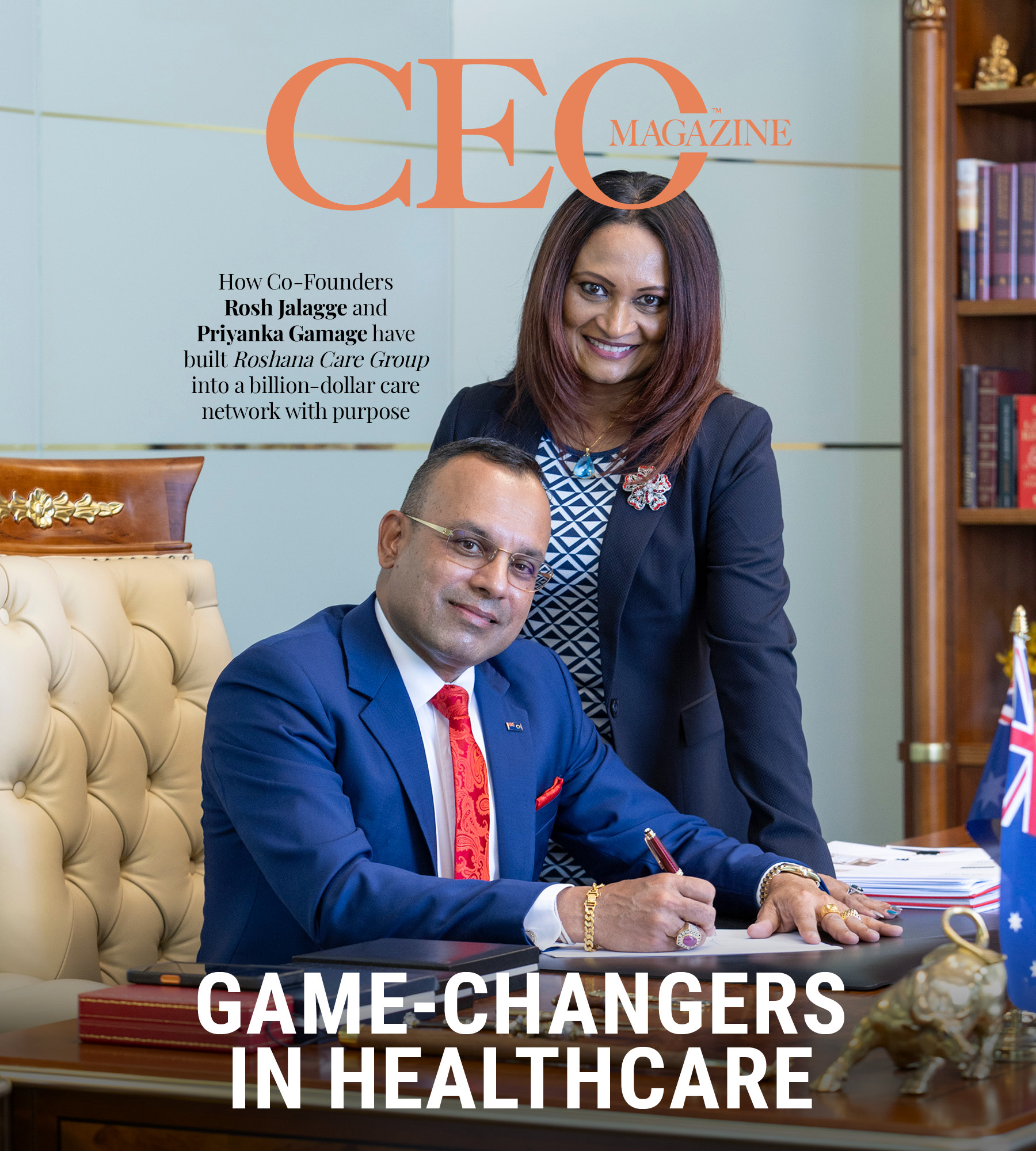
There’s a moment every founder faces – a quiet, yet defining point where the decision in front of them doesn’t quite add up on paper. For Dr Rosh Jalagge and his wife Priyanka Gamage, it’s a moment they’ve returned to again and again.
More than 30 years ago, they stood at one such crossroads and had to decide whether to take over a struggling mental health facility in Midland or walk away.
“Many people said we shouldn’t even think about it,” Jalagge, Roshana Care Group’s CEO, tells The CEO Magazine.
But stepping away never sat comfortably with either of them.
“When I see people waiting in hospitals for an aged care placement, a mental health facility or other essential services, I have always felt it as a deeply personal responsibility, something I needed to help resolve,” Gamage says.
That push and pull – between instinct and empathy and risk and responsibility – sits at the center of both their relationship and the business they’ve built together.
Over nearly three decades, it has shaped Roshana Care Group from a single mental health facility into a US$1 billion enterprise, spanning aged care, home care, disability, mental health and primary care, with thousands of staff and a growing footprint across Australia.
Long before Roshana Care Group became what it is today, it was just an option. Jalagge had arrived in Australia as an international student, navigating a new country the way most do – studying, working and figuring it out as he went. At the time, he had no idea that bookkeeping for a small mental health provider would open a door to something much bigger.
“After I graduated from university, the mental health provider I was working for approached me, asking if I’d like to buy the business,” he reveals.
The facility was modest, with only 35 beds and limited resources. But Jalagge saw something more.
“I thought, ‘My purpose is to serve the community. I want to do something for the elderly population and the mental health of the population,’” he says.

“We believe every life matters and providing our residents with the highest standard of care is our utmost priority.”
- Priyanka Gamage
Seeing the practice as an opportunity to fulfill his purpose, Jalagge was intrigued. There was just one problem.
“I didn’t have the money to buy a business,” he admits. “I’d also never run a business before.”
Even still, he offered to buy the business and, thanks to a vendor finance arrangement with the seller, the practice became his. Jalagge says he reinvested every dollar back into better clinical outcomes and, eventually, expansion.
Around the same time, Gamage was stepping into a completely different kind of uncertainty.
“I still remember arriving from the United Kingdom after completing my law degree and visiting the mental health facility in Honeybrook, Midland,” the Co-CEO recalls.
“After my husband and I made the decision to take over its management, he entrusted me with the responsibility of running that first service.”
What followed wasn’t confidence or clarity. It was doubt.
“At the time, I had no experience in the care industry or in mental health. I was overwhelmed, anxious and deeply unsure of myself,” Gamage says.
Then came the moment that would shape everything that followed.
“I remember telling my husband that I didn’t think I was capable of doing it,” she admits.
Jalagge didn’t push. Instead, he got his partner to see things from a different perspective.
“He reminded me of my strength with people and how my legal background could support and protect those in need. His belief in me gave me the courage to accept the challenge,” she says with a smile. “That moment shaped my purpose.”
The couple, driven by compassion and a vision to expand into other sectors of the care industry, grew the business by identifying and addressing the gaps within Western Australia’s healthy system. That’s not to say, however, that expanding was without its challenges.
“With very limited resources, we faced significant financial challenges, but our focus was never profit,” Gamage insists. “It’s always been about delivering the best possible care to those who need it most.”
This purpose has remained core to the business even as the stakes have grown.
“Roshana Care Group was built on a foundation of personalized, compassionate support for the most vulnerable members of our community and that remains at the heart of everything we do today,” Gamage explains.
For Jalagge, one of the defining shifts of the business came when he began to look beyond mental health and into aged care. He had seen firsthand how people with mental illness could fall through the cracks as they aged, especially if they had limited financial means or more complex needs.
“Unfortunately, when people are not financially sound, their opportunities are very limited,” he points out. “At the same time, the funding model in aged care, even now, won’t fund complex care at all. Therefore, a lot of providers won’t make it a priority.”

“Culture has always been the most important aspect of our business.”
- Priyanka Gamage
Two things struck Jalagge. One, that niche market was an opportunity. And two, he had to do something. That something was the acquisition of an aged care facility in Perth Hills in 2015. From there, the model began to evolve.
And true to form, the evolution had nothing to do with obvious growth corridors and prestige markets. It was all about taking care of underserved communities in rural Australia.
“Rather than competing with ‘the big boys’, we went to the places where those services were needed,” he says. “Regional Australia is starving for aged care facilities and other health services.”
From a conventional business perspective, these locations made little sense. Small populations, skills shortages, logistical challenges and tight margins would typically deter investment. But Jalagge saw something else.
“When you look at it as a business case, nobody would advise doing this,” he says. “It looks like a failure. But I never thought that way.”
One of the clearest examples came when the company took on three remote sites that others had struggled to run. The advice from banks and accountants was unequivocal: Walk away.
“I went the other way. I thought I should service these communities and I can make this happen,” Jalagge says.
He was on to something. The turnaround was swift; within 360 days, Roshana Care Group had turned around all three facilities, improving services, compliance and staffing. The same playbook was repeated in Blayney, New South Wales, where a small 21-bed facility serving a local community was facing major losses and operational challenges.
“If that closed down, the people who lived there would have had to travel another 150 kilometers or so away from their loved ones to get these services,” he says. “It wasn’t right, so for me it was like, challenge accepted.”
Again, the result was transformation.
“Within 350 days, we turned it around. Fortunately, another good outcome of that is that we’re now the largest provider in the region,” he confirms. “We have four facilities in that region and are now servicing the entire community.”
Indeed, the organization has moved from success to success, but both Jalagge and Gamage acknowledge they wouldn’t be where they are without a team of passionate individuals and a culture that values them.
“Guided by Roshana Care Group’s philosophy, every decision we make centers on empowering our people through a supportive team culture, individual involvement and continuous professional growth,” Gamage explains.
“We are deeply committed to creating an environment where staff feel valued, heard and safe to speak openly. Our doors have always been open to our people and to our community.”

“My wife is the powerhouse behind me, supporting me all these years.”
- Rosh Jalagge
Roshana Care Group’s emphasis on openness and support is crucial in care environments, where the emotional load can be heavy and burnout is a constant risk.
“My focus has always been to actively prevent toxic culture and instead foster an environment where teams work collaboratively, supported by clear guidance and strong leadership,” Gamage adds.
Jalagge believes that good care begins with strong clinical foundations.
“The biggest learning curve, I believe, has been around prioritizing training in clinical care. Across all our sites, clinical care is the top priority,” he says. “Even at a management level, we always hire registered nurses.”
He rejects the idea that struggling care businesses are primarily finance problems. More often, he suggests, the real issue is what happens on the ground with the quality of care, strength of leadership and systems supporting staff.
“We have 24/7 support in place from head office,” he says. “At the same time, our training system is very comprehensive – and we believe we need to continue investing in it.”
The organization is also investing in university partnerships, scholarships and research, drawing academic insight into real-world care delivery. But even as Jalagge talks about AI, hybrid models and changing compliance demands, he keeps returning to the people.
“We value the human side of our business, because at its core, this is a service business and people need to understand that,” he notes.
“I try to bring those core values – compassion, care and kindness – into everything we do day to day.”
Gamage puts it just as clearly.
“Culture has always been the most important aspect of our business,” she insists. “When challenges arise, we return to our core values of compassion, respect, communication, teamwork and integrity, ensuring every individual understands and lives by them.”
At Roshana Care Group, those values aren’t merely lip service or wall-mounted slogans; they’re operational guides.
“Values provide a powerful framework for better decision-making,” Gamage says. “Ultimately, our values act as an inner compass, providing direction and confidence as we navigate complexity and overcome challenges together.”
Running a company together has given Jalagge and Gamage a rare kind of alignment. While it has its challenges, they agree the upsides make it well worthwhile.
“Running a business alongside my husband has been both deeply rewarding and intensely demanding,” she confesses. “It carries high stakes and inevitable lows, blending the intimacy of marriage with the pressure of a professional partnership.”
Gamage understands exactly how thin the line can be between strength and strain.
“When managed well, it has brought us closer; when not, it has the potential to place immense strain on our personal life,” she concedes.

“It’s always been about delivering the best possible care to those who need it most.”
- Priyanka Gamage
And yet, from it emerges strength and resilience.
“As business partners and husband and wife, we bring different skills, perspectives and creativity to the table,” Gamage says.
“These differences allow us to manage operations with balance and depth. In moments of challenge, we consistently uplift and encourage one another, easing tension and restoring focus.
“Above all, what sustains us is our shared vision and aligned mindset, guiding us toward our goals together.”
Jalagge is just as direct about her role in the company’s rise.
“My wife is the powerhouse behind me, supporting me all these years,” he says with a smile. “We make decisions together.”
The way the duo operate extends beyond the executive level to how they think about care itself. Roshana Care Group’s model is not confined to residential aged care. In metro and regional communities alike, the Group has built an ecosystem around needs from home care to mental health and retirement living to primary care.
“It’s not just for my organization or the aged care facility situated in that community – we are caring for the community as a whole,” Jalagge says.
As Australia continues to grapple with aging populations, workforce shortages and uneven access to essential services, this broader lens proves increasingly important. For Roshana Care Group, continued success lies not in narrowing its focus but deepening its reach.
Jalagge confirms the company is continuing to add beds, expand sites and grow complementary services. But growth is never the headline on its own. The headline is what growth makes possible.
“The true measure of our success has never been financial,” Gamage says. “It lies in the moments of genuine connection with our residents and staff, in the heartfelt gratitude expressed by families, communities and government authorities and in witnessing the impact of care delivered with dignity and compassion.
“Seeing a smile from someone living with dementia, sharing laughter and listening to their life stories – these are the moments that define success for us.”
As Gamage looks ahead, her aim is simple.
“My hope is that Roshana Care Group is known as a leading service provider that always places people’s lives, dignity and wellbeing at the center of everything we do,” she reveals.
In an industry where so much can become transactional, this may be the company’s clearest point of difference. The organization is doing more than building facilities. It’s providing care that’s personal, dignified and deeply connected to the community.
“We believe every life matters and providing our residents with the highest standard of care is our utmost priority,” Gamage says.

“Rather than competing with ‘the big boys’, we went to the places where those services were needed.”
- Rosh Jalagge
And for the husband-and-wife team leading it, that belief is what sustains them – they keep going because the work still matters.
“In the later years of life, our goal is not simply care, but fulfillment,” Gamage stresses.
“We want our residents to live fully, find joy in each day and feel truly valued. We honor and are deeply grateful for the contributions older generations have made to our communities, shaping our economy, our culture, our families and the lives we live today.
“One day, we will all stand in their place. For this reason, we expect every member of our team to treat our residents with the highest level of care, compassion and respect they would wish for themselves or their loved ones.”
 RELATED ARTICLES



 Home
Home
 Podcasts
 Covers
 Be Featured
 Community