Language
You can read the magazine in one of the following languages

6-min read

 Bookmark now

 Copy Link
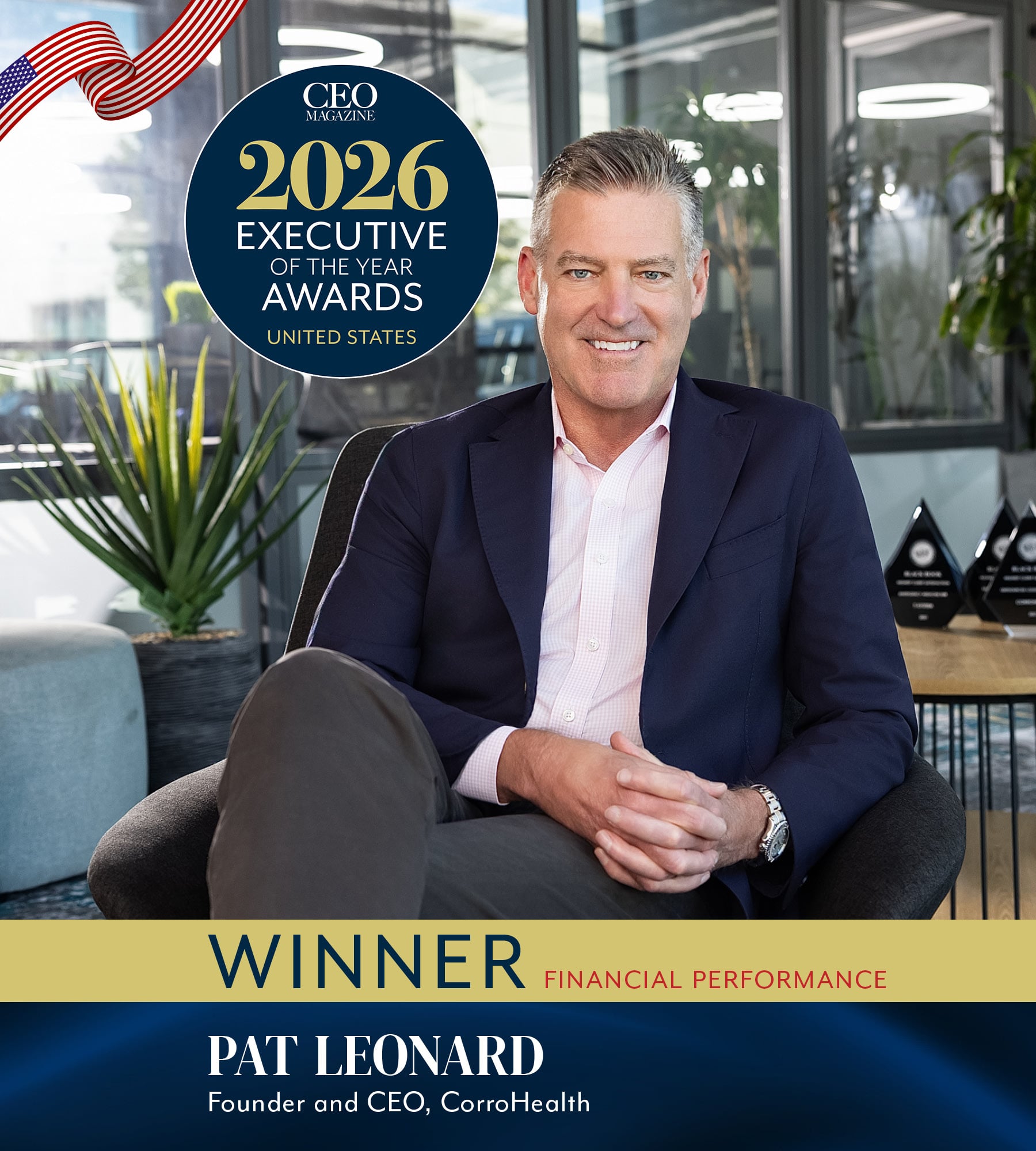
Success in business comes down to more than numbers. But for Founder and CEO of CorroHealth Patrick Leonard, they certainly paint a compelling picture of the company’s prosperity since its inception.
In 2020, CorroHealth had roughly 2,000 employees. Today, that number has skyrocketed to more than 17,000 and revenue is approximately eight times what it was six years ago.
But what the figures don’t capture is the weight of keeping a business grounded in its original values when almost everything about its size and operations have changed.
“The challenge is making the investments that growth requires without losing the entrepreneurial spirit that has helped shape what CorroHealth is today,” Leonard tells The CEO Magazine.
It’s a balancing act that has defined his leadership and seen him win the Financial Performance category at The CEO Magazine’s 2026 Executive of the Year Awards – United States.
CorroHealth operates in an area of healthcare that most patients never see, but one that providers rely on every day – revenue cycle management. Its services cover everything from securing insurance approvals and ensuring medical records are accurate to submitting claims and following up on outstanding payments.
For providers, getting these processes right can make a considerable difference to their financial health. And for patients, it can mean fewer delays and less time waiting for necessary treatment.
“Technology can have an impact across the revenue cycle, from prior authorization and clinical documentation to coding and claims follow-up,” Leonard explains.

“Interoperability is more than moving data between systems.”
“On the front end, automation can help streamline authorization and give clinicians timely feedback when the information in the chart supports the clinical criteria. That can help reduce delays and allow patients to be seen sooner.
“Done well, these solutions can give clinicians more time to focus on patients.”
One of the biggest obstacles to making healthcare more efficient is surprisingly simple, he explains. The industry’s multitude of computer systems don’t always understand one another.
A hospital might use one system to store patient records, while an insurer uses another to assess claims. Getting the right information between them can involve considerable effort, duplication and delays.

“Successful implementation takes experience.”
CorroHealth is working to address this problem through CorroHealth IGNITE technology. At the heart of this solution is Fast Healthcare Interoperability Resources or FHIR – pronounced ‘fire’.
A universal translator for healthcare, it allows different systems to share information securely and in a standardized format. CorroHealth IGNITE uses this approach to connect with major electronic health record systems like Epic and Oracle Health, making it easier for healthcare organizations to access the information they need when they need it.
But Leonard knows that introducing new technology isn’t always straightforward.
“FHIR is an important direction for secure data exchange, but adoption is still developing and can vary across organizations,” he points out.
“Successful implementation takes experience, and healthcare organizations need confidence that integration will not place an unreasonable burden on their IT teams or disrupt day-to-day operations.”
His priority, then, is to make those connections useful in practice, rather than simply introducing another layer of technology.
“As we see it, interoperability is more than moving data between systems,” Leonard says. “It helps providers, vendors and other healthcare partners work from consistent information and coordinate their processes more effectively.”
With AI and automation transforming industries around the world, healthcare is no exception. At CorroHealth, technology is already helping teams review medical records, identify missing information, check coding accuracy and follow up on outstanding insurance claims.
Alongside CorroHealth IGNITE, the company has developed VISION Clinical Validation Technology, PULSE Coding Automation Technology and PRISM Enterprise RCM Technology, bringing automation into different stages of the revenue cycle. Still, Leonard is careful to make any grand promises about what automation might achieve.
“There is a lot we know, but there is a lot we are still learning about automation’s potential,” he admits.
“We have to respond to potential customers and our partners’ interest in automation without overpromising.”
It’s a challenge he considers among the most significant of his time as CEO, alongside navigating the COVID-19 pandemic and the intensity it brought to working arrangements and recruitment.

“We have to respond to potential customers and our partners’ interest in automation without overpromising.”
Leonard also understands that conversations about automation can make employees feel uneasy about their future.
“We must balance stakeholder expectations and address employees’ concerns about what automation could mean for their work and their future,” he says.
“The way through that is to be thoughtful about where we apply automation and transparent about our approach. There’s real opportunity, but realizing it depends on executing carefully.”
While technology is an increasingly important part of CorreHealth’s offering, Leonard doesn’t want the company to be seen as just another software provider.
“We are not trying to be a point solution,” he says. “Our goal is to be a strategic partner across the revenue cycle, meeting healthcare organizations where they are.”
That means taking the time to understand each organization’s circumstances rather than assuming the same approach will work everywhere.
“Just as important, our delivery model emphasizes feedback, education and long-term partnership,” he explains.
The same emphasis on relationships extends to CorroHealth’s own workforce, Leonard says. Managing a global team of thousands presents challenges that are vastly different from those he faced when the company began.
“Part of the challenge is not changing the things people value about our culture just because we are a larger organization,” he says.
“For me, it’s important to stay connected to what is happening and remain accessible to team members, whether they are in the United States or elsewhere.”
It’s also why he’s quick to share the credit for his 2026 Executive of the Year Awards recognition.
“I am honored; however, I see it as a recognition of the team,” Leonard says. “My success is driven by the team we’ve built and what they accomplish.”
In his view, the connection between a strong internal culture and successful client relationships is clear.
“Transparency, commitment and honesty matter – and results matter too,” he says. “You can’t have strong partner relationships without great team members supporting and helping drive outcomes.”
Looking ahead, Leonard expects automation to fundamentally change how healthcare organizations operate. But he doesn’t believe that progress requires removing people from the equation.
“We are investing in both technology and people,” he says. “Automation will transform how work gets done, but we do not believe it will eliminate human contribution.”
Instead, the challenge is preparing employees to work differently, developing new skills and becoming willing to reconsider processes that may have been in place for years.
“Automation won’t work well if you simply try to fit it into existing processes,” Leonard explains. “In many cases, you have to rethink and adapt the process to accommodate it.”

“We are investing in both technology and people.”
That willingness to rethink established practices will be important as CorroHealth continues to expand its technology capabilities and deepen its partnerships with healthcare organizations.
But after six years of extraordinary growth, Leonard isn’t interested in changing the principles that brought the business this far.
“For me, it comes back to basics: stay true to our strategy, stay committed to our culture and do the right thing for our partners,” he says.
“We have to stay flexible as the market changes, but we can’t lose sight of those principles. They do not guarantee continued growth, but they go a long way toward supporting it.”
 RELATED ARTICLES
 SPOTLIGHTS ON LEADERS


 Home

 Podcasts

 Covers
 Be Featured

 Community