Language
You can read the magazine in one of the following languages
5-min read

 Bookmark now

 Copy Link
Ask most of the world’s business leaders to name an Australian wine region and the answers will cluster predictably: the Barossa, the Hunter, perhaps the Yarra Valley.
Almost none will say Queensland and fewer still will know that barely two hours inland from the Gold Coast’s beaches, past the last of the subtropical humidity, the land quietly lifts into something else entirely.
Rolling granite hills rise out of morning mist that clings to the valleys until mid-morning, burning away into hard, clear light and air noticeably cooler and thinner than the coastline behind you.
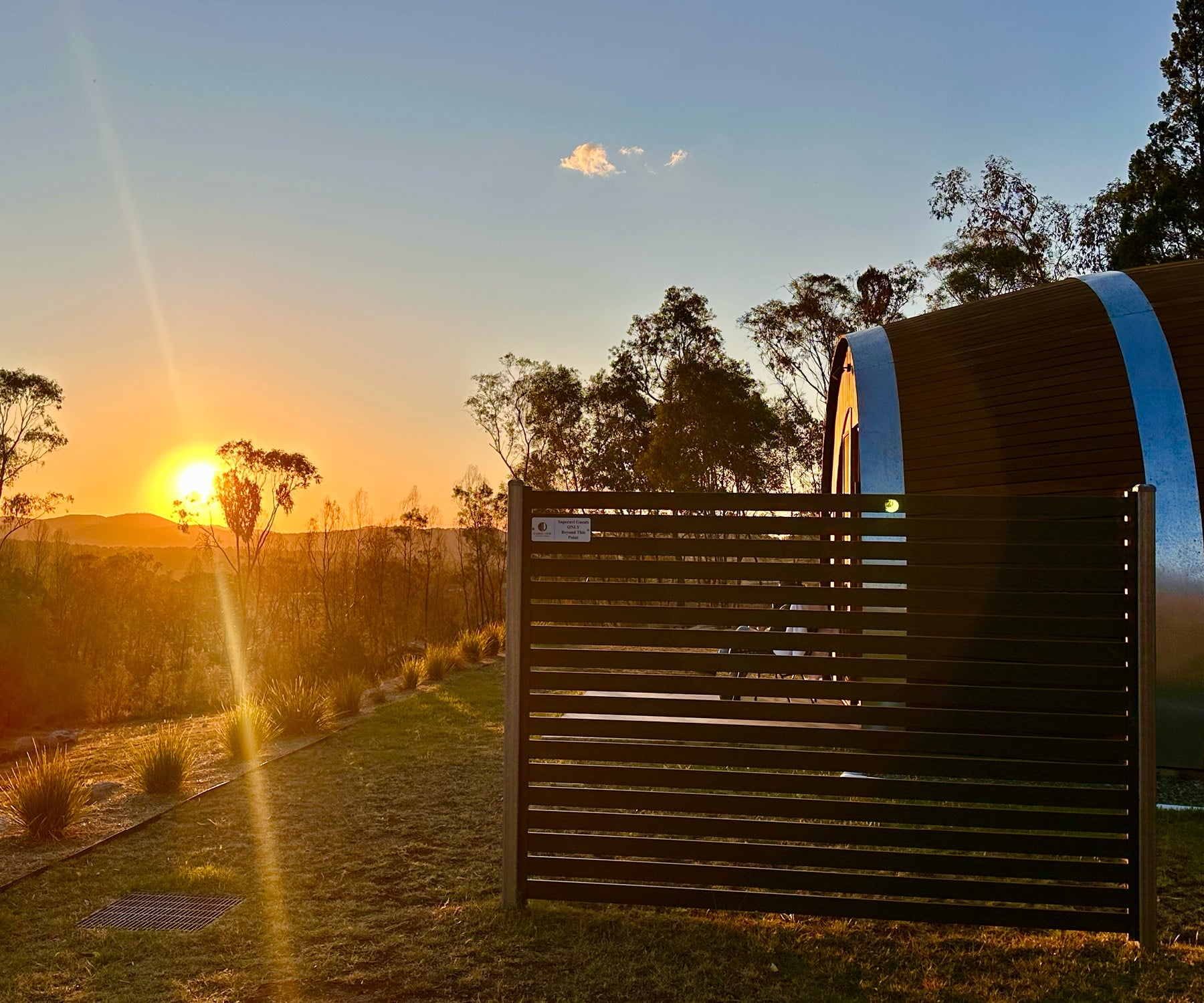
Rolling granite hills rise out of morning mist that clings to the valleys until mid-morning.
The smell changes too, eucalyptus and turned earth rather than salt. Somewhere in that shift, almost without noticing, you’ve crossed into cool-climate wine country, hidden in plain sight, already producing gold and silver medal-winning wine from vines that are remarkably young in years.
This is the Granite Belt, a pocket of southern Queensland climbing to more than 1,000 meters above sea level, where altitude rather than latitude does the climatic work usually reserved for a far more southerly address.
It’s also just received the kind of validation that matters to anyone assessing an emerging asset: Stanthorpe, the region’s principal town, was named Australia’s top tourism town for 2026.
Despite this win, the region remains quietly exclusive, discreet by nature and offering a sense of privacy rarely found in more familiar wine destinations, making it an ideal setting for executive groups seeking both distinction and seclusion – tellingly, just as the region’s most ambitious development opens its doors.
Meteora Vineyard, the largest single winery development the Granite Belt has ever seen, was founded by Andrew Catsoulis and, fittingly, named for the dramatic monastery-topped cliffs of central Greece.
The building announces itself from a distance. A long, low sweep of glass and aged timber rescued from abandoned railway tracks, set against the ranges, designed to disappear into the landscape rather than dominate it.
Inside, floor-to-ceiling windows frame uninterrupted views across rows of young vines toward hills that shift color through the day, gold in the morning, deepening to bronze and violet as the sun drops toward the west-facing terrace in the late afternoon.
Beneath it all sits Queensland’s only wine cave, carved directly through granite bedrock – a project that took four-to-six months of blasting once the rock’s scale became clear, rather than the few weeks originally planned.
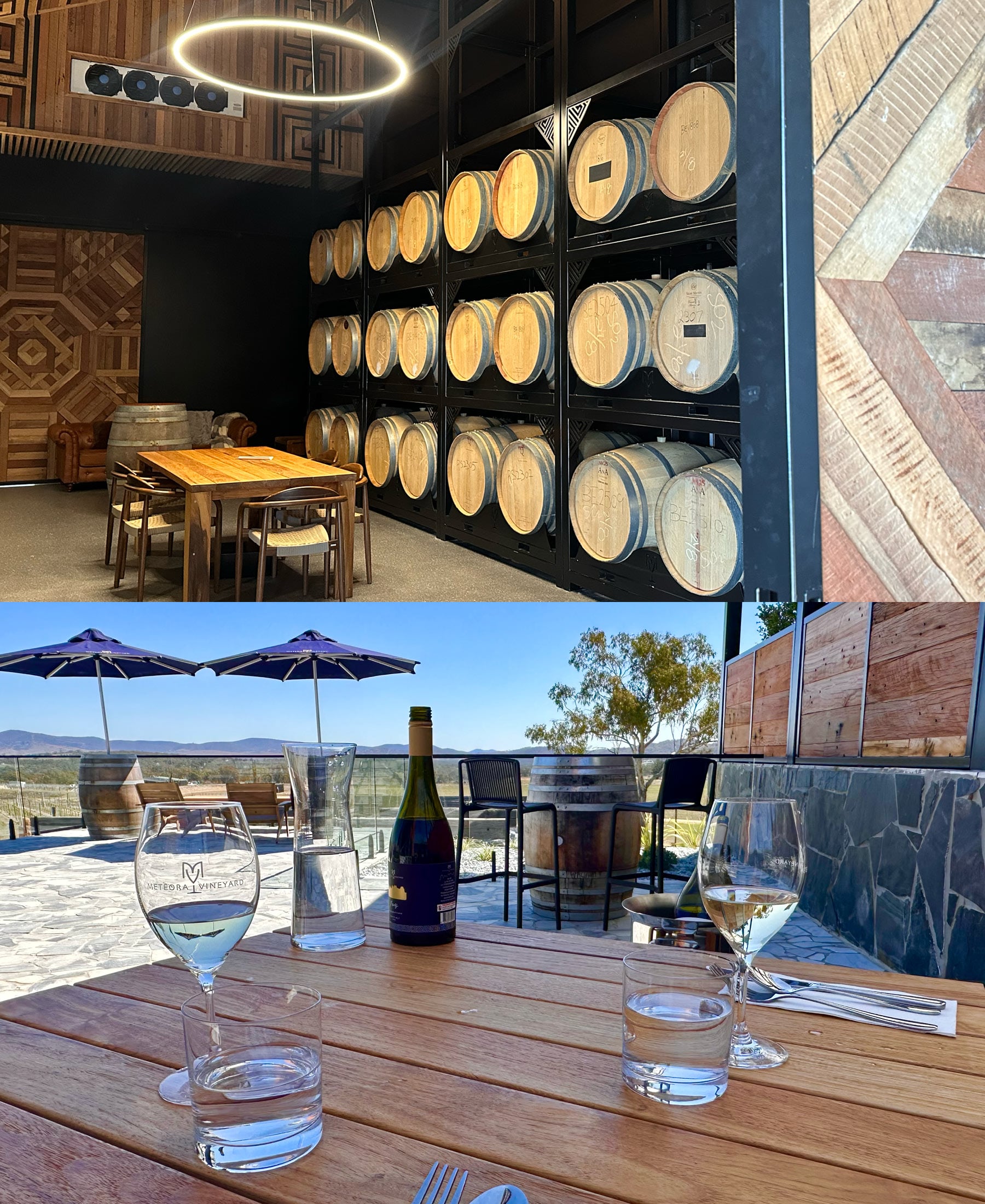
Rows of barrels sit aging in near-total silence.
Descend into it and the temperature drops sharply, the air turning cool and mineral against the skin. The energy of the property above falls away entirely and rows of barrels sit aging in near-total silence, timber and stone the only textures in the room, along with family heirloom furniture.
For executives weighing where to take a small group off the grid without losing a day to travel, the logistics are the real story.
Meteora Vineyard sits roughly a 40-minute helicopter transfer from Archerfield Airport in Brisbane – close enough to fly in, taste through a genuinely distinctive current Mediterranean release, savor a private regional produce lunch and be back at a desk or on a departing flight before evening.
The property itself is built to accommodate exactly this kind of visit – multiple distinct spaces suited to small private functions, team off-sites or client entertaining, alongside the working winery and its own wine cave for something considerably more memorable than a standard boardroom.
For those with more time, the drive from Brisbane takes under three hours, climbing steadily out of the coastal heat into the increasingly cool mountains of the Great Dividing Range to rolling granite-strewn countryside, past roadside orchards and the occasional glimpse of vines catching low afternoon light.
The regional wines justify the attention on their own terms. Meteora Vineyard’s newly released Mediterranean Collection deliberately steps away from Australia’s familiar shiraz–cabernet–chardonnay script in favor of vermentino, montepulciano, tempranillo, aglianico and lagrein – varieties well suited to this particular combination of altitude, light and cool night air. These are largely unfamiliar to international drinkers and, for that reason, genuinely interesting to anyone who collects or invests in wine as much as drinks it.
The vermentino pours pale and bright, with citrus and white blossom on the nose, a clean, zesty line of acidity that cuts straight through richer food. The reds carry real structure without heaviness – dark cherry, firm, grippy tannin and a dry, savory finish that lingers rather than fades.
“My philosophy is refreshment,” Chief Winemaker Andy Williams says. “A glass shouldn’t be a struggle – it should make you want another. Big, heavy alcohol wines aren’t refreshment to me.”
Tasted this young, the wines already show genuine poise; a region moving this quickly is worth watching over the next decade, not just visiting once.
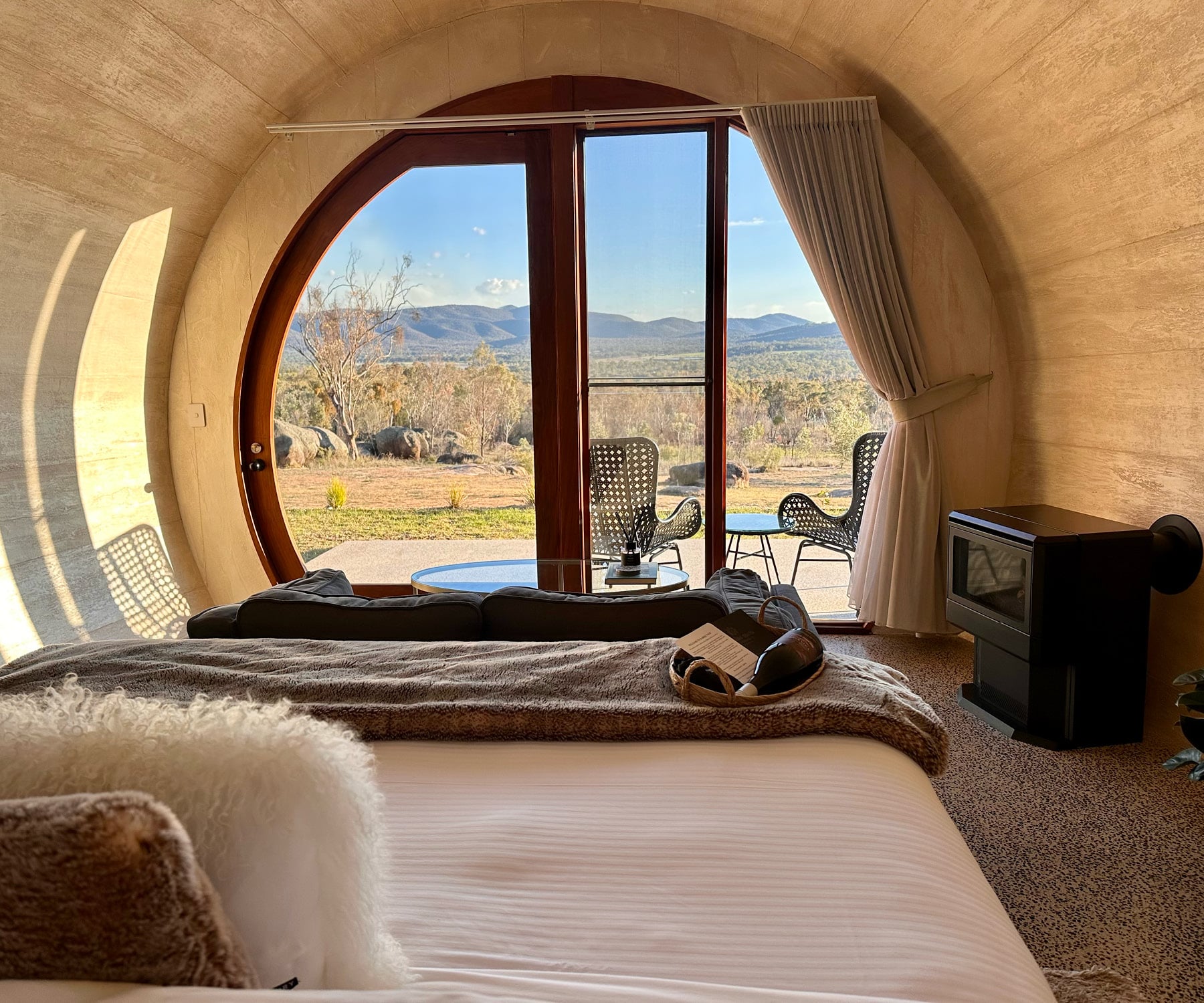
Lie back in bed and let the star-studded sky, dense and close enough to feel almost within reach, soothe your senses.
The food follows the same disciplined, locally sourced approach, led by Head Chef Simon Treller, whose own background spans years on private yachts and some of Australia’s most awarded kitchens.
Producers are drawn almost entirely from within a short drive – a butcher over the back fence, a local grower down the road, truffles shaved tableside once the cooler months set in – and the menu shifts with the season closely enough that no two visits are quite the same.
“We’re creating a destination,” Treller says. “You might not remember every dish, but you’ll remember how it tasted and how you were looked after – and that’s what brings you back.”
The result is understated, ingredient-led cooking, plated without excess ceremony. It reads as considered rather than performative, pairs naturally with wines grown meters from the table and is served by knowledgeable wait staff, rounding off the experience.
A short drive from Meteora Vineyard, Barrel View Luxury Cabins offer Australia’s first wine barrel-inspired accommodation: three unique private, free-standing cabins, each named for a grape variety, set among open granite-country sky.
There is no meaningful light pollution for kilometers in any direction; lie back in bed and let the star-studded sky, dense and close enough to feel almost within reach, soothe your senses.
Morning brings birdsong, kangaroos grazing below rather than traffic and a stillness so rare that guests often take a moment to notice how different the air feels.
The Granite Belt’s advantage is straightforward. A genuine cool-climate wine region, producing internationally competitive wine, less than a three-hour drive from a major Australian capital or an easy day’s return visit by air.
Stanthorpe’s tourism award this year confirms that the wine and the region are moving quickly, with the infrastructure now in place to match it. Meteora Vineyard, which opened in July 2026, is simply the clearest expression of that yet.
 RELATED ARTICLES
 5-min read
6-min read
7-min read
 SPOTLIGHTS ON LEADERS


 Home
Home
 Podcasts
 Covers
 Be Featured
 Community