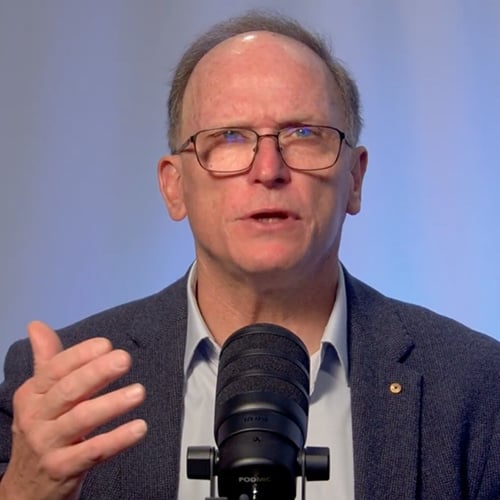
Speaker 1 00:00
People always talk to us. Oh my gosh, you're in Ukraine! How exciting! You're in Haiti, you're in Mogadishu in Somalia. No one ever asks me about the jobs we didn't take. We are bold in what we do, where we go into environments where our staff may be at risk, but we are not risky because there are lots of jobs we didn't take because they looked exciting. We could provide a solution, but when we went to look at the risks to our staff, to our patients, and to our customers, there were risks that we couldn't mitigate, that we couldn't stop, and so we would have been putting our people in danger. You need to get out of the way and let them get on with it, but if something goes wrong, you need to be prepared to stand up and take the hits for it, so that they know that you have their back every single day of that decision. I talk to people and they go, "I'm thinking of starting a company. I like the idea of having a purpose in what we do, but when we get to a million dollars revenue, that's when I'll try to institute it, or when I get to 10 people, that's when I'll try to institute it. I said, I think you institute it from day one, so that when the first staff member turns up, when the first contract gets struck, that's how you do business. But you've got to be consistent. If you just do it for the easy decisions and not the hard ones, people will see it's just fluff.
S
Speaker 2 01:25
What does it take to lead when the decisions you make can affect people's lives? I'm Lara Necessian, and this is CEO behind the scenes. Today, I'm joined by Glenn Keys, AO, founder and executive chair of Aspen Medical, an engineer and former Australian Defense Force officer, Glenn has built a global healthcare company known for taking on some of the industry's toughest challenges, from conflict zones to underserved communities. We're talking leadership under pressure, purpose and profit, and what happens when you build a business willing to tackle the problems others won't. Glen, welcome to the show.
Speaker 1 02:12
S
Thanks very much, Lara. It's a real honor to be
S
Speaker 2 02:14
here. It's such a pleasure and privilege to have you here with us, Glen. And before we get into Aspen Medical. I want to start with the moment that changed the trajectory of your life, because your son Aaron was born with Down syndrome. How did becoming a father change the way that you viewed the world and your place within it.
S
Speaker 1 02:42
Well, just to put that in context, Aaron is actually our second of three children, so he already had an older sister when he was born, but we didn't know that Aaron was going to have Down syndrome until 45 minutes after he was born, and so you know, as a father, you suddenly realize that there is more than just you. You are making decisions for. You've got to take into account your children and your family and where you're going to go. But when Aaron was born with a disability, that just completely took me unawares, and I have a very strong sense of my family history, and I was aware that there were no male descendants out of the Keys family at that time, and that Aaron was the first of those. And so, then to have a child with a disability really made me think about what I wanted for him, what it was going to mean for my my wife and I, and and it did as you said, it absolutely changed the trajectory in my life, and and for the better. And I'm I know I am a better person because of him.
Speaker 2 03:53
S
Thank you for sharing that perspective. I wanted to talk about the fact that you'd already spent 15 years in the Australian Defense Force at that point, what did that experience ultimately make you question about the career and the life that you'd been building?
S
Speaker 1 04:12
So it's a really interesting question. Erin came into our lives with our other children. We're moving. When you're in the military, you get posted around, and that had happened. And then we reached a point in my career where I was going to go off for quite a long training course, a 12-month training course, and then be posted to a really remote location in the Northern Territory on a two-year posting. My wife Mel is a social worker, and she had already been doing a lot with Aaron, using a lot of the assets that existed in community health around his support. And we identified that where we were going was a there was going to be very little of that community support structures, occupation. Therapist, speech therapist, etc. It's going to be very little of that. And secondly, I was going to be away from home about six months of the year on exercise, and so my wife was going to be in this remote location in the Northern Territory without family members around her, not my family or hers, and I'd be away for a lot of it without the support structures that we might have wanted to have, and so the thought was, well, maybe she should move to Melbourne with our two other children, and be surrounded by her family with the support structures, and I would go and do this job. And I just thought that was a terrible answer because, as I said at the time, you know, I married her and not the army, and to me, being together as a family was really, really important. It was something that was important to me, and so that led at that time to me deciding to leave the military. And I should say, I was having a great time in the military. I really enjoyed it. The army was a great place. I'd had terrific education. We'd been posted to England, to Germany. I'd lived in Papua New Guinea. I'd traveled. I'd had a lot of learnings, and I was having a great career. And I thought my career was doing really, really well, and and would continue to do well, but that was not as important as making sure that I would be with my family and support my son Aaron as he got the services he needed. So it ended up not being a difficult decision, which was to leave and then decide on a on a new career path.
Speaker 2 06:39
S
And what did that career path transition look like for you? Because even though you said the decision itself was a relatively easy one to to make because it was based on your own personal values and priorities at that time, but making a career change from being in the Australian Defense Force to then transitioning into healthcare. I imagine that that could be quite an interesting change to make. What what was that experience like for you?
S
Speaker 1 07:11
Well, there was an intermediate step between leaving defense and starting Aspen, which was I was recruited to stand up a startup, and so I got recruited to stand up a company that was doing outsourcing of government engineering and flight testing, and so I moved. Well, we all moved to Canberra, and I set that up from scratch. We built that company to about 80 people across three cities, which was Adelaide, Canberra, and Sydney, and then the owner of the business who'd recruited me decided to sell to a large U.S. multinational defense company. So I'd had four years growing the company, and then I transitioned across and went to work for this large U.S. defense company, which was a good company. But it made me realize that perhaps I wasn't a large multinational sort of guy, and that perhaps I wanted to do something else. And so that consideration is: this what I want to do? Do I want to do something else? That overlaid with an amazing opportunity, which was having a dinner with a close friend in England who said Tony Blair is going to completely revolutionize the health market in the UK, but there's going to be a need for new companies with a new way of thinking to come in and deliver those services, and that was created the opportunity. So I left, and that's when I started Astro Medical, and that was 23 and a half years ago, when we we did that,
S
Speaker 2 08:43
that's such a great story, and it really speaks to how one conversation, one dinner, can have such a significant impact on your career and your life. So, thank you for sharing that. An interesting part of your story as well is that you're not a clinician; you're an engineer, so tell me what qualifies you to own and run a global health company.
Speaker 1 09:09
S
You know, I think that one of the things that I really benefited from, first up from my learnings in defense, and then secondly from starting and running that that business, and then working in a global multinational was that I'd learnt a lot about how to start a business, how to grow it
up, how to manage people, how to resolve really really challenging issues and complex problems, and then delivering on those. And so I'd learnt all of the bits necessary to running a business, and I think there is a real benefit to not being a clinician, because when you're not a clinician, you're not sitting there with a locked-in view of what a doctor would think, or what a nurse would think, or what a surgeon would think. You actually get to look at the problem and define the. Solution, and so I would come at it with a well. Let's define the solution necessary to answer this problem. Design that solution, and whether that was doctors, nurses, paramedics, equipment, whatever it was you needed to design the solution. That's what myself and the others would do to grow that capability. So not being a clinician meant that I think you could come at the problem with with a very unbiased view of what an answer might be. And so, one other thing that you learn in the military is you are not experts in everything you want to do. So, you need to pull in the right people and ask them, listen to what they tell you, and then incorporate that into your answer. And I think that's been really critical in Aspen Medical's growth as well.
S
Speaker 2 10:48
Absolutely. In speaking about challenging issues and and complex situations, Aspen Medical has built its reputation around tackling those more difficult healthcare challenges. Why deliberately build a company and go where the the problems are hard?
S
Speaker 1 11:11
We love solving problems. We love taking a really really wicked problem and designing an answer for it. And part of it might be, well, it's yes, you're setting up a a hospital with ward care and pathology and radiology and and a clinic and dental and pharmacy, which lots of people might be able to do, but maybe you want it done in a really remote, challenging location. Maybe you want it done in a very very very short time frame. Maybe you want it done where the logistics are very very challenging. Well, that's brilliant to be able to deliver that care for people who can't get it, may not get it at all, without us being able to design a solution. That is wonderful work, and part of what we do, I think, echoes back to why I enjoyed being in the military, which is it's about service to others. So when you are in the military, they talk about you are in the service, the armed services. Well, I think healthcare is another service. It's a way of delivering a service to others. Yes, we're a business and we get paid to do it, but we're delivering care in remote Indigenous communities in Haiti, in Mogadishu, in Somalia, in the Ukraine, in the Pacific, in Southeast Asia. These are areas where, if we weren't there, either there'd be no service or people may well be dying. That is an exciting thing to do, and certainly something that enriches your soul.
S
Speaker 2 12:42
It reminds me of one of my favorite quotes, Jim Rohn, that said something along the lines of, "When you have a powerful and compelling way, the how becomes easier. And so it almost feels like the the mission and purpose behind what you're doing makes it so that when you are met with those inevitable challenges, you're able to lean into them more, as opposed to lean out.
Speaker 1 13:07
S
Great, great quote, and and I absolutely agree with you. I think having that purpose behind what you do gives you a clarity, gives you a north star around delivering, because then you do sit down and you go. All right, how do we get to success? What have we got to do here to get across the line to get there? And I see that every single day in Aspen Medical's operations with all of our team. You don't have to demand it of it; they demand it of themselves. They're out there thinking of innovative ways to deliver solutions in in ways that I have never thought of, but all of them are around keeping that sense and clarity of purpose around what they're trying to do to help others.
S
Speaker 2 13:52
And on that note, I'm curious your perspective on what it's really taken to build an organization where people are genuinely capable of operating in complex, high-pressure environments. What has been your experience in being able to lead an organization where the people are able to really to step up to the plate?
S
Speaker 1 14:16
So I think you've got to do three things. First up, you've got to get the right people. So picking the right people is is really really critical, and you need to spend the time to get to know them, to check that they're ready to step into that environment. So that's really critical. The next is giving them really clear responsibility of what they have to do, so they understand our job is to set this facility up, get it operational, work within the budget. They know what their responsibility is, and they take personal responsibility. And the third bit is you need to get out of the way and let them get on with it. But if something goes wrong, you need to be prepared to stand up. And take the hits for it, so that they know that you have their back every single day of that decision.
Speaker 2 15:07
S
How did that leadership capability evolve to be able to lead in the way that you do?
S
Speaker 1 15:15
So I think there's hopefully we all learn all of our lives, and I think the first bit of it I learnt from my parents. My parents owned their own shops. They had a couple of shops in Newcastle. We lived above one of the shops. It was a gift woolen toy shop. But mum and dad worked in the shop together. Now I didn't realize it till years later. But what I saw was they were they were gender blind in around people getting the jobs done. They just picked the right people to do the right job, and they did it even within themselves. You know, my mum was great at picking what they should sell. She ordered all of the stuff. She ran all of the books. My dad could sell. He could do stuff. And of an evening, he would go down and be working in the shops on the knitting machine, doing cuffs and collars and buttonholes and getting all that done, while mum was sitting upstairs doing the books. But they then I saw when they pick staff and they helped grow staff from be there just as a shop assistant up to the managers to managing other shops for us. They trusted people, but they grew them and supported them in everything they did. So I also saw them support them in their lives. You know, we went to weddings of of our staff. We knew their families, we knew their kids, and so understanding them in their lives and supporting them with their ups and downs was really critical. So that was the first bit. The next bit was what I learnt in the military, which was you don't know everything. You need to get people in. You need to listen to them. But once you've got all of that and you make a decision, then you need to take responsibility because you've made that call. So you get to sit in the big chair, you take all of the kudos and the credit when it comes, but if there's a problem, you need to take that and you need to take it on the chin, and you don't go out and blame your staff because you made that call, and you use that to learn to be better the next time round, and I think what I learned from my parents and what I learnt in the military were really, really critical. And I, you know, I'm still learning every day around what we should do. You know, this morning we had a team in around a particularly difficult situation we've got overseas, and talking to all of the team. And I had a clear view what I wanted to do. And by the end of the discussion, we didn't go down my path. We went down the path that was recommended by the team because that was exactly the right thing to do when they spoke it through with me, and they felt they had position permission to explain their permission and reasoning.
Speaker 2 17:55
S
I really love your perspective on that, and I'm curious because a lot of leaders who are listening to this show are in CEO positions where they do hold the ultimate responsibility, but there's a discernment between being able to make decisions because you believe it's the right thing versus allowing yourself to be open to other people's feedback, perspectives, expertise in the way that you've described, where you you're in a position where you've allowed yourself to change your mind. For leaders that feel like maybe they need to have it all together all of the time, they need to be right all the time. Perhaps the ego gets in the way of them being able to change their mind about a particular decision, because they don't want to look like they've changed their mind about something. What what advice would you share to them? Because you've just confidently articulated changing your mind about something. For leaders that are in a position where they struggle to do that, what would you what would you say to them?
S
Speaker 1 19:00
I love quotes, right? And I think that a quote for the wrong way to behave was Margaret Thatcher when she issued the quote that you know this lady's not for turning, right? About changing her opinion, and I think you get new information, the scenario changes, the situation changes. Then why wouldn't you want to incorporate that data into your decision? Another quote I remember Paul Keating had said when he was prime minister one year that if Australia didn't get 4% growth the next year, he should resign. Right? The next year Australia got 1% growth, and the reason we only got 1% growth was because the Asian tigers had had a massive collapse. There'd been a recession across most of Southeast Asia. They were all in negative growth, and Australia had got 1% And one of the reporters said, "You said this last year. Do you think you should resign? And he said, "Well, when I said that, all the Asian." Economies were going gangbusters. We were riding on the back of that, and we should have continued to grow. But their economies have now had a recession. They're in negative growth, and we still have 1% growth. So that's a great answer based on where we are today. And he said, just remember, there's forever, forever, and there's forever for now. Forever, forever, as the sun will come up. Forever, for now, is we'll have 4% growth unless we can't. And so, to not incorporate new information, to not incorporate a change situation, would just be wrong, right? It'd be like saying, in 2019, we're going to double the number of stores we have. If you're a retail outlet, we're going to hire 1000 people, and COVID hits. Someone says, "Well, obviously you'll have to change that. You go, "No, I've said we're opening 1000 stores and hiring 1000 people, and you go, "Well, that makes no sense. So, to me, if you don't take on new data, if you are not prepared to change your mind, you are not doing the right thing by your shareholders, by your staff, and by your customers.
Speaker 2 21:05
S
I want to ask you around leadership when lives are literally on the line. How does that change the way that you lead and make decisions?
S
Speaker 1 21:17
It's absolutely critical because if those people are prepared to travel to a dangerous environment like we've had Afghanistan, Iraq, Sierra Leone, Liberia, DRC, Mogadishu, Haiti, these are areas where people's lives are on the line. Then you need to make sure that your decisions are going to be the best by the people we're caring for on the site, as well as our own staff. And so you have to look at what the risks are, and can you mitigate the risks? If you can't mitigate the risks to ensure that your staff will be safe, then you shouldn't do it. And so people always talk to us. Oh my gosh, you're in Ukraine! How exciting! You're in Haiti, you're in Mogadishu in Somalia. No one ever asks me about the jobs we didn't take. No one ever says, "Oh my God, you're not in this environment or that. Why is that? Because there are lots of jobs we didn't take because they looked exciting. We could provide a solution, but when we went to look at the risks to our staff, to our patients, and to our customers, there were risks that we couldn't mitigate, that we couldn't stop, and so we would have been putting our people in danger. We are bold in what we do, where we go into environments where our staff may be at risk, but we are not risky, and I think risk is something that a lot of Australian businesses judge poorly. So I think a lot of businesses either look at risk and go, "Oh my God, there's some risk over there. We shouldn't do it, and they miss opportunities, they miss chances to grow their business or support a new customer. They haven't looked at how to mitigate the risks? Then there is the customer, the supplier who's worse, who goes risk. I laugh in the face of risk. We walked through a minefield once and didn't explode. I should do it again, right? That is terrible, right? Because they are putting their staff, their shareholders, their customer, and their patients at risk. So risk is something you need to look at, you need to be honest about, you need to evaluate it, you need to develop mitigators. But if you cannot get to a position where you can accept that risk, then you should not be doing that job.
S
Speaker 2 23:33
Sometimes saying no is equally, if not more, important than saying yes.
S
Speaker 1 23:38
Absolutely,
Speaker 2 23:39
S
Aspen Medical has been working in Ukraine. What is it that you're doing there, and what does delivering healthcare in an active conflict environment demand from an organization?
Speaker 1 23:54
S
So we're doing a range of tasks, and we continue to grow. We've been there since the start of the war, and we do a number of jobs. The first up is that we have people located across Ukraine in all of the trauma hospitals, gathering data from the combat trauma surgeons who are operating every day. So what would happen normally is someone's in a hospital on one side of the country develops a new technique that helps save one somebody, or you know, bring treatment quicker. You've got someone on the far side of the the country who might have a similar problem, but hasn't thought of that solution. And it might take weeks, months, or even longer for this doctor on this side of the country to learn about what this doctor over here did. And so, what we do is we're gathering those lessons every day, and then every other month, we bring a selection of the trauma surgeons together, and we run training on all of the lessons that have been learnt across the country, all of the tricks, all of the things they're doing that are helping saving lives, treating people better, using novel and innovative ways. To treat people, and so now we are supercharging those learnings across the country, and it's exactly the same as what Ukraine is doing around the use of drones and intelligence and information. They are supercharging how they are adapting to war in the current environment. We are helping them supercharge how they're adapting their learnings, but in healthcare, we are helping them bring more advanced, faster, and more efficient and effective clinical treatment to people who are injured across the country. So that's the first thing we're doing. The second thing we're doing is we're involved with a prosthetics program, there's been at least 50,000 amputations in Ukraine since the start of the war, and so there's a lot of prosthetics needed, typically arms or legs needed, to be able to support people in that environment. So we trained over 400 prosthetic technicians that are located in every single hospital across the Ukraine. We then worked with the Alcoa Foundation and the Aspen Medical Foundation to roll out treatment of prostheses, so a rapid prosthesis that could be used quickly and adaptably to support people who've lost a limb, so that's been really successful. We've worked very closely with a charity called Unbroken. It's the largest rehabilitation charity to bring that to people, and we've had videos sent over to us of amputees who are walking now on the prostheses that we help develop for them at short notice, which is just incredibly powerful, and then we're now working on a PTSD research program. It is the most up-to-date PTSD research in the world. They reckon there's going to be four to 5 million PTSD sufferers in Ukraine after the war, and so we're working on an innovative and novel model of PTSD treatment and pain management. We're working on that with research institutions and universities out of the U.S. We're delivering that. We've already treated over 120 people. The rate of success is very, very high. We're really excited. So we've still got about 1819, months to go in that program, but that data is going to be critical to help treat PTSD sufferers globally. So in America, 17 veterans take their life every day, and so if out of this PTSD research we can help just one of those every day. That in itself would be a blessing. So we're involved in that area as well, and we're also involved in doing testing out innovative and new techniques and equipment that can be used in the battlefield. So one of them is a tourniquet. So you will have seen lots of drones in the air, so you can't use helicopters. You will have seen there's been no helicopters in footage in Ukraine, really since the first six months of the war. So subsequently, to move people, you are now moving people on trains. So you're getting people who've been injured, shrapnel, gunshot injuries, spending three days on a train, and there's three, 400 people on a train, and there might only be 510, 20 clinicians on the train to support them during that journey. So they might have got a severe wound on their arm or their leg.
S
Speaker 1 28:33
They'll have a tourniquet on, but if you're in pain and you're not managing it, you might end up three days later at the hospital, and they say, well, look, you haven't bled to death, but you've got gangrene, and we're going to have to remove your leg because the tourniquet stayed on too long. This is a device that you clip onto the tourniquet. It measures your blood pressure and it gives you advice of when to remove the tourniquet, so that it allows the wound to scab over and stop bleeding, but then open up over time to allow blood to flow back to the rest of the limb, so that you don't lose the limb. Out of that 50,000 amputations, they reckon somewhere between five or 10,000 of those were preventable. This will dramatically help in dealing with that, so that's the sort of thing we're doing. We're also help carrying Australian technology to the battlefield. So things like Wear Optimo, which was developed at ANU in Canberra, hydration, temperature, and heart rate monitoring device. That's going into a trial. Roam Technologies, which is a portable oxygen generator and how that can be used in the battlefield as well. So that opportunity to supercharge innovation and and get it saving lives. You know we're doing we're working across all of those areas, and and it is just incredibly exciting to know that there are people. Alive in Ukraine because of the work we've done.
Speaker 2 30:03
S
That's so incredibly powerful. I want to talk about the fact that closer to home, you're also working with First Nations communities across Australia. What have those communities taught you about what effective healthcare really requires?
S
Speaker 1 30:21
I've learned an enormous amount after being involved in Indigenous communities. I've learnt that very often a lot of good people want to come to those communities and help without listening. They think they know what needs to be done, but the communities know. I mean, they know what their husbands, wives, children, grandparents need. So the first thing I've learned is you've got to listen, and you have to listen over time. Just asking one question isn't enough. You need to listen to them, understand what's important, and work out how to deliver that for them because that's really, really critical. Next, you need to design that solution with them. So, just saying, oh well, you need ear care because kids have got glue ears, so they're not working at school. Well, you need to work out how are you going to access those kids. How are you going to do it in a way that the parents are going to trust you to bring? Which leads to the third bit is you have to create trust. So there's a lot of reasons that Indigenous communities don't trust a lot of things that are said to them by charities, community, and government. And so being able to listen first, design solutions with them, and then grow that trust is really, really critical, and the final bit is you need to stay. You just can't come in and say I'm going to do this for three months and we'll fix it and go. You need to be prepared to be there for a long period of time because you've got to create trust. You've got to deal with the root cause of issues, and then you've got to keep going back to them and listening. Are things working? Do we need to change? But when you do that, when you do all of those things, the impact is so powerful and the benefit is enormous. We are so lucky in this country. We have access to so much healthcare, so much good government, and yet you get out of rural, remote, and particularly rural, remote, challenging Indigenous communities, and they don't have access to all the things we have, and they don't have it consistently. So for us, being there, listening, designing a solution, and being there for the long haul-that's what's really important.
Speaker 2 32:40
S
And something that's really come through as you've been sharing some of these insights around the work that you're doing is discernment. Discernment around risk was one piece of it, but then also discernment around what kinds of projects and initiatives you decide to work with versus what you don't do because it feels like if you're doing something for the long haul, there's a lot of strategy. There's a lot of intentionality behind what it is that you're doing. So, how do you actually approach those kinds of decisions from from your position?
S
Speaker 1 33:18
Well, there's a few elements to that. One is the fact that I we all look at it, so we draw on all of that. It's usually not just me; it's the team looking at it. We look at it from a clinical point of view, an operations, a logistics, financial point of view. We look at it from all of those to make sure: can we do this? Can we do it in a sustainable, long-term way? Can we do it in a way that will be impactful? So for me, legacy is really critical, right? If we just come in and we do a flash in the pan and go, "This is great. It looked good in a photo, and I've got a great little story, and we're going to leave, that is unhelpful. Matter of fact, it might even be worse than not going in, because you create hope and you create change, and then you walk away and you leave them high and dry. So legacy is really critical. In actual fact, what we love is when we can do ourselves out of a job. So when we can work with them and create a sustainable, long-term legacy-based solution that no longer needs us, even though it might take longer, that's something we would prefer because we've just left that community, that area, that country in a better place than when we arrived, so that ability to look at it from all of those aspects is really, really critical. I think, though, the overarching thing that we always have is around purpose. Does what we're doing align with purpose, with how we think business should be, and if it doesn't, then we're probably not going to do it.
S
Speaker 2 34:45
I would love to talk to you more about purpose and specifically the intersection of purpose and performance, because you believe that purpose and commercial performance can align. What does that look? Like when you're actually running a business and making some of those more difficult commercial decisions,
Speaker 1 35:07
S
it does mean making hard decisions and then standing by them and living them. So we've walked away from business that did not align with our purpose. We've been asked to do some business that we went that I I can't I can't do that, and we've made it and moved on. Now commercially, financially, it might have been very profitable, might have been great to do, but I think it would have eaten our soul. And so for us, it wasn't a hard decision to make. Even though you go, oh, I would have loved to see that in the revenue numbers. You knew that it just wasn't the right thing to do, but I know when it's working at a company level, because in actual fact, I don't need to be the one saying it. My team is saying it, and so we've had several opportunities where I've had the staff, not just at a CEO level or even a C suites level, but below that, saying I don't think we should do this because I don't see how this aligns with our value set at all. And you go, well, that's brilliant because I'm not the one carrying the standard, I'm not the one beating the drum. Everybody is, and I think that's a key reason that we've got such straight great staff retention, so we have 50% of the staff turnover of the health industry in Australia, and two thirds that of all businesses in Australia. And I think a key part of that is the fact that we have that social purpose at our core, and we have a very very clear idea where our north star is, and when we talk to people about why they stay, within the top two reasons, always is that commitment to purpose.
S
Speaker 2 36:52
It's interesting because as I'm hearing you share your experience around building a purpose-led organization, something that comes to mind is the fact that purpose has become such a ubiquitous corporate term. People talk about purpose, talk about values, they they stick them up on the wall, but it doesn't necessarily translate to the embodiment and and living by those kinds of values. How do you stop it from becoming something that just exists in a strategy document versus something that is genuinely lived by and helps shape those decisions?
S
Speaker 1 37:32
I think it happens with what you do every day at every level. So, for example, today is International White Cane Day, so it's around being aware of people who are visually impaired, what it means, how you can help. We had a a talk on it for an hour today across all of our offices by our disability engagement officer Ben Clare, who is in visually impaired. I didn't set that up. Our executives didn't set it up. It came from one of our team in Brisbane, who saw it was going to be International White Cane Day, who reached out to Ben and said, "Would you be willing to talk? Reached out to the Culture and Performance team and set the briefing up for everybody. So the fact that someone five levels down from me thinks this is something we should do as a company and sets that up is terrific. And this weekend, the Bravery Trust have got their dusk till dawn fundraiser running around and around the war memorial, raising money in support of veterans, and we have a team running that. I didn't set that up. My CEO is one of the people doing it. My chief medical officer is in there as well, and our ops manager for our rural placement program is in there. They are running that in their own terms, starting at seven at night and finishing at seven in the morning, because they can see that's a value to do, and like the to me, the final one is that example I gave before, when somebody sitting in one of the team says, "I don't think we should do that work because I don't see how that aligns. To me, that I see purpose is now ingrained in the DNA of every decision we make. That to me shows it's not a strategy document. It's not hidden on a shelf. It is incorporated into how people think about how they work, how they live, and how we deliver our services every single day.
Speaker 2 39:34
S
And how did you influence that to to begin with? Because I imagine there's a lot of leaders listening to this, that want to create more of a purpose-led, value-led business, but they don't know how to actually transcend the the values on the document into the actual lived experience of them. Where would. Advise that they start.
S
Speaker 1 40:01
Start day one. You know, I I talk to people and they go, I'm thinking of starting a company. I like the idea of having a purpose in what we do. But when we get to a million dollars revenue, that's when I'll try to institute it. Or when I get to 10 people, that's when I'll try to institute it. I said, I think you institute it from day one, so that when the first staff member turns up, when the first contract gets struck, that's how you do business, and so everybody knows from day one that's where it is. And then you talk about it, you make it visible, and you talk about how that purpose drives your decision making when you grow the company, when you talk to customers when you talk to suppliers, and so as you do that, people will know and hear it. But you've got to be consistent. You can't say, "Oh, I'm going to have purpose around these decisions, but not these ones. You've got to use your purpose-led decision making in all that you do, both the good, easy decisions and the hard ones, even the hard ones that might impact on you commercially, you've got to have it there. Once you start to do that, people will see you're living by it. If you just do it for the easy decisions and not the hard ones, people will see it's just fluff.
S
Speaker 2 41:18
It's something you've got to do consistently, not occasionally.
S
Speaker 1 41:22
It's got to be every single day.
Speaker 2 41:24
S
Aspen Medical, even though you are very purpose driven, you're also very focused on on outcomes. How does being outcome led change the way you think about growth and success?
S
Speaker 1 41:36
We think that being outcome led, and that's around problems is actually the way to go for the future. Just selling, you know, I'm going to provide five bodies here, you know, five nurses or five docs or whatever. That's a race to the bottom. There's no smarts in that. There's no innovation in that. There's no solution in that. What we love is when we get a problem from a customer who goes, "I've got this problem and I don't know how to deal with it. That allows us, that gives us permission to design a solution that'll be innovative, that might bring in different ways of thinking, might use technology in different ways, and to me, that drives growth because people go, well, that's amazing. If you can do that solution, can you do this over here? Now, part of that outcome-based solution might be saying, "Look, you want me to provide you 20 staff, but that's actually quite expensive, and it's not the smartest way to do business. I think I can do it with 10 staff and some technology. It's cheaper for you in the long run, and it's a better answer. Now, some businesses might go, "Well, that's dumb. You've just gone and reduced your revenue. But you will grow the business because of that, because they will see that you are willing to do the right by them, by the customer, by giving them a better solution, and you will end up growing the business with them. They will be a referee for you. They will reference you to other people, and we have found that time and time again over the last 23 years. When you truly have the customer's best interests at heart, and you are willing to give them a solution that is cheaper, easier, less complex than they thought, they will acknowledge it, and they will support you the next time round, and that's what will grow your business in the long term.
Speaker 2 43:26
S
And you've described health as an increasingly an economic resilience and workplace productivity issue. Why should that matter to every executive, not just applicable to leaders working in healthcare.
S
Speaker 1 43:42
I actually think this was evident to us out of COVID. Right, I think everyone pre-COVID had seen health sitting over on the left, and over here I'm driving. You know, my bottom line, and I'm driving three PL and logistics and efficiencies and IT and all that stuff. And health was something you thought of differently. COVID showed us that health connects with every single thing that we do in our business. If you don't have people who are fit and healthy, they're not in your workplace. If you are not helping them with their mental health, they are operating subpar. If you are not understanding what their life is like outside of the work environment, they're not giving the best to you in their work environment, and then we forgot it. Like it's just gobsmacking. We did for two or three years, and then we went, "Oh, that's over. That'll not be relevant anymore. And yet now productivity is important. Like if it's not housing, we're talking about productivity. Our productivity growth has been ramped down to 0.7% by the RBA going forward. It's incredibly low. We've had no growth in productivity in years in Australia. We need to look towards what's going to improve it, and I genuinely believe health is a critical part of driving it. So let's not wait till people are sick and then say, "Oh." Maybe now we should do something. Let's work with your staff to say how do I make sure you are fit and well and happy and healthy physically and mentally to do your job and be even more productive than you are today, because that's going to be great for you in the workplace and it's going to be great for them when they go home with their families. So health drives productivity, it drives efficiency, and it reduces your costs. And we saw it in COVID, and we can do better with it even today.
Speaker 2 45:30
S
Absolutely, AI is something that I wanted to speak to about because it's being positioned as one of the biggest shifts healthcare has seen. Where do you think its genuine potential lies beyond the hype?
S
Speaker 1 45:47
So I think it probably falls into a number of areas. The first of these is with patients, right? So they can gather more data to understand stuff. So they can go away and learn stuff and understand what might be driving a condition or whatever else, but it shouldn't be the be all and end all. The next bit is around the clinician. It's going to help them be more efficient. It's going to help them to draw in more information to make decisions on. So it's going to allow them to be more productive, more capable, more efficient. But then the final piece we have to do is we have to make sure it's right. So we've got to make sure that there is a human sitting in the loop validating that data, and not only validating the data but validating what we do with that data. There are so many stories about AI hallucinating. We know it's a problem, and to be honest, it's only going to get worse because there are already stories about how people are now creating data sets to manipulate what AI will put out. So you need a human in the loop that is validating that data, is going to look at it. We need to know: is it 100% they need to check? Is it 20% Is it 50% What elements of it are they checking? But if we use AI correctly in health, it's going to make our clinicians even more efficient. It's going to allow people to use the outcomes from the clinician even more efficiently and effectively to be healthier for longer and earlier. And it's going to give us a much richer, valuable data set, but it is not a set and forget, and we'll just use AI on its own. We have to validate it and draw that into the discussion.
S
Speaker 2 47:32
And I could imagine that that people piece is particularly important in healthcare, where it could affect someone's health or potentially even their life, so that responsible government's piece is critical.
S
Speaker 1 47:47
Oh, look, the responsible governance is really, really critical, and I think there are a number of areas that are starting to concern people that you can contact a website and get a script cut for you and sent without anybody talking about well, what are your background medical conditions, and so governance around the use of AI is really, really important at all of those levels, and the corporate governance of AI and its impact into healthcare will be even more important as we go forward, particularly when we're doing care delivery at scale,
Speaker 2 48:21
S
and looking beyond AI, what changes in healthcare should business leaders be paying closer attention to over the next, say, five years?
S
Speaker 1 48:32
I think there's going to be a couple of areas that are going to be really critical. One is, as what I mentioned before, which is around preventative care. I think we need to acknowledge that it is actually not efficient for business. It's not efficient for our staff to wait for someone to get ill or
to to break. So if we can invest in people in preventative care, that's actually going to be better overall for our businesses. It's going to be better for society. But to say I've got to invest in preventative care, going well, they're not sick. Why am I doing anything? So we need to get business leaders to understand that preventative care is good for them, and it will actually reduce their costs and improve their productivity over time. So that's a really, really important aspect that we need to build towards the next bit is how do we better integrate technology, not just AI, but all technology into the care delivery that we're seeing. So, for example, minimally invasive surgery. The work we're doing in Indonesia, we're looking at bringing the latest globally in minimally invasive surgery there. One of the areas we're looking at is orthopedics. So there's an amazing doctor in Sydney who is doing same day hip replacements. So preparing people for the surgery to do all their prehab, that surgery, then getting them back out to be fit and healthy and recovering quickly. That's really really important. So realizing that maybe we're going to need more work before surgery, different types of rehab, but less hospital beds, right? So that rather than people say, "Well, you've had a hip replacement. We'll see you in a month, maybe we say, "Take a bit of time off leading up to getting in for your hip replacement, and then you'll be back at work in a week because we worked with you around your complete treatment plan. So understanding that how someone's treatment goes on outside the workplace actually has an enormous impact inside the workplace. That's going to be a seminal shift for business leaders to think of, and yet it's going to be really efficient to drive productivity and efficiency, and reduce their costs of delivering services.
Speaker 2 50:47
S
I read that Aspen Medical has a 200 bed hospital due to open in West Java in 2027. What does that project tell us about where you see the next big opportunities and needs in healthcare.
S
Speaker 1 51:04
So this is very exciting. It's in Depok, which is just below Jakarta. It's a city of two to 3 million people. A lot of people who live there move in and out of Jakarta every day for business. Jakarta is a city of 30 million people. So to put that in context, it's more than the population of the whole of Australia. It's designed using some really really innovative design techniques, and we're going to have key specialties that are going to be critical to growth. So minimally invasive surgery, rehabilitation for things like stroke and major trauma, gastro surgery for a whole range of areas. So these are really key areas that are coming into what we are seeing as care for the future. But but that's only one hospital. This is the first of 23 hospitals that we are building across Indonesia, and a growth pattern we have into Southeast Asia. Southeast Asia, the ASEAN countries have a huge rate of growth, several times that of Australia, and it is a huge engine of growth with a growing middle class who are looking with their disposable income to improve their health and standards. We see an enormous opportunity into that area, in the same as in the Pacific, where we're in Fiji, PNG, and elsewhere, to really grow. So for us, developed world care in the developing world is a really key growth area for us over the next 10 to 20 years.
S
Speaker 2 52:34
Glen, we have a closing tradition here at CEO Behind the Scenes. We like to wrap up all of our interviews with the same two questions. So the first question I wanted to ask you is: What is one thing that you've changed your mind about recently, and why?
S
Speaker 1 52:52
It's probably around the rate of technology change. I've known that technology always impacts on us and will do things, but I think the rate of change for technology to impact on business and how we deliver is accelerating, and I don't just mean AI. I mean all of the things we're seeing, and we see it with drones in in Ukraine, we see it in manufacturing techniques in China, we see it in robotics. So I think how technology impacts into us being more efficient, better at our jobs, more productive. I think that is going far faster than I had thought it would, and I think the challenge for me and other business leaders is staying up to pace with how quick that technology can positively impact into our businesses.
Speaker 2 53:42
S
And part two of the question is: What's one thing that you've not changed your mind about? A belief that you'd want to share to help others lead or live better?
S
Speaker 1 53:52
I'm going to sound like a broken record here. This is around having a purpose at the center of your business. I think not only have I not changed my opinion, it's only been affirmed and reaffirmed that having a strong social purpose at the core of your business, living it every day, and and engaging your team to live it every day is fundamental to a sustainable, long-term business with sustainable growth, and that's something I can't imagine I will ever change my opinion on.
S
Speaker 2 54:26
Glenn, it has been such a pleasure to have this conversation with you. And what really stands out is your take on leadership. What really happens when the stakes are human, but that purpose piece being front of mind is really quite powerful. So, thank you so much for joining us for this conversation. It's been a real pleasure,
S
Speaker 1 54:48
Lara. I've really enjoyed it, and thank you very, very much.
Speaker 2 54:51
S
Thank you. And if you enjoyed this episode, please be sure to subscribe, rate, and review the show, and share it with someone. In your network, who you know would really benefit from hearing Glenn's insights that he so generously shared with us today. Thank you so much for being here, and we'll see you next time on CEO: Behind the Scenes.



 68
 1


 Host
 POPULAR TOPICS
 FEATURED PODCASTS


 Home

 Podcasts

 Covers

 Community

 Sign In