Language
You can read the magazine in one of the following languages
3-min read

 Bookmark now

 Copy Link
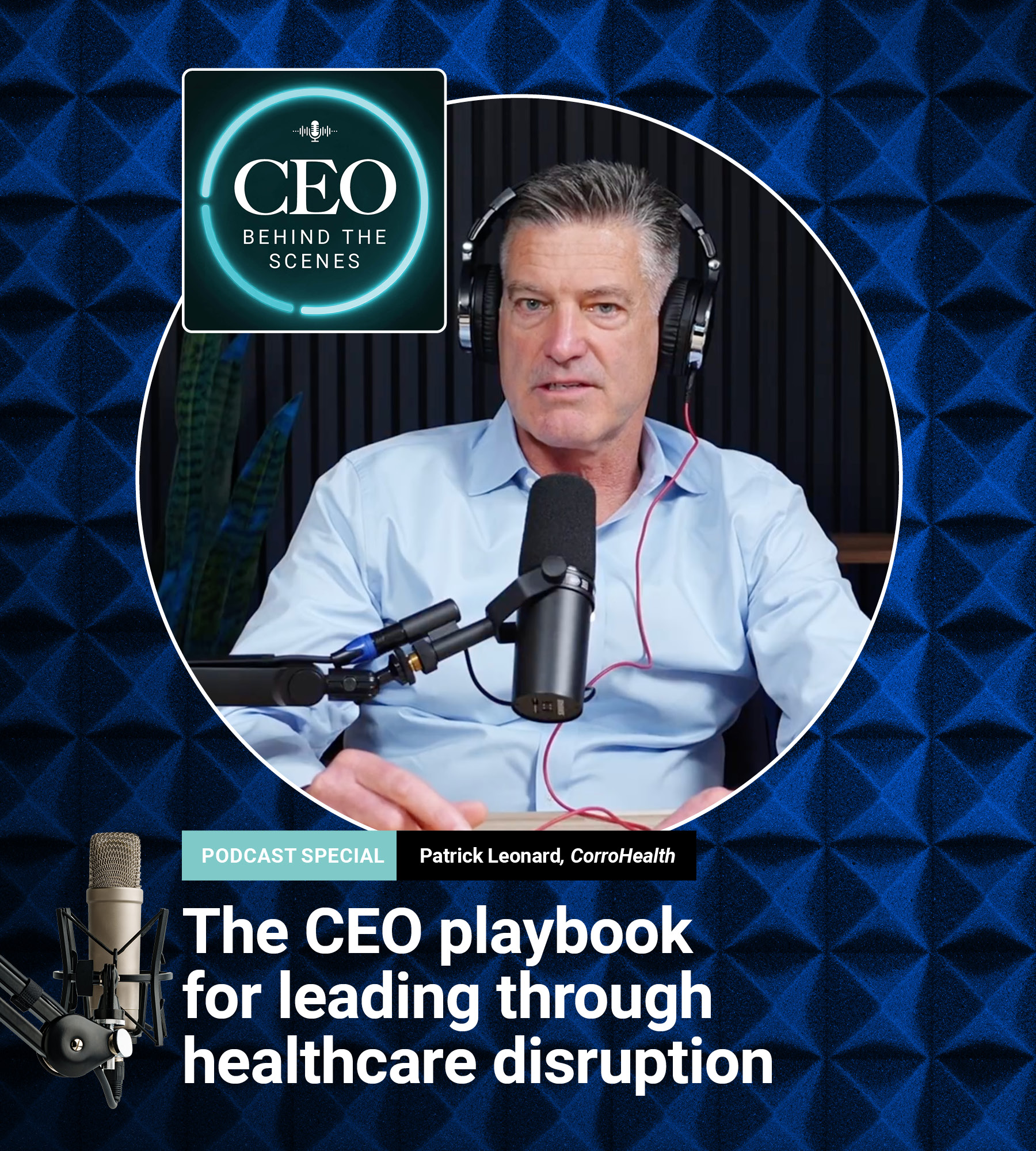
Few leaders get the opportunity to build a global healthcare platform during one of the most turbulent periods in modern medical history. For CorroHealth CEO Patrick Leonard, that challenge arrived almost immediately.
Leonard stepped into the CEO role in early 2020, just months before the COVID-19 pandemic began reshaping healthcare systems worldwide. What followed became a defining leadership test.
“It was a great opportunity, really, to be able to kind wof test leadership and how you’re able to bring a team along through a crisis,” he reflects on CEO: Behind the Scenes.
The company not only weathered the disruption – it accelerated through it. When CorroHealth formed in 2020, the organization had around 2,500 employees. Today, it has grown to roughly 17,000 team members operating across the United States, India, the United Arab Emirates and the United Kingdom.
For Leonard, scaling at this pace requires a clear foundation. CorroHealth’s strategy is anchored by three guiding pillars: technology and automation, data-driven analytics and clinical expertise.
As he puts it, the company has stayed focused on technology and automation, data-driven analytics and clinical expertise.
Much of that growth has been fueled by acquisitions. Since its formation, CorroHealth has completed 12 acquisitions – far more than most organizations attempt in a similar timeframe.
But Leonard believes integration success depends on humility. Too often, he says, acquired teams are met on day one with the message: ‘This is our way.’
CorroHealth took a different approach. Rather than forcing newly acquired organizations to conform immediately, the leadership team focused on understanding what made those businesses successful in the first place.
“Let’s learn from them what’s working and then let’s figure out how that fits in our platform and how we can adapt to make them successful versus forcing our ways upon them,” Leonard says.
At the center of this strategy is a leadership philosophy that challenges the traditional image of the CEO operating at a distance from day-to-day operations.
“I think most people would say you’re a CEO, you should be operating at 20,000 or 30,000 feet. What I would say is the way the market and the environment have evolved, it’s almost imperative to come down a level or two, you know, in terms of really understanding what’s happening in the market,” he adds.

“I think having a deep understanding of what’s going on in the market is super important.”
In healthcare, that proximity matters. The sector faces enormous complexity – from evolving payment models to growing administrative burdens and workforce shortages.
Technology, Leonard believes, will play a crucial role in solving many of those challenges, but only when applied realistically.
“There’s a lot of great technology out there that is very effective at solving like, 80 percent of the day-to-day. And that’s significant – it’s high volume,” he explains. “But that 20 percent is typically very complex, very meaningful in terms of financial return.”
For Leonard, the real promise of automation isn’t replacing people but empowering them. By reducing administrative workloads, technology can allow clinicians to spend more time focusing on patient care.
“There’s not enough physicians; there’s not enough nurses,” he points out. “Clinicians need more time to spend with a patient.”
But perhaps the most important lesson Leonard has learned as CEO is about curiosity. In a sector evolving as quickly as healthcare, leaders can’t afford to become disconnected from the market.
“I think having a deep understanding of what’s going on in the market is super important,” he says.

Listen to the latest episode of our CEO: Behind the Scenes podcast with Patrick Leonard on Amazon, Apple or Spotify.
 RELATED ARTICLES


 Home
Home
 Podcasts
 Covers
 Be Featured
 Community