Language
You can read the magazine in one of the following languages
3-min read

 Bookmark now

 Copy Link
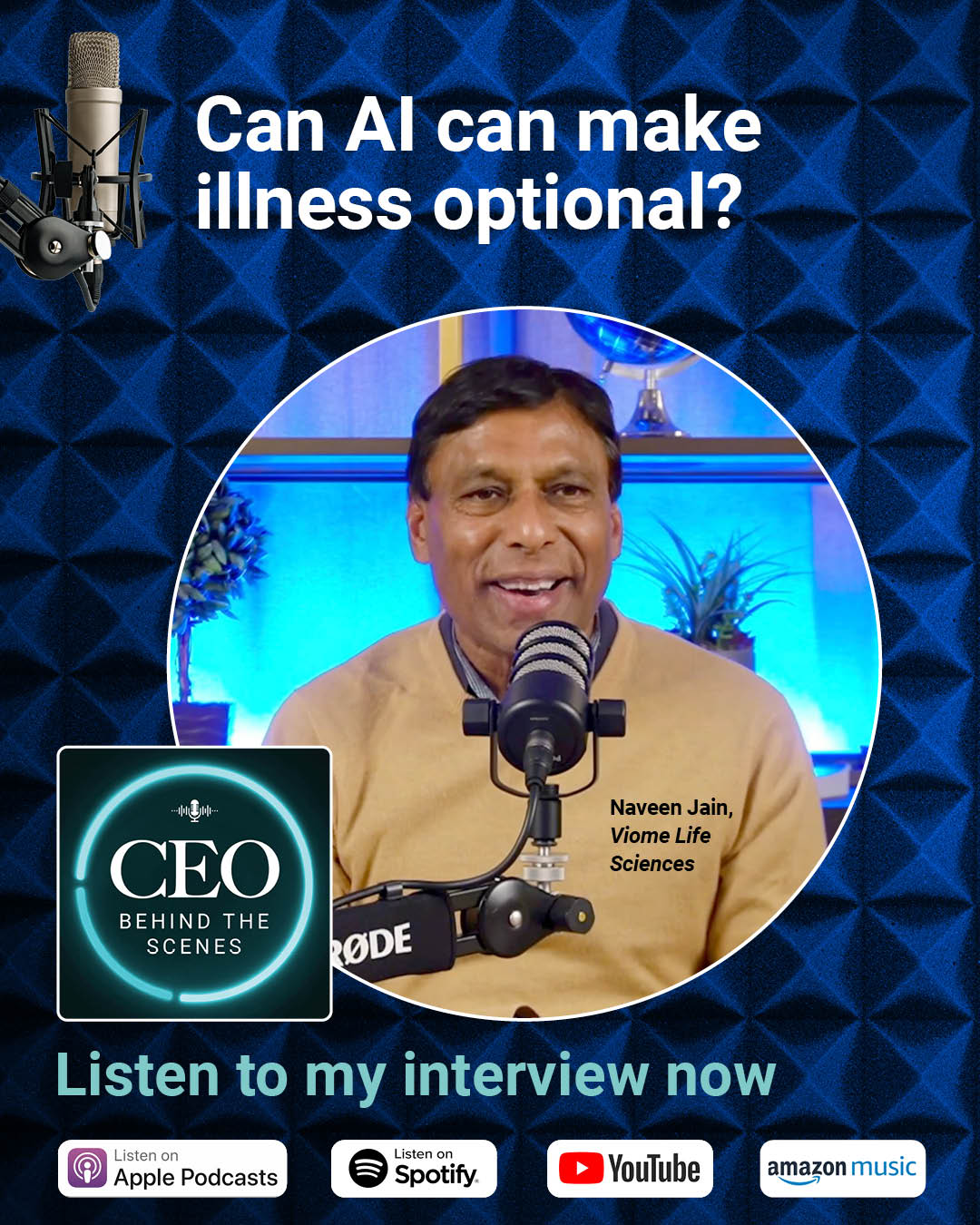
Chronic disease has become the defining burden of modern healthcare. Diabetes, heart disease, cancer and neurodegenerative conditions now account for the vast majority of global health spending – yet outcomes continue to worsen. According to Naveen Jain, Founder and CEO of Viome Life Sciences, the problem isn’t a lack of treatment; it’s a failure of timing.
“Now, fortunately for us as humans, none of these diseases happen overnight,” Jain says. “Biochemically, your body is changing for eight-to-10 years before you become diabetic.”

“What I really finally learned is that if it is for everyone, it’s not for you.”
Speaking on CEO: Behind the Scenes, Jain challenges the foundational assumption behind modern medicine – that illness is something to be treated once it appears. Instead, he argues, chronic disease is a long, measurable process. And if leaders are willing to rethink how health is monitored, it may be largely preventable.
For decades, genetics has been positioned as the key to understanding human health, but Jain believes that focus has been misplaced. He argues that DNA alone can’t explain human health because it doesn’t change when your body changes. Instead, he notes, both RNA and DNA must be reviewed to provide a better picture of health and potential disease.
That distinction is what led him to build Viome – a platform designed to continuously measure how the body is functioning today, not what it might do someday. Instead of generalized advice, people receive precise, evolving recommendations based on their own biology, from food choices to supplements to early risk signals.
“What I really finally learned is that if it is for everyone, it’s not for you,” he says.
Jain’s conviction is rooted in experience as much as theory. After years of building companies across industries – from early internet ventures to lunar exploration – it was the sudden loss of his father to late-stage pancreatic cancer that forced a reckoning.
“We think we can colonize the moon and Mars and we can create a multi-planetary society, and yet we don’t even understand what causes us, our fellow humans on planet Earth, to actually suffer every day and die from these diseases that are completely preventable,” he says.
At Viome, the goal isn’t to replace doctors or hospitals but to shift healthcare upstream, identifying dysfunction at the molecular level long before symptoms appear.
The implications are significant. Jain points to emerging capabilities in detecting early-stage oral, throat and pancreatic cancers – conditions that are typically diagnosed far too late – as proof that earlier measurement can change outcomes.

“We don’t even understand what causes us, our fellow humans on planet Earth, to actually suffer every day and die from these diseases that are completely preventable.”
Looking ahead, Jain envisions healthcare becoming largely invisible – integrated into daily life through continuous monitoring and AI-driven insight that intervenes only when needed.
“Everything around us is now actually collecting the data for us. All this data is now being integrated together, not to overwhelm you,” he says. “It is your health AI agent. It will only alert you when it says, ‘He needs something to be done about it’.”
For leaders, the takeaway is not about technology but mindset. Progress doesn’t come from reacting faster. It comes from paying attention earlier.
And if Jain is right, the future of health may no longer hinge on hospitals at all – but on understanding the body well enough that illness never has to arrive in the first place.

Listen to the latest episode of our CEO: Behind the Scenes podcast with Naveen Jain on Amazon, Apple or Spotify.
 RELATED ARTICLES


 Home
Home
 Podcasts
 Covers
 Be Featured
 Community