Language
You can read the magazine in one of the following languages

5-min read

 Bookmark now

 Copy Link
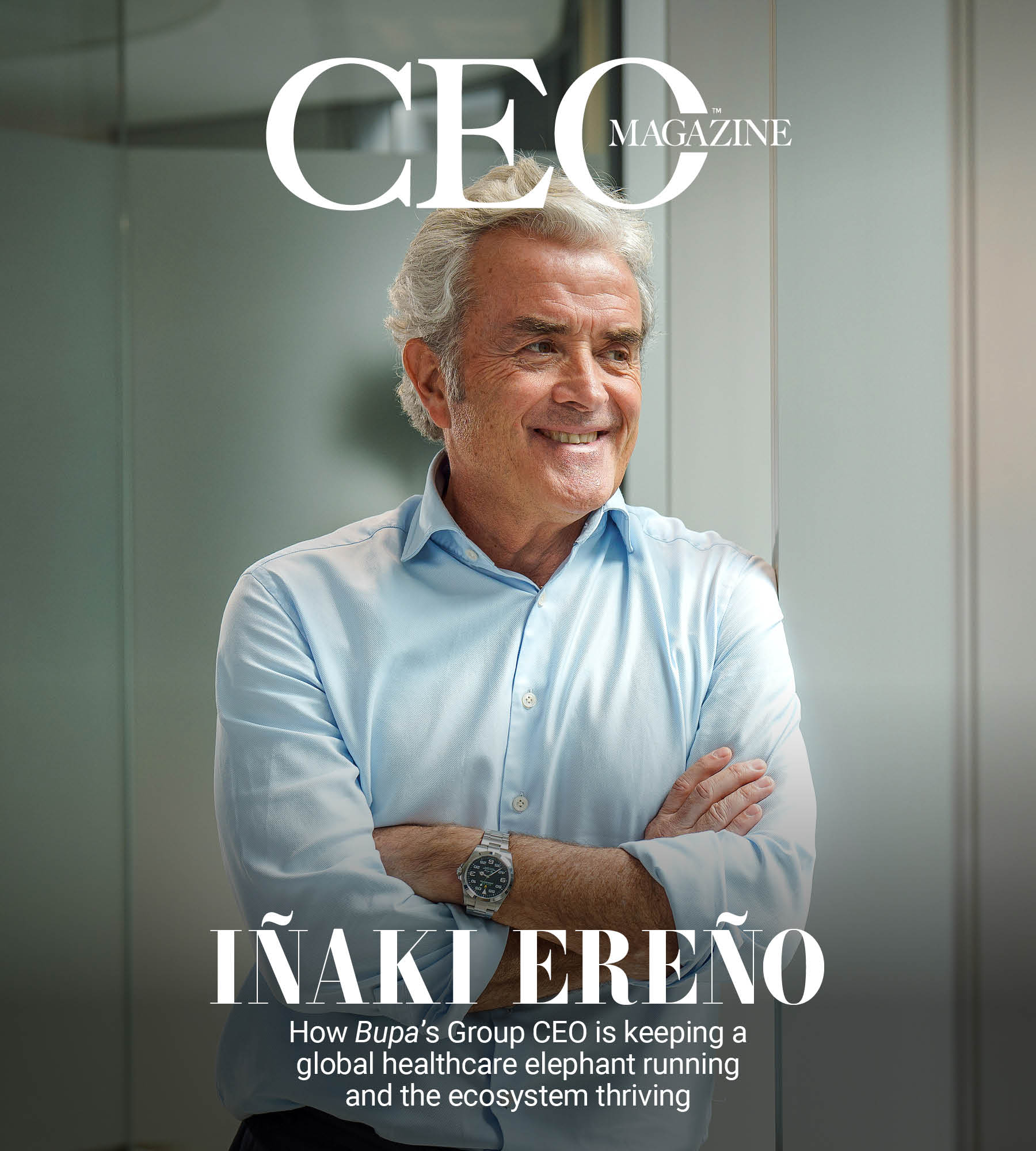
You don’t often hear a global CEO talk about elephants and ecosystems in the same breath as net promoter scores (NPS) and AI. But then, Iñaki Ereño doesn’t run a typical company. As Group CEO of Bupa, he’s responsible for a healthcare business that spans more than 100,000 employees and 60 million customers worldwide.
And yet, for Ereño, it’s not about the size – it’s about the shift.
“We want to be caring and responsible,” he tells The CEO Magazine. “And we’re also building our bravery muscle to prepare Bupa for the future.”
That future is unfolding through ‘Savannah’, the healthcare giant’s latest global strategy from 2025–27. It builds on the foundation of its previous 2021–24 plan, aptly named ‘Elephant’.
“When looking back at Bupa’s performance in 2021, the year I became Group CEO, we pictured ourselves as a sleepy elephant that needed to wake up and start running,” Ereño explains.
“We chose the elephant intentionally because it’s the only four-legged animal that, when running, always keeps one foot on the floor. We want to run – but in a caring and responsible way.”


Elephant is now firmly in motion, with Savannah focusing on how Bupa interacts with the wider ecosystem.
“Elephants are ecosystem engineers. When they’re in a good place – they feel big, happy and confident – they produce good things for the ecosystem, not only for themselves,” he explains.
For Bupa, that means expanding its reach while helping more customers to stay healthy. By the end of 2027, the company aims to serve 100 million customers – that’s 40 million more than it serves today – with growth fueled by accessible, digital-first solutions.
“In the United Kingdom, you can now be a Bupa customer for around £20 [US$27] a month,” he says. “We believe a big part of our growth will be through digital, more affordable products.”
When it comes to customer feedback, few companies invest in it like Bupa. Over the past four years, the company has built the Bupa Customer System – a global framework designed to capture insights across all Bupa businesses.
“We have mapped micromoments, the moments when the customers might need us, across our business units, with each one assigned an owner responsible for reviewing feedback and driving improvements,” Ereño explains.
“By the end of 2024, over 35 million NPS surveys were sent to customers experiencing key micromoments across all markets.”


NPS surveys gauge how likely customers are to recommend a company, product or service to others.
Ereño reveals a key component of the Bupa Customer System is ‘detractor’ callbacks to understand their pain points. The company then uses that data to implement more than 10,000 customer experience improvements annually.
“We are very happy to see that almost all of our business units have an NPS of over 50 points. In fact, we’re now pointing with a new strategy to NPS 100,” he says. “It’s a bit bold, but that’s where we’re headed.”
To remain deeply customer-centric, innovation is central to Bupa’s evolution, with technology acting as a bridge to better care. The company’s digital health platform Blua now operates across every market, offering virtual consultations, home diagnostics and tailored health plans.
“Blua has over 8.1 million customers,” Ereño confirms.


He also shares that AI is increasingly being used to streamline physician workflows.
“If a consultation takes 15 minutes, more than half of that time is spent on a computer today,” he explains. “Now, the system reduces seven minutes of computer work into 30 seconds so that the clinician can spend even more time talking to their patients and giving them human connection.”
Meanwhile, Bupa is also shifting its core infrastructure to the cloud.
“We are moving to the cloud because we believe that is what will set Bupa up for a strong future,” he says.
Ereño adds that collaborating with partners such as NuraLogix, Clear Robotics and SageTech Medical is vital to ensuring the organization meets the needs of customers in the long-term, too.
“The big relationships that we have built up through the years are a big part of Bupa,” he confirms.
Managing operations across dozens of countries requires sophisticated organizational balance. Ereño’s approach combines an umbrella strategy with local execution autonomy.
“It’s not easy being global, but we love it,” he reveals. “In every market we operate in, we strive to serve our customers well, use data responsibly, leverage great technology and stay ambitious – all of which must be brought to life at the local level.”


This global–local balance extends to Bupa’s purpose: ‘Helping people live longer, healthier, happier lives and making a better world.’ And its latest mental health clinic expansion exemplifies this approach. After successful pilots in Poland, over the next three years Bupa aims to open 200 mental health clinics across countries including Australia, Spain, Brazil, Chile and the United Kingdom.
“Mental health is the new pandemic,” Ereño points out. “Opening these new ‘Mindplaces’ is a big move for us. There’s not another company out there that has as many clinics as we’ll have very soon.”
This is a prime example of the kind of ecosystem engineering the company has undertaken to support its customers. Having a shareholder-free structure, he says, enables the rapid scaling of initiatives like this.
“Since we don’t have shareholders, we don’t pay dividends. Instead, all our profits are reinvested into our business to help deliver our purpose of helping people live longer, healthier, happier lives and making a better world,” he points out.
When it comes to healthcare leadership, Ereño breaks it down into two critical elements. One, credibility must be built over decades. And two, technology capabilities must be at the cutting edge. Bupa is strategically committed to both.
“Fortunately, Bupa’s been in the market for 75 years,” he says. “While some big tech companies have tried to jump into healthcare, they haven’t been able to succeed. That’s because they don’t have the credibility.
“What makes Bupa different is we have the reputation and the technology.”


This fuels Ereño’s confidence for the future. And the momentum it has built up as an organization 100,000 people strong is powerful.
“Imagine 100,000 people moving. It’s like a big ship. You need to move that ship,” he says.
“But once it moves, it stays moving. And this is why once the elephant is up and running, it will never stop. It will even sleep standing up.”
 RELATED ARTICLES


 Home
Home
 Podcasts
 Covers
 Be Featured
 Community