Language
You can read the magazine in one of the following languages
4-min read

 Bookmark now

 Copy Link
The workplace has always accommodated the self. Ambition, humor, insecurity, ego, resentment and vanity have long played a role in organizational life. At the same time, individualism was balanced against something larger: the needs of the organization, the team and the customer.
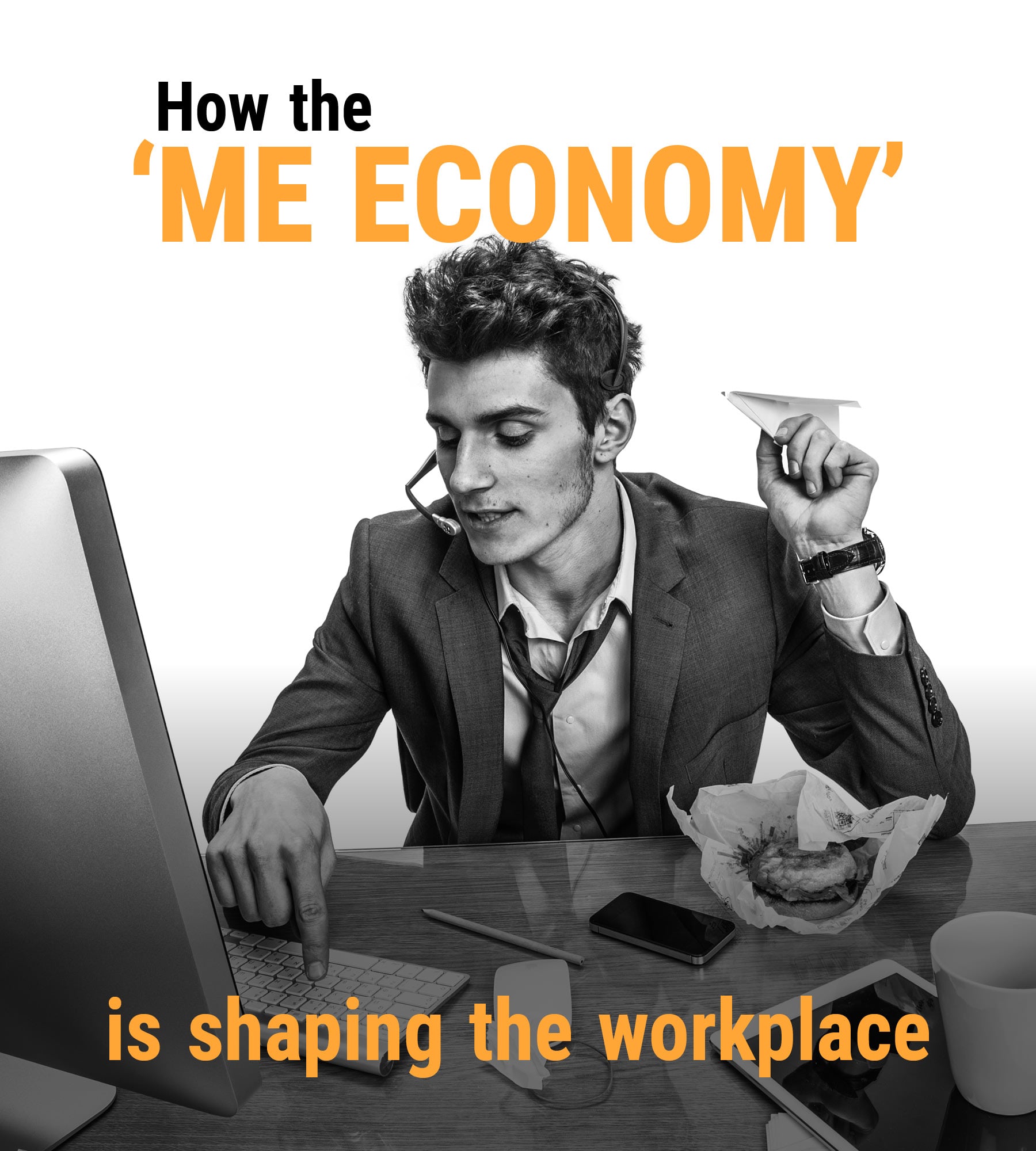
That balance has changed. Now, employees increasingly sit at the center. Work is no longer organized around the institution. It’s organized around the person.

Today, employees are more willing to question if the rules make sense.
The ‘Me Economy’ is not about selfish employees or demanding younger workers. It’s a workplace expression of today’s culture that personalizes almost everything. News, shopping, entertainment and social feeds are increasingly tailored to the individual. Our modern life constantly asks, “What works best for me?” People now bring that same question to work.
For leaders, this represents a fundamental shift in the psychological contract. The old agreement was simple: loyalty and conformity in exchange for security, progression and income. That bargain has been weakening for decades. Who reneged first is up for debate. What holds true is the new deal that has been brokered – does this job fit my life, values and future?
Some of this is a good news story. Decades of motivation research, including self-determination theory, show that people perform better with some autonomy, competence and connection. Equally, workplaces that ignore individual needs often pay the price through turnover, disengagement or resistance to change.
Then there is the other side. Business cannot be built entirely around individual preference. Organizations must have standards, consistency, commercial discipline and people willing to do what’s required, even on occasions when it isn’t personally meaningful. The challenge is not to defeat the ‘me’. It is to reconnect it to the ‘we’.
Employees have become more conscious of the exchange they are making. Salary matters, but it is not the only currency. Flexibility, learning, wellbeing and lifestyle now form part of the equation. This doesn’t mean people are disloyal. It means they are more transactional.
Employees are likely to ask themselves if the organization is still worth the effort. They may stay, but not simply because they once joined. They may work hard, but not because a manager says, “This is how we have always done it.”
This can be uncomfortable for executives who built their careers in a different moral economy of work. Today, employees are more willing to question if the rules make sense in the first place.

Leaders who dismiss the personal dimension risk resentment and disengagement.
In the ‘Me Economy’, authority still counts, but it no longer carries the weight it once did. Leaders now feel pushed to explain more. Why this return to office policy? Why this structure? For many executives, it feels like every decision needs a defence.
Yet explanation is not the enemy of authority. Done well, it strengthens it. People are usually more prepared to accept a decision they dislike when they can see the reasoning behind it.
What weakens leadership is not transparency, but vagueness. Balance is key. Leaders who dismiss the personal dimension risk resentment and disengagement, and those who over-accommodate risk creating inconsistency and confusion.
The most effective leaders recognize the shifting leadership dynamic, knowing it’s about creating a workplace of trust, context and clarity where people willingly follow.
One of the more difficult effects of the ‘Me Economy’ is the rise of exceptions – one employee wants flexibility, another wants a different workload. Someone else wants special consideration for family demand or personal circumstances.
Often, the request is reasonable. Sometimes it is not. Most sit in the gray area where leaders must exercise judgment rather than apply a simple rule.
Another problem is that exceptions rarely remain private. Teams notice who receives flexibility, who carries the extra burden and who is rewarded for speaking up. These decisions become signals and this is where culture is formed. Not in the values statement, but in the small decisions that teach people what is tolerated, rewarded and expected.

The future of work may well be more personal.
The great promise of the ‘Me Economy’ is agency. The great risk is fragmentation. When every employee experiences work as a personal contract, organizations can lose their shared rhythm. One person wants flexibility, another wants boundaries. One seeks rapid progression, another less pressure.
It can leave leaders managing a collection of individual arrangements, rather than a cohesive workforce. And can be commercially dangerous. Customers do not experience an organization as a set of personal preferences. They experience whether the phone is answered, the deadline is met, the product works, and the promise is kept.
Yesterday’s workplace was hardly a paradise of fairness and wisdom. Many people were expected to endure poor leadership, rigid structures and unnecessary sacrifice. Some of the ‘Me Economy’ is a correction to that.
But it is not enough to replace one imbalance with another. Yes, people have lives, needs, ambitions and limits. Yet teams rely on standards, customers expect reliability and managers need the right to make decisions.
The future of work may well be more personal. It probably should be. The leadership quandary is how leaders can turn individual ambition, preference and agency into something larger than the self.

Roxanne Calder
Contributor Collective Member
Roxanne Calder is the author of ‘Employable – 7 Attributes to Assuring Your Working Future’ and the Founder and Managing Director of EST10 – one of Sydney’s most successful recruitment agencies. Find out more at https://est10.com.au/about-us/



 Home
Home
 Podcasts
 Covers
 Be Featured
 Community