Language
You can read the magazine in one of the following languages
5-min read

 Bookmark now

 Copy Link
A few years ago, one of our best people at Aceleron left for a bigger, more established company.
I could hardly blame them. The new company could offer more money, more stability, a clearer career path and definitely a far less chaotic Monday morning. Startups are exciting from the outside, but from the inside, they can be exhausting. The mission is really important, of course, until the reality of all the bills that need paying and the mortgage comes due.

A lot of organizations treat AI as if the advantage comes from the model.
I wasn’t bothered by the fact he left; in fact, I love the idea of being the best place one can graduate from. What actually bothered me was that everything this person learned walked out of the door with them. Specifically, it was what we had invested a lot in developing – the way this person understood our technology, our product and the history of our decisions and why we made them. The small bits of judgment that had built up from years of being close to the work.
On paper, we still had the company and the intellectual property, but a lot of the useful knowledge was sitting in people’s heads. When people left, some of it left with them. That experience has shaped how I think about AI now.
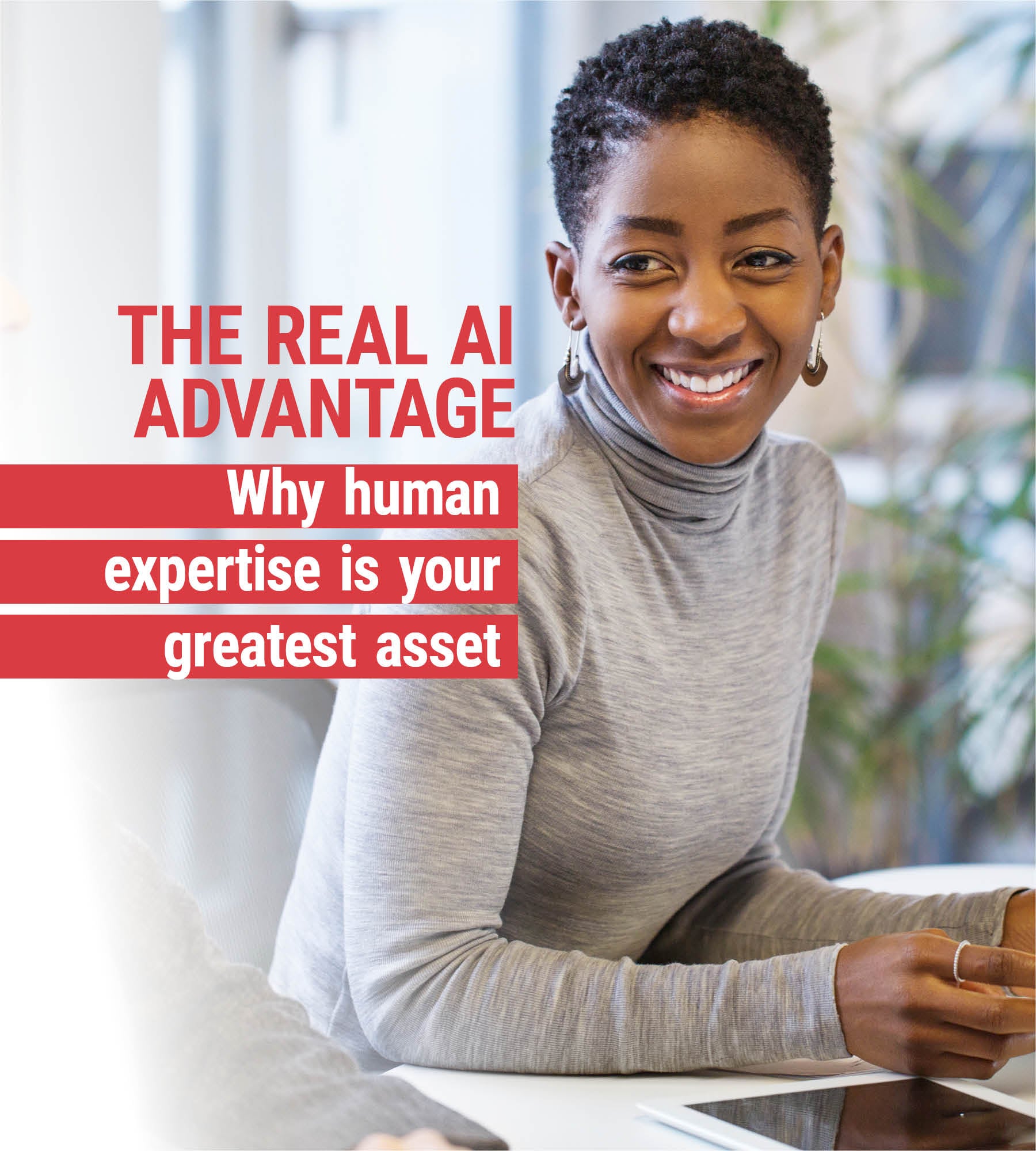
A lot of organizations treat AI as if the advantage comes from the model. Bigger model, faster model, cheaper model, better interface. These things are important, but they miss the fundamental differentiator, which is actually the underlying data and intelligence. After all, most organizations will have access to broadly similar AI tools. The difference will be what those tools are able to work with. And that means the real advantage is still human expertise.
The problem is that most companies are surprisingly bad at capturing it. They capture meetings badly, if at all. They write strategy decks that flatten the messiness (read: reality) of what people actually know. They lose context when people change roles. They run events, workshops and customer conversations where the best insight appears briefly and then disappears into the air as if it never happened.

Human expertise is what makes AI worth using.
I see this all the time now with Lorefully. We capture expert conversations at live events and turn them into insights organizations can actually use. That might be a conference, a roundtable, a workshop, a trade show or a closed-door discussion with sector experts. The technology is, of course, important, but the real magic is the expertise inside the room.
People say things out loud, in conversation, that they would never put in a survey. They share frustrations that have been building for years. They describe where policy is missing the point, where a sector is stuck, where customers are changing behavior, where investment is flowing, where trust has been lost. There is an enormous amount of intelligence in those conversations. Historically, most of it has been wasted.
An organizer might get a few feedback forms. A sponsor might get a short report. A manager might leave with some scribbled notes. But the richness of what was said in the room – and why it is important – rarely becomes an enduring asset.
That is the shift AI makes possible, if we use it properly.
AI should not be treated as a replacement for human expertise but rather as a tool that can greatly enhance organizational intelligence and therefore ultimate productivity.
For managers, this is a very practical point. Your team already knows things that your strategy process does not know. Your customers are already telling you things that your dashboard cannot see. Your frontline staff are already noticing patterns that will only show up in the numbers months later.
Your partners, suppliers and sector communities are already carrying insight that could change how you make decisions. The question is whether you have a way to hear it, keep it and use it.
Most organizations confuse information with knowledge. Information is the transcript, the customer relationship management note, the slide, the spreadsheet. Knowledge is richer than that. It has context along with the judgment. It knows why something failed last time and it carries the scar tissue of people who have had to make things work in the real world.

Imagine not losing the expertise of people who retire, move jobs or sit quietly at the back of a room.
That kind of knowledge is difficult to capture, but it is so incredibly valuable. At scale, this becomes much bigger than one-off events. Imagine being able to map what hundreds of engineers, clinicians, teachers, founders, manufacturers or community leaders are seeing in real time. Imagine being able to compare what different sectors know about the same problem.
Imagine not losing the expertise of people who retire, move jobs or sit quietly at the back of a room because nobody thought to ask them the right question.
That is where I think this goes. For exhibitors and sponsors, it helps prove what people really cared about. For organizers, it turns events into living intelligence assets. For policymakers, it can reveal where reality is diverging from the official narrative. For investors, it can show where markets are moving before the market data catches up. For large companies, it can help capture the expertise that is currently scattered across teams, regions and functions.
But the principle is simple. If you want AI to create value in your organization, start by asking what human expertise you are currently wasting.
Whose knowledge only exists in their head? Which conversations disappear after they happen? What do your best people understand that your systems do not? Where are you relying on memory, habit, or a few trusted individuals to hold the company together?
Because that is the uncomfortable truth. Many organizations are short of ways to preserve intelligence but are not short of intelligence itself.
The companies that win with AI will be the ones that understand people are the center of this next-generation transition – not just something to be automated away. Human expertise is what makes AI worth using.

Amrit Chandan
Contributor Collective Member
Amrit Chandan is an entrepreneur and award-winning innovator dedicated to unlocking human potential through technology. With a PhD in Chemical Engineering, Amrit has built a career at the intersection of sustainability, AI and business transformation. He is now the Founder and CEO of Lorefully, which uses AI to provide real-time intelligence from events and communities, providing instant data analysis, predictive trends, enhanced decision-making and optimized engagement. Learn more at https://amritchandan.com/about-amrit
 RELATED ARTICLES
  SPOTLIGHTS ON LEADERS


 Home
Home
 Podcasts
 Covers
 Be Featured
 Community